revisiting the legacy of the bombay progressive artist group
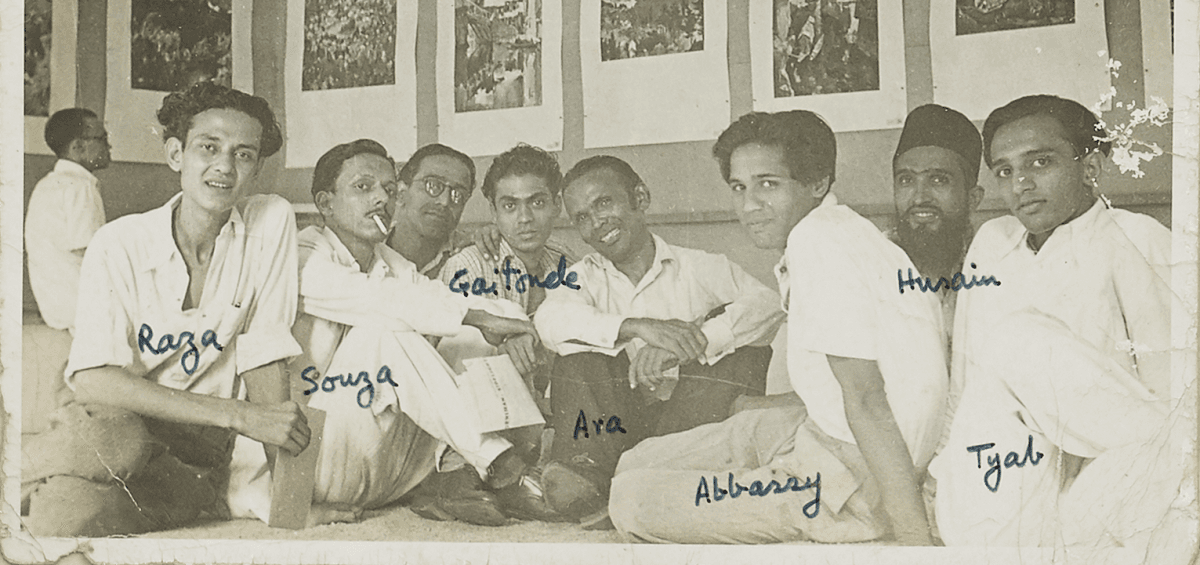
The establishment of Modernism in India has been an arduous and heroic struggle much like the battle for Independence from the British Raj. And perhaps this social revolution left the Indian art world struggling to find its foot in a vulnerable society. This very tumult led to the birth of many artist groups that helped define India’s artistic stance and mark a place for it on the global map. The Progressive Artists’ Group of Bombay was a result of this unrest amongst the Indian modernists and was formed in 1947.
The PAG was established to provide direction to the budding artists of the time and inspire them to practice their trade freely in a newly independent India. Although the group did not have a particular style, its members sought to form a synthesis of traditional Indian Art with Western and European Modern styles. They adopted the styles prevalent during the first half of the 20th century to create their own version of expressionist and abstract sensibilities.
The founding members of the Progressive Artist’s group were nothing less of legends -

Maqbool Fida Husain.

Sayed Haider Raza

Francis Newton Souza

Krishnaji Howlaji Ara

Hari Ambadas Gade

Sadanand Bakre (S. K. Bakre - the only sculptor of the six.)
The saga of Modern Indian Art would be incomplete without these artists.

The other artists who were later associated with the group were Manishi Dey, Ram Kumar, Akbar Padamsee and Tyeb Mehta. In the coming years, these artists would go on to paint the history of Modern India - one stroke at a time. In 1950, Vasudeo S. Gaitonde, Prafulla Dahanukar, Krishen Khanna and Mohan Samant joined the Group. Later, the departure of two main founders - Raza and Souza, led to its disbandment in 1956.

As the name suggests, these artists aimed to break away from the conservative preachings of the nationalist Bengal school of Art to establish a unique pictorial speech that would catapult Indian Art among European art forms. Each member experimented in their own way - from the expressionist etchings of Souza to the tranquil abstractionism of Raza to the pure abstraction of Gaitonde - resulting in various different styles emerging to occupy a permanent space in the Indian art subconscious.
These artists not only inspired the new creators to break the conformity of cultural burden but used their talent as a weapon, a tool to educate the masses. They believed that art can serve as a medium to convey messages and inculcate the seeds of revolution. M F Husain’s controversial paintings are a testament to this theory adopted by the Progressive Artists’ Group.
The works created by these artists are fragments of Indian history that tell the tale of time and transformation.
AstaGuru’s Modern Indian Art Online Auction will feature 50 milestone works many of which are works by the PAG members, some of which will be showcased for the very first time. The Auction is slated to take place on the 8th & 9th of September, 2021.
Head to the AstaGuru catalogue page to explore more details about the auction and the featured lots.