romancing the nude: how iconic western artists explored the theme
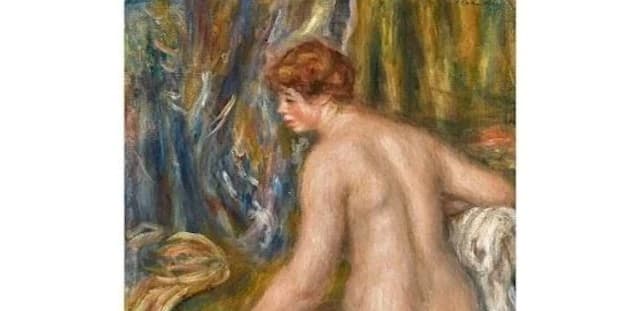
The study of nude form has been central to aesthetics in all eras and cultures of the world. In the western world, whether it is the ancient Roman Greco art and architecture or the Renaissance art from the mediaeval period, the depiction of nude figures has been common. Similarly, through the course of modern art, nude imagery has been a consistent motif employed by all revered artists across the world. Here are some exquisite examples of such creations which will be showcased in AstaGuru’s upcoming ‘International Iconic’ auction.
Lot no. 8: ‘Baigneuse Assise’ by Pierre Auguste-Renoir
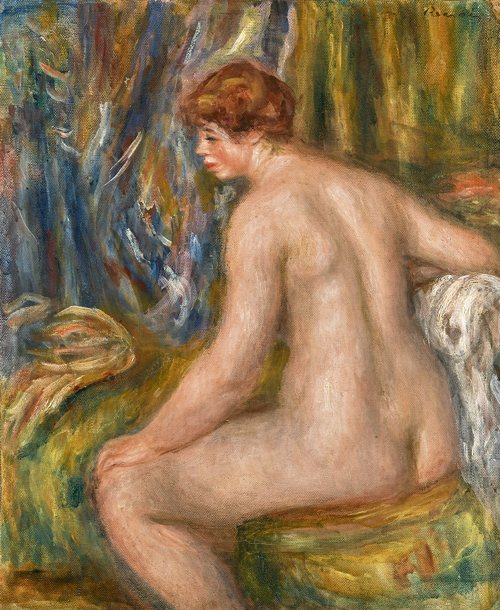 The nude subject was paramount in the oeuvre of Pierre Auguste Renoir, a theme he returned to consistently throughout his ever- evolving career. With their voluptuous figures and pearly skin, these highly sensuous paintings epitomised the artist's ideal of the feminine beauty. Some of the most celebrated of these paintings, such as the presented work, belongs to the artist’s mature phase. Emerging from his highly personal rendition of traditional classicism inspired by Renaissance masters like Raphael, Titian and Rubens, the shimmering nudes painted in the twilight of his life were executed with loose feathery brush strokes, a warmer reddish colour palette and a sense of quite romanticism. Titled Baigneuse Assise or the Seated Bather, the circa 1915, oil on canvas creation depicts the sitter in profile with a softly defined figure against a warm abstract dominated by a brown and green background that almost blends with the contours of her figure. Her curled hair, pink naked flesh, and the nonchalance of her unassuming posture in this idyllic masterpiece are exemplary of the intimate study of his models undertaken by Renoir. With variations of a rich mould of colours and sporadic thick impasto, the surface of the canvas evokes a dreamlike, almost ethereal harmony. This work was formerly in the collection of revered English playwright and novelist W Somerset Maugham who was also a passionate collector of Impressionist and Modern art.
Lot no 6: Baigneuses Sur La Plage by Fernand Le´ger
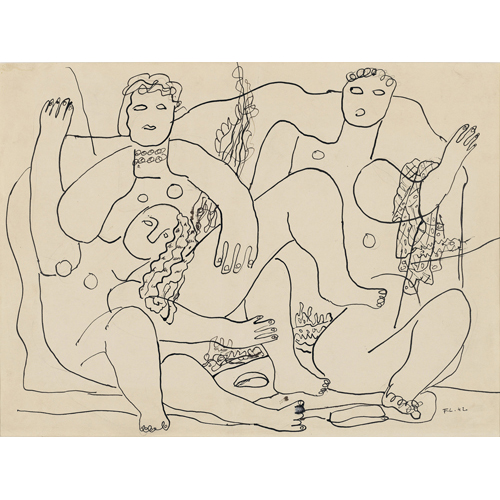 French painter, sculptor, and filmmaker Fernand Le´ger was one of the icons representing the dawn of modern art in the twentieth century. At first, highly influenced by Impressionism, Le´ger’s style witnessed a seismic shift. Viewing works by Paul Ce´zanne at Salon d’Automne had a great impact on Le´ger’s approach to form. During this period, he was also developing his unique Cubist vocabulary and presented his interpretation for the first time with his work Nudes in a Forest, showcased at Salon d’Automne in 1910. These early years were highly productive for the artist and he continued to refine his style, also presenting his first solo exhibition at Galerie Kahnweiler, Paris in 1912. The presented work was executed by the artist in 1942 with Pen & India ink on paper.
Lot no. 5: ‘Buste D’homme Et Femme Nus’ by Pablo Picasso
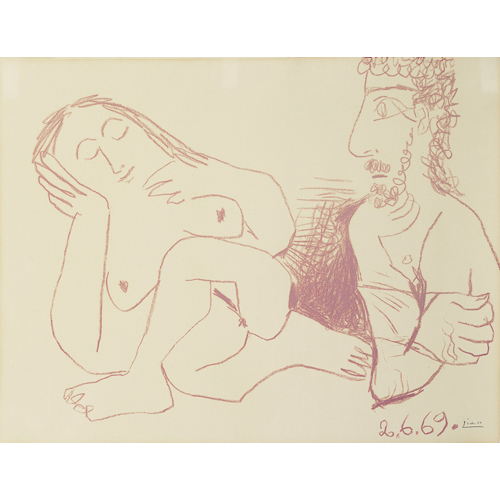 The reinterpretation of the female nude is one of the greatest legacy in the oeuvre of Pablo Picasso. Picasso's groundbreaking works on this subject not only questioned the long-standing conventions, but also introduced a disconcerting new way of looking that rejects the majority of the constraints that had hitherto characterised the feminine body. His reimagined nude sparked a fresh perspective, inspiring other artists to engage in a comparable process of questioning and reinventing. Through flattened perspective and grotesque distortions, he praised the female figure. His handling of the body in a secular manner liberated it from its long-held idealised status. Picasso was a lover of beauty and women, as art historians have noted, yet despite this, his depictions of women in nude states could not escape his critical eye, which dissected everything it encountered, both living and nonliving. Executed with coloured wax crayon on paper in 1969, this work was exhibited at R.S. Johnson International Gallery in 1971.
‘Femme au Serpent ‘ by Fernando Botero
 The presented lot titled Femme au Serpent was executed in 1983 and is a brilliant example of his passion for sculptural works and attention to detail. Accentuating the sensuality of the curves is a common feature in Botero’s sculptures. In a quest to present his aesthetic sensibilities in a three- dimensional output, the artist completely dedicated himself to the medium in the 1970s. Such was his fascination with the medium that, towards the end of this decade, he essentially stopped working in any other medium. During the early 1980s, the artist went deeper into his devotion by acquiring two buildings in the small town of Pietrasanta near Tuscany, Italy. These buildings were not just near the historic marble quarries used by old master Michelangelo but had also become a thriving space for some of the world’s best bronze foundries. Drawing inspiration from the classical sculpture tradition, Botero begins his process by creating a clay maquette, which is then scaled up in plaster. He then follows up by creating a cast on which his model is ultimately rendered in bronze. "Sculptures permit me to create real volumes... One can touch the forms, one can give them smoothness, the sensuality that one wants,” the artist has said in the past about his sculptures.
The collection for AstaGuru’s upcoming ‘International Iconic’ auction will showcase a medley of works by revered and iconic global artists. The rich assortment of artworks belonging to different periods also puts a spotlight on the emergence and impact of modern art towards the mid-twentieth century with creations by artists such as Pablo Picasso, Henri Matisse, Fernand Léger, Bernard Buffet, Marc Chagall, and Salvador Dali. The auction is scheduled for November 28-29, 2022. Visit the AstaGuru website to view the catalogue and register to bid today.
About AstaGuru
AstaGuru was conceptualised in the year 2008 with the sole purpose of creating a safe and secure platform to conduct online auctions for Indian, Contemporary & Modern Art. The word AstaGuru is a thoughtful conjugation of ‘Asta’, of Italian origin, which translates to auction and ‘Guru’, Sanskrit connotation for ‘master’ that indicates our distinguished finesse at being the leaders of auctioneering art and artefacts in India as well as globally. With the world melting into one harmonious digital cosmos, AstaGuru has strived to successfully bridge the gap between prospective buyers and consignors by transcending the limitations of live auctions. AstaGuru imparts effortless transparency to the process of acquiring and selling art and rare collectables. Our diverse portfolio includes categories such as Jewellery & Fine Silver, Timepieces, Textiles, Celebrity Memorabilia, Rare Books, Numismatic, Philately and Vintage Cars. AstaGuru’s mobile app enables our esteemed bidders to follow and participate in our auctions seamlessly, and in real-time.
For more information, please log on to www.astaguru.com