s h raza - naga encounter (1995) | overview
.jpg&w=3840&q=75)
S H Raza's "Naga Encounter" also referred to as "Nagas" represents a significant phase in the artist's late-career exploration of Indian spiritual and mythological themes. This body of work draws on the symbolic potency of Nagas, serpentine deities in Hindu cosmology embodying kundalini energy, cosmic forces, and primal vitality to infuse S H Raza's abstract geometry with deeper ethnographic and philosophical resonance. Created during a period of intensified reconnection with Indian roots after decades in France, these paintings mark S H Raza's shift toward themes like Kundalini and Mahabharata motifs.
Understanding “Naga” in Indian Tradition
A Naga, in Hindu, Buddhist and tantric traditions, is a divine or semi-divine serpent being, often represented as a cobra or a multi-hooded serpent. Nagas are associated with the earth, water, fertility and protection. They represent renewal, transformation, cycles of life, and the energy of creation.
Because the Naga symbolizes regeneration, protection, and primal cosmic forces, it naturally fit within Raza’s spiritual and symbolic framework. When he turned toward Naga imagery, he was drawing from a rich cultural and metaphysical tradition, not from literal or folkloric serpent depictions.
From 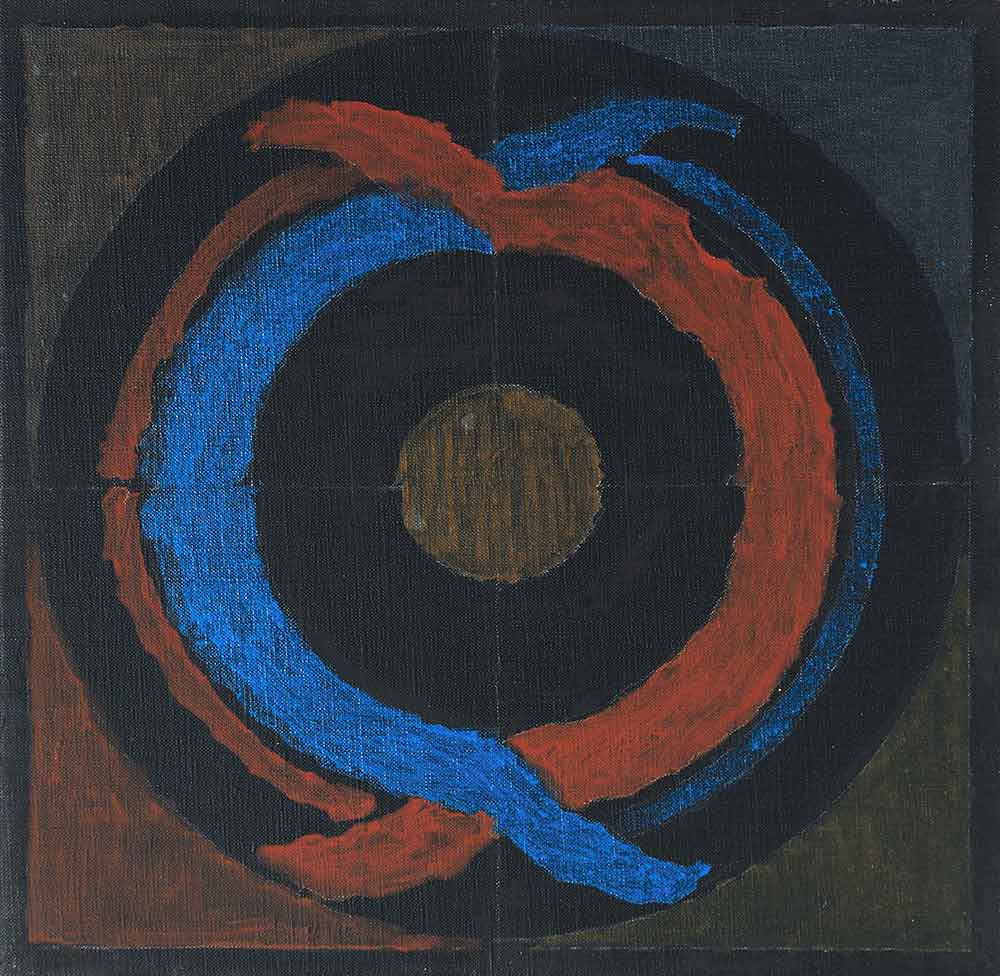 Bindu to Naga
S H Raza’s journey toward the Naga motif began with the Bindu. When he was a child, a teacher told him to focus on a single dot to calm his mind. This early memory, revisited in adulthood, became the organizing principle of his art. Throughout the 1970s and 1980s, he developed a vocabulary of geometric shapes, vibrant colors, and meditative compositions grounded in the idea of the Bindu.
By the late 1990s and 2000s, S H Raza expanded this symbolism to include serpentine, coiled forms that represented the Naga. These forms suggested kundalini energy, cosmic cycles, and the tension between creation and dissolution.
Visual Characteristics of S H Raza’s “Naga” Works
•> In his 1998 painting Naga, Raza layered concentric circles and pulsating geometric forms that evoke tantric diagrams and coiled spiritual energy.
•> In Surya and Naga (2007), the canvas is divided into symbolic panels: a sun symbol, a watery or feminine element, and a coiled Naga shape representing regeneration and cosmic continuity.
•> His use of bold colors, simplified geometry, and symbolic patterns transformed ancient mythological subjects into contemporary metaphysical abstractions.
For S H Raza, painting was a form of meditation. The Naga was not simply a serpent but a metaphor for energy, life force, balance, and cyclical transformation.
Significance of the Naga Motif in S H Raza’s Work
•> Integration of Indian spirituality with modern abstraction: Raza united traditional Indian symbolism with modern visual language in a way that felt timeless and universal.
•> Meditative engagement: His Naga works invite viewers to reflect on energy, movement, creation, and cosmic order.
•> Return to cultural roots: After spending many years abroad, Raza used such motifs to reconnect with Indian philosophical traditions.
•> Universal symbolism: The spiral, the coil, and the circle are universal symbols of life and energy. This made Raza’s Naga imagery accessible even to viewers unfamiliar with Indian mythology.
Legacy in Exhibitions and Auctions
Paintings like "Nagas" and "Surya and Naga" have appeared in major auctions and serigraph editions, underscoring Raza's market influence post his 1956 Prix de la Critique win. Specific works such as "Naga Encounter" highlight his return to India's heartlands for inspiration, blending modernism with tantric essence. Raza's Naga phase cements his status as a bridge between Western abstraction and Indian profundity, with pieces like those from Serigraphs V continuing to captivate collectors.
Conclusion
S. H. Raza’s Naga paintings represent a profound synthesis of abstraction, spirituality and symbolic depth. By merging the Bindu with serpentine forms, he explored the energetic patterns of the cosmos and the cyclical nature of creation. The Naga becomes a symbol of life’s eternal flow: birth, renewal, energy, and transformation. In embracing the Naga, S H Raza was not merely depicting a mythological figure. He was expressing a vision of the universe, a meditative understanding of existence, and an artistic philosophy rooted in India’s rich spiritual and cultural traditions.