sadanand bakre - still life (1963) | overview
.jpg&w=3840&q=75)
Sadanand K. Bakre (1920–2007) remains one of the most important figures in the history of modern Indian art, a pioneering painter and sculptor whose work helped shape the trajectory of 20th century Indian visual culture. This Still Life from 1963, painted in oil on canvas and measuring 22.5 × 22.5 in (57.2 × 57.2 cm), is a representative example of his artistic evolution during a formative period in his career.
Visual and Stylistic Overview
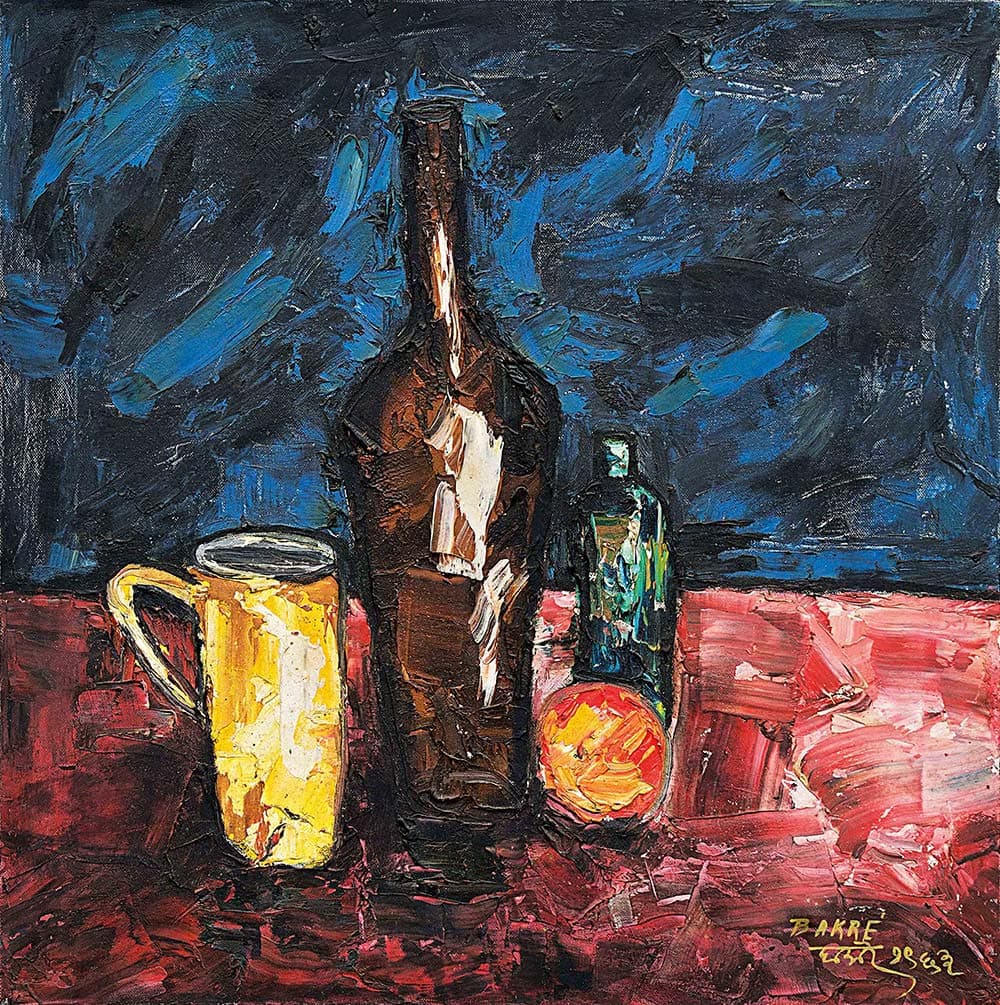 In Still Life (1963), Sadanand Bakre arranges everyday objects, a bottle, a mug, and a fruit, into a closely knit pictorial composition. The brushwork is vigorous and textured, with thick applications of oil paint that almost sculpt the surface of the canvas. The rich, earthy tones of the objects, deep browns, vibrant yellows, and warm reds, contrast against a cooler, dynamically brushed blue background. The effect is not merely representational; rather, the paint itself becomes part of the subject, giving the objects a tangible physicality that reaches beyond simple depiction.
Sadanand Bakre’s training as a sculptor informs the handling of form here. The still life subjects are not merely outlined but seem to emerge from and recede into the textured planes of paint. This deep, visceral approach to composition gives weight and presence to the ordinary, a hallmark of his mature painting style.
Context Within Bakre’s Career
By 1963, Sadanand Bakre was firmly established in Europe, having relocated to London earlier in his career. It was during the 1950s and early 1960s that he transitioned from sculpture to focus primarily on painting. This period saw him assimilate international modernist currents while retaining a distinct visual language that blended structural understanding with expressive color.
His involvement with the Progressive Artists’ Group, a collective of Indian artists seeking to break from academic realism and engage with contemporary global art movements, shaped his early artistic identity. Although Bakre originally trained in academic realism, he quickly moved into abstraction and experimental forms, a shift visible in his still lifes of the early 1960s where repetition of shape and expressive surface becomes central.
Interpretation and Significance
This Still Life is more than a depiction of objects on a surface. It reflects Sadanand Bakre’s sculptural sensibility and his interest in how color, mass, and spatial tension interact. The bold, tactile application of paint transforms a traditional subject into an inquiry into form and perception, aligning Bakre with international modernist concerns while grounding the work in his own evolving artistic voice.
Art historians note that after 1963, Sadanand Bakre’s forms became more simplified and his use of bright, flat color grew more pronounced, trends that can already be glimpsed in works like this one. His use of everyday objects in Still Life rises above mere representation; it becomes a canvas wide exploration of balance, rhythm, and painterly structure.
Legacy of the Work
Still Life (1963) occupies an important place in Sadanand Bakre’s oeuvre and in the story of modern Indian painting. It stands at the intersection of his early academic training, his assimilation of Western modernism, and his uniquely expressive approach to form and surface. Today, works from this phase of his career continue to be exhibited internationally and remain prized in collections and auctions, a testament to Bakre’s enduring influence on Indian art.
In summary, Sadanand Bakre’s Still Life (1963) is a compelling synthesis of sculptural insight, painterly vigour, and modernist sensibility. It exemplifies how Bakre transformed humble subjects into powerful statements on form, color, and artistic expression.