shanu lahiri - woman on a rickshaw (2003) | overview

Lady on a Rickshaw by Shanu Lahiri
Shanu Lahiri (1928–2013), one of Kolkata’s most distinguished modern artists, is celebrated for her dynamic and socially engaged art. Her 2003 painting, Woman on a Rickshaw, stands as a poignant testament to her unique approach melding everyday urban scenes with the expressive language of modernism.
Context and Artistic Evolution
By the early 2000s, Shanu Lahiri had evolved from a student of the Government College of Art & Craft in Kolkata and the École du Louvre in Paris to a leading figure in Indian contemporary art. Her style was deeply influenced by French modernism, yet she infused it with distinctly Indian themes and contexts. This synthesis allowed her to navigate the tension between Western modernist techniques and the indigenous revivalism championed by the Bengal School. Her works often depicted women in repose, capturing moments of leisure and introspection, a perspective seldom explored by her contemporaries.
Woman on a Rickshaw (2003): A Visual Narrative
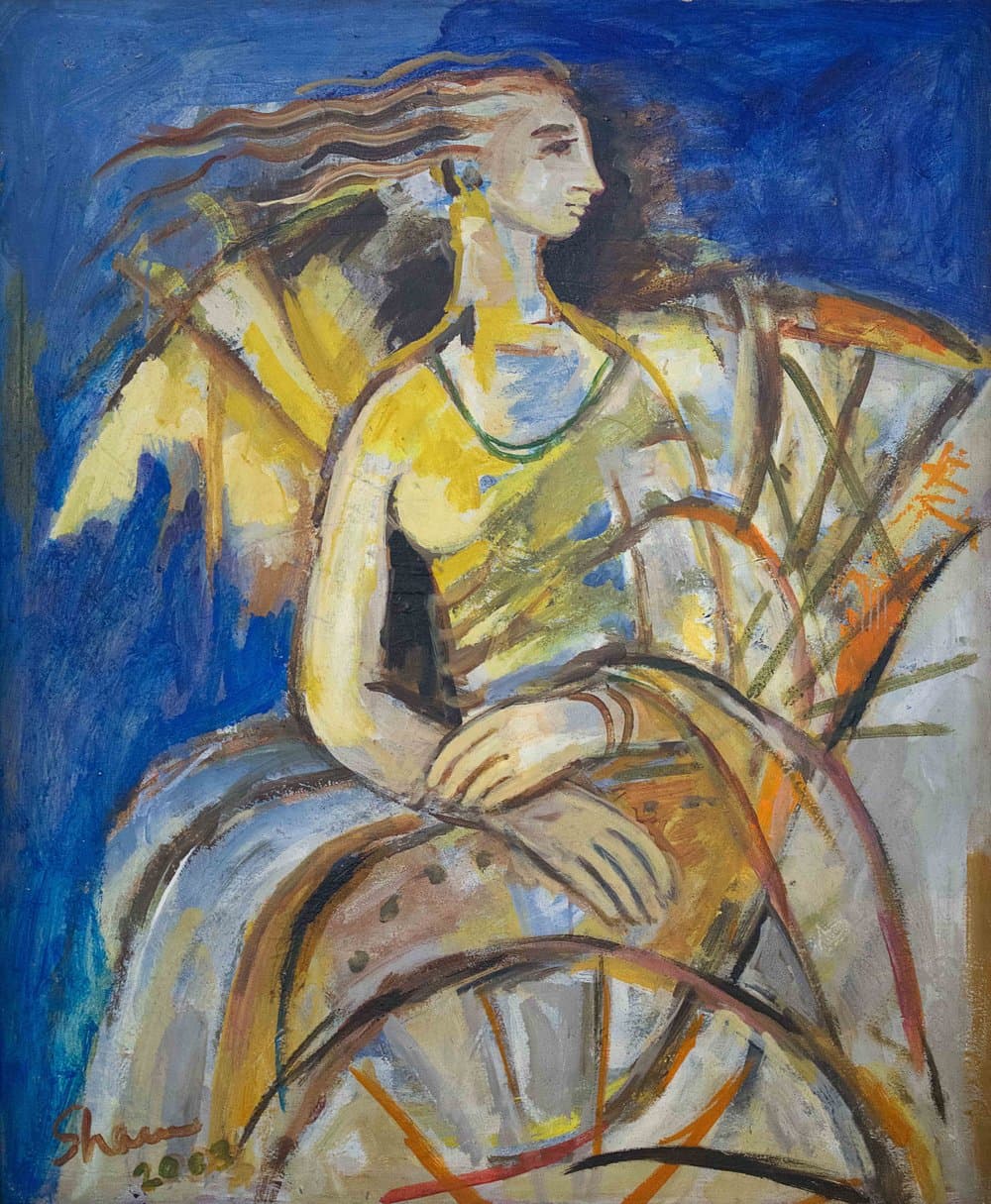 Woman on a Rickshaw encapsulates Shanu Lahiri’s signature style i.e old brushstrokes, fluid lines, and a vivid color palette. The painting portrays a woman seated on a hand-pulled rickshaw, a ubiquitous sight in Kolkata. Lahiri's use of dynamic lines and minimalistic color choices directs the viewer's attention to the subject's posture and expression, emphasizing themes of resilience and dignity. The composition reflects Lahiri's ability to transform a common urban scene into a profound narrative, highlighting the interplay between the subject's inner world and the external environment.
Artistic Significance
Shanu Lahiri's work is characterized by a blend of narrative depth and formal experimentation. In the 1980s, she began exploring large-scale compositions that combined storytelling with modernist abstraction. This approach is evident in her series depicting women on rickshaws, where she employed simplified forms and a restrained color palette to convey complex emotions and social realities. Woman on a Rickshaw exemplifies this phase, showcasing her mastery in balancing narrative content with formal innovation.
Legacy and Influence
Beyond her studio work, Lahiri was a pioneering public artist in Kolkata. In the 1980s, she initiated the 'Love Calcutta Project,' mobilizing students and street children to create murals that beautified the city's walls, often obscured by political graffiti. Her public art projects, such as the creation of the 'Parama' statue on the Kolkata Bypass, reflect her commitment to integrating art into everyday life and her belief in art's power to foster community and social change.
Shanu Lahiri's contributions to art education, particularly as a professor and later as the Dean of the Faculty of Visual Arts at Rabindra Bharati University, further cemented her legacy. Her innovative teaching methods and dedication to nurturing young talent have left an indelible mark on the artistic community.
Conclusion
Woman on a Rickshaw is more than a painting; it is a narrative that bridges the personal and the universal. Through this work, Shanu Lahiri invites viewers to reflect on the lives of ordinary women and the broader social contexts they inhabit. Her ability to infuse everyday scenes with emotional depth and modernist aesthetics ensures that her work remains a significant contribution to contemporary Indian art.