


shibu natesan – profile, history, paintings & art style
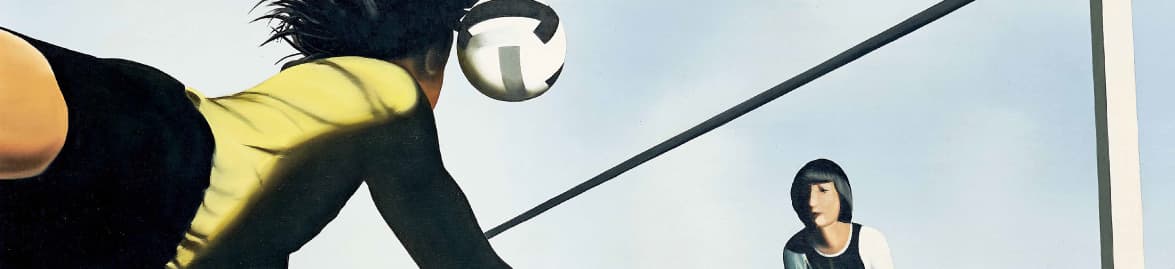
Shibu Natesan (born 1966, Vakkom, Thiruvananthapuram, Kerala) is a prominent contemporary Indian artist renowned for his realist and hyperrealist paintings that interrogate visual perception and the mediation of reality. Natesan’s practice spans painting, printmaking, and multimedia, and is marked by a critical engagement with sociopolitical themes, popular culture, and the complexities of representation. He completed his Bachelor of Fine Arts (BFA) in Painting from the College of Fine Arts, Thiruvananthapuram, in 1987, and his Master of Fine Arts (MFA) in Printmaking from the Faculty of Fine Arts, Maharaja Sayajirao University, Baroda, in 1991. He was awarded a prestigious residency at the Rijksakademie van Beeldende Kunsten, Amsterdam (1996–97), where he was introduced to European art movements and further honed his practice.
Natesan has exhibited widely in India and internationally, with solo shows at leading venues such as Sakshi Gallery (Mumbai, New Delhi), Jack Shainman Gallery (New York), Grosvenor Gallery (London), and Vadehra Art Gallery (New Delhi). He currently lives and works between London, Vadodara, and Thiruvananthapuram.
Early Life and Education
Growing up in Kerala during the politically charged 1980s, Natesan was influenced by the region’s vibrant cultural environment, as well as global currents in cinema and literature, particularly Latin American films and Expressionist art. His foundational years at the College of Fine Arts, Thiruvananthapuram, instilled in him a humanistic sensibility and an awareness of the socio-political context of art. His postgraduate studies at Baroda brought him into contact with the narrative tendencies of the Baroda School and artists such as Bhupen Khakhar, whose influence is evident in Natesan’s early explorations of power structures and social imbalance through photorealistic painting.
The residency at Rijksakademie van Beeldende Kunsten in Amsterdam exposed him to European artists like Gerhard Richter and David Hockney, further shaping his approach to realism and the manipulation of photographic imagery in painting.
Career and Exhibitions
Natesan’s career began with a focus on photorealistic and hyperrealistic painting, using imagery sourced from media and popular culture to create works that both mimic and subvert reality. His first major solo exhibition, “The Futility of Device” (Sakshi Gallery, 1995), established his reputation for critically engaging with memory, aggression, and the cyclical nature of violence. Subsequent exhibitions, including “Missing” (Mumbai, 1999), “Linkage” (Amsterdam, 1997 & 2001), and “Existence of Instinct” (New Delhi, 2005), showcased his evolving engagement with political, social, and existential themes.
His work has also been featured in significant group exhibitions, such as the Fukuoka Asian Art Triennale (Japan, 2005), ARS 01 at the Museum of Contemporary Art Kiasma (Helsinki, 2002), and “Sightings: Out of the Wild” at Kiran Nadar Museum of Art (2019).
Paintings
Early and Mid-Career Works
Natesan’s early paintings are marked by a striking photorealism, glossy finishes, and the use of metallic paints. These works often employ images from media, film, and popular culture, transformed into metaphors that comment on issues such as racism, migration, industrialisation, and the imbalance of power in society. His critical realism is achieved by subverting the meaning of familiar images without altering their appearance, prompting viewers to question their own perceptions and beliefs. Series such as “Missing” are notable for their use of photographic sources and their exploration of absence, memory, and loss. Works like “The Futility of Device” use symbolic relics and motifs to evoke the oppressive repetition of violence and aggression.
Recent Works
In recent years, Natesan has shifted towards plein air and still life painting, focusing on landscapes and everyday objects. These works are inspired by 19th- and early-20th-century European Impressionists, with an emphasis on light, shadow, and atmosphere. Despite the apparent serenity of these paintings, they retain a meticulous attention to detail and a subtle psychological depth, reflecting Natesan’s ongoing interest in the complexities of perception and the passage of time.
Notable works include “Topi Amma,” “Interrogation of Silence,” “Retro,” “Fruit Shop,” and “Fancy Fish” (watercolour on paper), as well as oil paintings such as “Wrist Watch,” “Swati Market, Baroda,” and “Sisters of Mercy”.
Art Style
Shibu Natesan’s art style is distinguished by:
- Photorealism and Hyperrealism: His early and mid-career works are defined by a meticulous, almost photographic rendering of subjects, often with glossy finishes and metallic paints.
- Critical Realism: Natesan uses realism not simply to replicate reality, but to interrogate and subvert it. By displacing meaning while retaining appearance, he challenges viewers’ assumptions about visual truth and representation.
- Surreal and Symbolic Elements: Many works incorporate surreal juxtapositions, vibrant colours, and symbolic motifs drawn from popular culture, media, and personal memory.
- Narrative and Political Engagement: His paintings often reflect on sociopolitical issues, including migration, power dynamics, and the effects of industrialisation, while also exploring existential themes of absence, memory, and identity.
- Transition to Landscape and Still Life: In recent years, Natesan’s practice has embraced plein air painting and still life, focusing on the painterly qualities of light, shadow, and atmosphere, while maintaining a subtle psychological resonance.
- Influences: His influences range from the photorealism of Gerhard Richter to the expressive figuration of Richard Hamilton and Vija Celmins, as well as the narrative traditions of the Baroda School and the broader context of Indian and European art.
Conclusion
Shibu Natesan is a significant figure in contemporary Indian art, known for his rigorous engagement with realism, his critical interrogation of visuality, and his ability to draw on a wide range of cultural and artistic influences. His work continues to evolve, moving from the photorealistic and politically charged paintings of his early career to the contemplative landscapes and still lifes of recent years, always marked by a deep awareness of the complexities of perception and representation.




