stamping ink, turpentine & revelation: the unique techniques behind velu viswanadhans art
.jpg&w=3840&q=75)
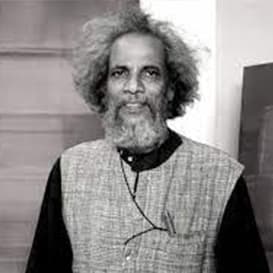 Velu Viswanadhan (born 1940), often referred to as "Paris Viswanadhan" is a globally acclaimed Indian painter and filmmaker. A pioneer of Indian abstraction, his work is a sophisticated dialogue between the ritualistic traditions of Kerala and the minimalist movements of the West. He is best known for his geometric abstractions that evoke the primordial energy of nature’s elements.
Early Life
Velu Viswanadhan was born on 1 January 1940 in Kadavoor, Kollam, in the southern Indian state of Kerala. He grew up in a traditional blacksmith family a background that, far from distancing him from art, gave him an early and intimate relationship with materials, form, and craft. His childhood in the lush, spiritually rich landscape of Kerala left a permanent imprint on his artistic imagination. The ritual diagrams, kolams, temple murals, and the pulsating colours of Kerala's festivals seeped into his consciousness long before he ever held a paintbrush professionally.
His family background was rooted in manual craftsmanship. Before formally entering the world of fine arts, he received training in blacksmithing and carpentry skills that instilled in him a respect for structure and material that would later manifest in the architectural rigour of his compositions. This unusual early formation distinguished him from most of his artistic contemporaries and gave his paintings a tactile, almost constructed quality that is immediately recognizable.
Later Life
In 1968, Velu Viswanadhan made the decisive move that would define the rest of his life he relocated permanently to Paris, becoming, alongside S. H. Raza, one of the very few Indian painters to make the French capital their enduring home and creative base. Paris at that time was a cauldron of artistic revolution, and Viswanadhan immersed himself fully in its intellectual and aesthetic ferment without ever losing his Indian identity.
He joined the prestigious Galerie de France soon after his arrival and steadily built a reputation in the European art world. His engagement with Paris was not one of assimilation but of dialogue he brought his Kerala-rooted vision of space, ritual geometry, and colour to conversations with Western abstraction, and the encounter produced something entirely new.
In his later years, Viswanadhan ventured beyond painting into filmmaking, creating a celebrated series of short films based on the five classical Indian elements earth, water, fire, air, and ether titled The Pancha Bhoota. He also made the film Ganga and the series Back to Elements, reflecting his enduring preoccupation with nature and the primordial. His work is currently represented in Paris and Brussels by Galerie Nathalie Obadia and in New Delhi by Nature Morte Gallery. In 2025, he was honoured with a dedicated pavilion at Sharjah Biennial 16, curated by Natasha Ginwala one of the most prestigious recognitions of his career.
Family
Velu Viswanadhan is married to Nadine Tarbouriech, a French art expert and member of the U.F.E. (Union Française des Experts), who specialises in the categories of painting, cinema, photography, and literature. Nadine is currently preparing the catalogue raisonné of Viswanadhan's complete body of work a monumental undertaking that will document every painting, drawing, print, sculpture, and film he has created. This shared commitment to art has made their partnership both personal and professional. Viswanadhan has made Paris his home for over five decades, and his domestic life in the city has been inseparable from his creative life.
Education
Velu Viswanadhan's formal artistic education began when he enrolled at the Government College of Fine Arts, Chennai (then Madras) in 1960. It was here that he came under the transformative influence of the legendary painter K. C. S. Paniker, one of the founding figures of Indian modernism and a visionary who encouraged his students to look inward, toward Indian tradition and philosophy, rather than blindly imitating Western models.
Viswanadhan secured his diploma in 1966 after completing his studies. The education he received under Paniker was not merely technical; it was philosophical and ideological. Paniker's emphasis on finding an authentic Indian visual vocabulary drawing from tantric diagrams, Sanskrit scripts, and ritual symbols profoundly shaped the direction Viswanadhan's art would take. Before his formal art training, he had also received grounding in blacksmithing and carpentry, which gave him a practical understanding of materials that enriched his later work enormously.
Painting Style
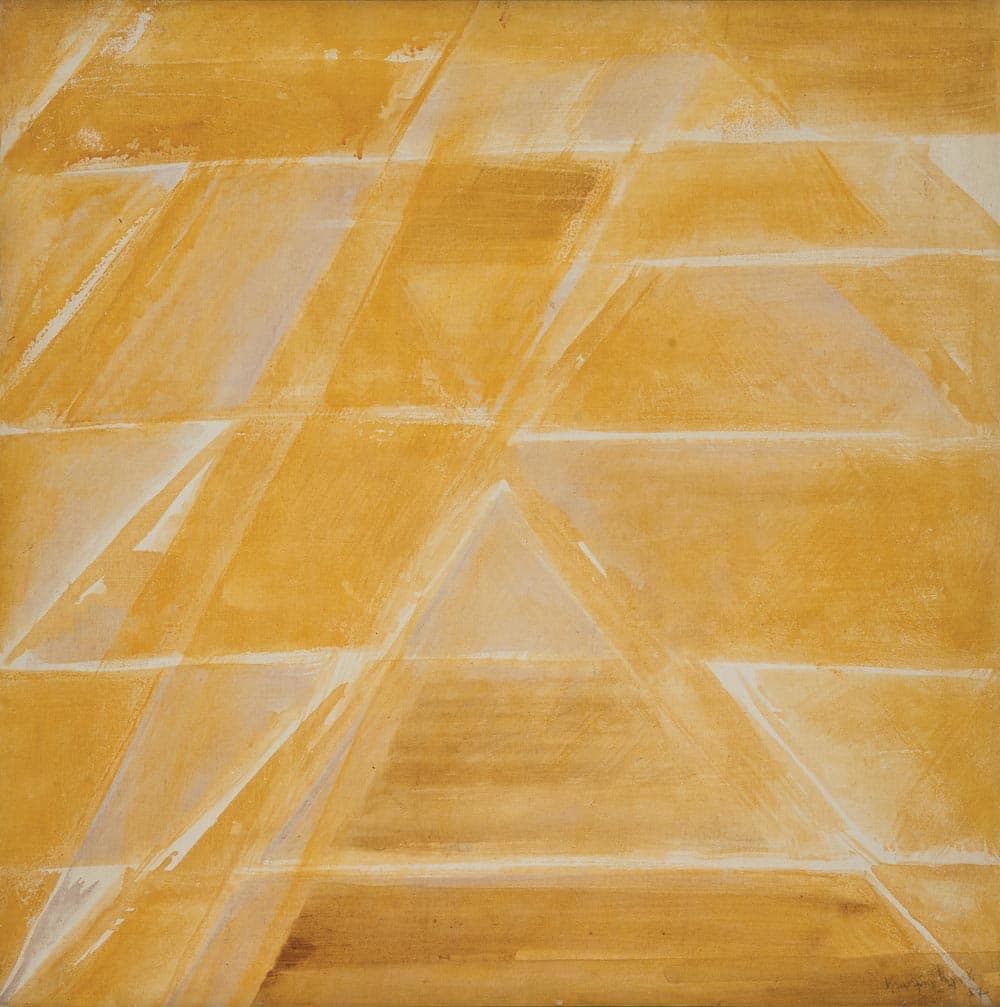 Velu Viswanadhan's painting style is a carefully evolved language that bridges Eastern mysticism and Western modernism. His early work was largely figurative, but through years of exploration, he gradually moved toward abstraction and geometric form, arriving at a style that is entirely his own.
The most distinctive feature of his technique is his unique method of drawing: he begins by laying down outlines in thick stamping ink, then applies oil paint with a brush, and finally washes the surface with essence of turpentine. This process produces a transparency that allows the underlying geometric forms to breathe through the paint surface creating layers of visual depth that are simultaneously physical and metaphysical.
His primary inspiration comes from the geometrical ritualistic-magical diagrams of Kerala yantras, mandalas, and kolam patterns which he treats not as religious iconography but as a universal language of space and time. When he arrived in Paris, contact with contemporary Western abstraction prompted him to reinterpret space not merely as a geometric concept but as an experience of time.
Colour is central to Viswanadhan's vision. The colour red dominates his canvases with near-obsessive intensity deep crimsons, vibrant scarlets, and warm mauves saturate his compositions, evoking both the heat of Kerala's landscape and the emotional intensity of lived experience. Greens, mauves, and crimsons coexist in rich, layered harmonies. He works across a range of mediums including paper, canvas, and metal plate, and has also created large horizontal works in Indian ink.
He has described his drawings as akin to liberated sound: "When they are earthbound, they are like drums. The saxophone and flute are air-bound." This musical metaphor captures the rhythmic, structured yet free-flowing quality of his compositions.
Famous Paintings
• Untitled (Red Composition) One of his most celebrated abstract works, typifying his use of deep reds and geometric layering.
• Tantric Mandala Series A body of work exploring the visual language of Kerala's ritualistic diagrams, translated into abstract geometric forms.
• Rapsodia Series Lyrical, music-inspired compositions that reflect his deep interest in the relationship between visual art and sound.
• Naga-Panchika Works Works drawing from the serpent deity symbolism of Kerala's folk traditions.
• Hassia Matha An abstracted representation of the mother goddess, reflecting his engagement with tribal and ritual imagery.
• Kala Bhavana Series (2008) Works created in connection with Santiniketan, reflecting the spiritual geography of India.
• Space-Time Series Abstract compositions in which space is treated as an experience of time rather than a purely geometric concept, produced after his encounter with contemporary Western art in Paris.
Characteristic Features of His Paintings
Several defining qualities recur across Viswanadhan's oeuvre, making his work instantly identifiable:
• Dominance of Red: More than any other colour, red defines Viswanadhan's visual world. It appears across virtually all periods and series of his work, sometimes in nearly monochromatic compositions and at other times layered with complementary tones.
• Geometric Abstraction with Ritual Roots: His compositions are built on geometric forms circles, grids, angular divisions that trace their origins to Kerala's temple diagrams and tantric mandalas, though they are never merely illustrative of these sources.
• Layered Transparency: His technique of stamping ink, oil paint, and turpentine wash creates surfaces with multiple visible layers, producing a sense of depth and revelation.
• Space as Time: A philosophical treatment of pictorial space not as a static field but as a dynamic, temporal experience canvases that seem to unfold over time as one looks at them.
• Small Formats with Large Ambition: Practical constraints of studio space in Paris led him to favour smaller formats, yet his compositions carry the weight and presence of monumental works.
• Meditative Quality: His paintings demand sustained attention; they reward slow, contemplative looking rather than quick visual consumption.
• Material Variety: His use of paper, canvas, metal plate, Indian ink, and oil paints in different combinations gives each series a distinct material character.
Contribution in Indian Art
Velu Viswanadhan's contribution to Indian art operates on multiple levels. As a founding member of the Cholamandal Artists' Village near Chennai the remarkable artist cooperative established under K. C. S. Paniker's vision he helped create one of India's most important centres for the nurturing and promotion of contemporary art. Cholamandal became a model for artist-led communities across the country.
His work in Paris served as cultural diplomacy of the highest order. At a time when Indian art was largely unknown in European circles, Viswanadhan's presence in major Parisian galleries, biennales, and institutions introduced discerning international audiences to the depth and sophistication of the Indian modernist tradition. In this regard, his role parallels that of S. H. Raza they were, together, the most prominent Indian artistic voices in France.
His synthesis of Eastern and Western visual traditions refusing to subordinate one to the other demonstrated that Indian modernism need not be derivative or apologetic. It could stand on its own philosophical foundations while engaging freely with the world.
His films on the Pancha Bhoota extended his artistic vision into a new medium, establishing connections between visual art, nature, philosophy, and cinema that enriched Indian cultural expression well beyond the gallery wall.
Enduring Legacy & Impact
Velu Viswanadhan's legacy is that of an artist who maintained absolute integrity across a long career, never chasing fashion or critical favour, always following the internal logic of his own exploration. His influence on younger Indian artists particularly those working in abstraction and geometric form has been considerable, even if often unacknowledged.
The dedicated pavilion at Sharjah Biennial 16 (2025), titled "To Carry", curated by Natasha Ginwala, marks a significant institutional recognition of his enduring importance. It placed his six-decade-long practice in conversation with the most urgent contemporary discourses in global art.
His participation in the Art Rises for Kerala (ARK) initiative at the 2019 Kochi-Muziris Biennale where his paintings were auctioned to aid flood relief demonstrated that for Viswanadhan, art was never separate from social responsibility and rootedness in his homeland.
The preparation of his catalogue raisonné by Nadine Tarbouriech ensures that his complete body of work will be systematically documented and preserved for future generations of scholars, collectors, and artists.
Exhibitions
Velu Viswanadhan's exhibition history spans over five decades and multiple continents:
• Biennale de Paris Participated in 1967 and subsequent editions
• International Biennale of Engraving, Ljubljana Major international participation
• Centre Georges Pompidou, Paris One of the most prestigious venues in France
• Galerie de France, Paris His long-standing Paris gallery
• Galerie Nathalie Obadia, Paris & Brussels Current representation
• National Gallery of Modern Art (NGMA), New Delhi Retrospectives and solo shows
• Vadehra Art Gallery, New Delhi
• Marlborough Gallery, New York Solo show in 2008
• Nature Morte Gallery, New Delhi Current Indian representation
• Delhi Art Gallery, New Delhi Viswanadhan: Early Years (2008)
• Jehangir Art Gallery, Mumbai
• Tao Art Gallery, Mumbai
• Galerie Espace
• Birla Academy of Art and Culture, Kolkata Besides Paris (2010)
• Institute Valencia d'Art Modern (IVAM), Spain India Moderna (2008–09)
• Kochi-Muziris Biennale ARK initiative (2019)
• Sharjah Biennial 16, UAE Full dedicated pavilion (2025)
Awards
• Best Documentary Film Award, Festival dei Popoli, Florence (1986)
• Chevalier des Arts et des Lettres, French Government (2005) one of France's highest cultural honours
• Inaugural K. C. S. Paniker Award, Kerala Lalithakala Akademi (2008)
• Raja Ravi Varma Award (2018)
Conclusion
Velu Viswanadhan is one of the most quietly profound figures in the history of modern Indian art. He never sought the spotlight, yet the spotlight has found him with increasing consistency as the global art world catches up to what his work has always offered a rigorous, philosophically grounded, deeply personal visual language that transcends geography and epoch. From the blacksmith's forge in Kadavoor to the galleries of Paris, from the Cholamandal village on the outskirts of Chennai to the pavilions of Sharjah, his journey is one of extraordinary discipline, curiosity, and creative fidelity. In his paintings, Kerala and Paris are not opposites but rhymes two places that taught him different things about light, space, and time, and whose lessons he has spent a lifetime weaving together on canvas. His art endures because it does not explain itself; it simply opens, like a door onto something ancient and inexhaustible.
Lesser-Known Facts
• Blacksmith by birth: Viswanadhan was born into a family of blacksmiths in Kadavoor, Kerala, and trained in blacksmithing and carpentry before turning to painting an unusual background that informed the structural and material consciousness of his art.
• The name "Paris Viswanathan": He is so closely identified with the French capital that he is widely known simply as Paris Viswanathan a nickname that captures both his adopted home and his enduring identity as an outsider-insider in the city.
• Co-founder of Cholamandal: He was among the very first batch of members at the Cholamandal Artists' Village, helping Paniker physically set it up after graduating in 1966, before departing for Paris two years later.
• Stamping ink technique: The unusual practice of using thick stamping ink (ordinarily an office supply) as the basis for his drawings is a technique he developed himself, and it remains a signature element that no other artist has replicated in the same way.
• Filmmaker with five elemental films: His film series The Pancha Bhoota one film each for sand, water, fire, air, and ether won him the Best Documentary Film Award at Florence's Festival dei Popoli in 1986 and showed a dimension of his artistic practice that remains largely unknown.
• Catalogue raisonné in progress: His wife Nadine, a certified French art expert, is currently preparing a complete scholarly catalogue of all his works across painting, cinema, photography, and literature a project that will be among the most thorough documentation of any Indian artist's output.
• One of only two Indians in Paris: Along with S. H. Raza, Viswanadhan is counted as one of only two Indian painters to have genuinely made Paris their permanent creative home a distinction that places him in a very exclusive artistic lineage.
• Art for flood relief: In 2019, he donated paintings to the Art Rises for Kerala initiative at the Kochi-Muziris Biennale, where they were auctioned to support reconstruction after the devastating 2018 Kerala floods a gesture reflecting his enduring bond with his homeland.