Blogs
.jpg&w=3840&q=75)
The History & Impact Of Cubism As It Marks 118 Years
Sakshi Batavia | 5 Feb, 2022
118 Years On, Why Cubism Still Matters?
In the early years of the 20th century, two young artists working in the bohemian quarters of Paris initiated a revolution that would forever alter the course of visual art. Pablo Picasso and Georges Braque, through their radical experiments with form, space, and perspective, shattered centuries of artistic convention and reassembled the fragments into something entirely new. Cubism, the movement they pioneered between 1907 and 1914, represented nothing less than a complete reimagining of how artists could depict reality on a two-dimensional surface.
For over 500 years, Western art had been dominated by Renaissance principles of linear perspective, which created the illusion of three-dimensional space receding from a single viewpoint. Cubism rejected this singular vision, proposing instead that objects could be depicted from multiple viewpoints simultaneously, fragmented and reassembled to reveal deeper truths about form, structure, and perception itself. This revolutionary approach didn't merely change painting, it fundamentally transformed how we understand visual representation, influencing sculpture, architecture, literature, music, and design throughout the 20th century and beyond.
Today, 118 years after its inception, Cubism remains one of the most influential and recognizable art movements in history. Its geometric forms, fractured perspectives, and analytical approach to representation continue to resonate with contemporary artists, designers, and digital creators who find in Cubism's revolutionary vision enduring possibilities for exploring our complex, multifaceted world.
Definition
Cubism is a revolutionary early 20th-century art movement that radically departed from traditional European painting by rejecting single-point perspective and naturalistic representation. Instead, Cubism depicts subjects from multiple viewpoints simultaneously, fragmenting objects into geometric shapes and reassembling them on the picture plane to reveal different facets and dimensions at once.
The movement's name derives from a dismissive comment by art critic Louis Vauxcelles, who described Georges Braque's 1908 paintings as reducing everything to "geometric outlines, to cubes." While initially intended as criticism, the term was adopted by artists and historians to describe this revolutionary approach to pictorial space.
Cubism operates on several fundamental principles: the rejection of traditional perspective in favor of multiple simultaneous viewpoints; the flattening of three-dimensional forms onto the two-dimensional canvas; the fragmentation and geometric simplification of objects; the use of overlapping planes to suggest depth without illusionistic space; and the privileging of conceptual understanding over purely visual perception. Rather than depicting what the eye sees from a single fixed position, Cubism represents what the mind knows about an object's complete form and structure.
The movement evolved through two primary phases: Analytical Cubism (approximately 1908-1912), characterized by monochromatic palettes and extreme fragmentation of forms, and Synthetic Cubism (approximately 1912-1914 and beyond), which introduced brighter colors, simplified forms, and collage techniques incorporating real-world materials like newspaper, wallpaper, and fabric.
History & Origin
Cubism emerged from a confluence of artistic, intellectual, and cultural developments in early 20th-century Paris. The movement's immediate origins can be traced to 1907, when Pablo Picasso, a twenty-five-year-old Spanish artist already established in Paris's avant-garde circles, began work on a large, ambitious painting that would become Les Demoiselles d'Avignon.
This revolutionary work, depicting five female figures with radically distorted and fragmented forms, drew inspiration from multiple sources: African masks and Iberian sculpture that Picasso had studied at the Musée d'Ethnographie du Trocadéro; Paul Cézanne's late paintings, which reduced forms to geometric essentials; and a desire to shock bourgeois sensibilities with confrontational imagery. When Picasso showed the painting to friends and fellow artists, reactions ranged from bewilderment to horror. Even Georges Braque initially found it disturbing.
However, Braque soon recognized the painting's revolutionary potential. Throughout 1908, he created landscapes featuring simplified, geometric forms and ambiguous spatial relationships. When these works were exhibited, critic Louis Vauxcelles wrote dismissively of "bizarreries cubiques" (cubic oddities), inadvertently naming the movement.
From 1908 to 1914, Picasso and Braque worked in close collaboration, sometimes visiting each other's studios daily, developing Cubism through intensive experimentation. Their partnership was so close that Braque later compared their relationship to "two mountaineers roped together," each pushing the other toward greater innovation. During this period, they often worked in similar styles, making their paintings difficult to distinguish.
The years 1909-1912 saw the development of Analytical Cubism, as Picasso and Braque fragmented objects into increasingly complex geometric facets, using predominantly ochre, gray, and brown palettes. By 1911-1912, their paintings approached complete abstraction, with objects barely discernible amid overlapping transparent planes.
In 1912, the movement entered its Synthetic phase when Picasso created Still Life with Chair Caning, incorporating actual oilcloth printed with a chair-caning pattern, the first Cubist collage. This innovation opened new possibilities, and both artists began incorporating newspaper clippings, wallpaper, sheet music, and other materials into their works, creating what they termed "papiers collés" (pasted papers).
Other artists soon joined the Cubist revolution. Juan Gris brought systematic rigor and brilliant color to Cubism. Fernand Léger developed a distinctive variant emphasizing cylindrical forms and mechanical subjects. Robert Delaunay explored color relationships in what Guillaume Apollinaire termed "Orphism." By 1911, the Salon Cubists including Albert Gleizes, Jean Metzinger, Henri Le Fauconnier, and Fernand Léger exhibited together, bringing Cubism to wider public attention.
World War I disrupted the movement's development. Braque and Léger were severely wounded in combat, while Apollinaire, the movement's eloquent defender, died in 1918. The intense collaboration between Picasso and Braque ended, though both continued exploring Cubist principles throughout their careers.
Types
Cubism evolved through distinct phases and generated several variants:
• Analytical Cubism (1908-1912): The movement's first major phase, characterized by the systematic fragmentation of objects into multiple geometric facets shown from different viewpoints simultaneously. Analytical Cubist paintings typically employed restricted, monochromatic color palettes predominantly ochres, grays, browns, and greens to avoid distracting from the complex formal analysis. Objects were broken down into overlapping transparent planes that revealed multiple aspects simultaneously, often becoming nearly abstract as fragmentation increased.
• Synthetic Cubism (1912-1914 and beyond): The second major phase, marked by simplified forms, brighter colors, and the introduction of collage techniques. Rather than analyzing objects by breaking them down, Synthetic Cubism synthesized or built up images from distinct elements. Artists incorporated actual materials; newspaper, wallpaper, fabric, sand into paintings, creating mixed-media works that questioned boundaries between fine art and everyday objects. Forms became flatter, more decorative, and often more legible than in Analytical Cubism.
• Orphism (Orphic Cubism): Developed primarily by Robert and Sonia Delaunay around 1912-1914, Orphism emphasized brilliant color and abstract forms inspired by light and movement. Named by poet Guillaume Apollinaire after Orpheus, the mythical musician, this variant prioritized color relationships and dynamic compositions over the structural analysis central to mainstream Cubism.
• Salon Cubism: Practiced by artists including Albert Gleizes, Jean Metzinger, Henri Le Fauconnier, and others who exhibited at the Salon des Indépendants and Salon d'Automne. These artists developed more accessible, sometimes more decorative variations of Cubism, often retaining greater legibility than Picasso and Braque's hermetic works.
• Crystal Cubism: A late phase (approximately 1915-1925) characterized by a return to greater clarity, flatter planes, and geometric precision. Works from this period feature sharper edges, clearer colors, and more architectural compositions.
• Cubist Sculpture: Three-dimensional explorations of Cubist principles by artists including Picasso, Alexander Archipenko, Jacques Lipchitz, and Henri Laurens. These works fragmented forms in space, employed multiple materials, and sometimes incorporated void spaces as positive sculptural elements.
Characteristics
Cubist works share distinctive formal and conceptual characteristics that define the movement:
• Multiple perspectives: The most revolutionary characteristic, objects depicted simultaneously from various viewpoints, showing front, back, sides, top, and interior views at once. This "simultaneity" rejected the single, fixed viewpoint that had dominated Western art since the Renaissance.
• Geometric fragmentation: Forms broken into geometric planes, facets, and angular shapes. Curves were reduced to straight lines and angles, organic forms geometricized into crystalline structures.
• Shallow pictorial space: Rather than creating deep illusionistic space receding into the distance, Cubist paintings typically employ shallow space with forms pushed forward toward the picture plane. Depth is suggested through overlapping planes rather than linear perspective.
• Passage: A technique where edges of forms blend into surrounding areas or other objects, creating ambiguity about where one object ends and another begins. This interpenetration of forms emphasizes the painting's unified surface.
• Limited color palette: Especially in Analytical Cubism, restricted colors (ochres, browns, grays, greens) focused attention on formal analysis rather than decorative color effects. Synthetic Cubism introduced brighter, more varied colors.
• Incorporation of text and collage: Letters, numbers, words, and newspaper fragments appear in paintings, while actual materials are glued onto surfaces, collapsing distinctions between representation and reality.
• Suppression of texture: Smooth, relatively uniform paint application in Analytical Cubism emphasized intellectual analysis over sensuous surface qualities. Synthetic Cubism's collage elements introduced varied textures.
• Conceptual rather than purely visual representation: Cubism depicts objects as the mind understands them rather than as the eye sees them from a single viewpoint, privileging conceptual knowledge over optical appearance.
Symbolism
While Cubism is often characterized as primarily formal and analytical rather than symbolic, the movement engaged with symbolic dimensions in several ways:
• Fragmentation and modernity: The fractured, multiple perspectives of Cubist paintings symbolized the fragmented nature of modern experience. In an age of rapid technological change, urbanization, and shifting values, the unified Renaissance worldview seemed inadequate. Cubism's shattered forms reflected modern consciousness experiencing reality from multiple simultaneous perspectives.
• Intellectual analysis: Cubism symbolized a rational, analytical approach to understanding reality, reflecting early 20th-century faith in scientific and intellectual progress. The systematic decomposition of forms paralleled scientific analysis breaking phenomena into constituent elements.
• Democratic vision: By rejecting the privileged single viewpoint of Renaissance perspective (associated with the viewer as sovereign individual), Cubism suggested a more democratic vision where multiple viewpoints coexist without hierarchy, a visual parallel to emerging democratic and socialist politics.
• Subject matter symbolism: While formal innovation dominated Cubist concerns, subject choice carried meaning. Still lifes with musical instruments symbolized artistic creation and bohemian lifestyle. Newspapers referenced contemporary events and popular culture. Café scenes evoked modern urban sociability.
• Collage materials: The incorporation of actual newspapers, advertisements, and everyday materials symbolized the dissolution of boundaries between high art and mass culture, challenging traditional hierarchies that elevated painting above ordinary objects.
• African art influence: Picasso's engagement with African masks in developing Cubism symbolized the decentering of European culture and recognition of non-Western aesthetic traditions, a radical gesture in colonial-era Europe, though complicated by problematic appropriation.
Painting Techniques
Cubist artists developed distinctive technical approaches to realize their revolutionary vision:
• Faceting: The fundamental Cubist technique of breaking forms into multiple geometric planes or facets. Artists would analyze objects, identifying different surfaces and viewpoints, then represent these facets as overlapping geometric shapes on the canvas.
• Shading and modeling: In Analytical Cubism, subtle tonal gradations suggested volume and depth within individual facets while maintaining overall surface flatness. This careful modulation required considerable skill to balance dimensionality with pictorial flatness.
• Grid structure: Many Cubist paintings employ underlying grid structures organizing the composition. Vertical and horizontal lines create scaffolding upon which fragmented forms are arranged, providing coherence amid apparent chaos.
• Passage (open form): Edges of forms left incomplete or blended into adjacent areas, allowing forms to interpenetrate and merge. This technique unified the picture surface while maintaining suggestion of distinct objects.
• Limited brushwork: Analytical Cubist paintings typically feature relatively smooth, uniform paint application with minimal expressive brushwork, emphasizing intellectual analysis over emotional expression or painterly virtuosity.
• Monochromatic palette: Deliberate restriction to ochres, browns, grays, and muted greens in Analytical Cubism focused attention on form and structure. This austere palette distinguished Cubism from Fauvism's wild colors.
• Papiers collés and collage: Revolutionary technique introduced in Synthetic Cubism, gluing actual materials (newspaper, wallpaper, fabric, oilcloth) onto canvas. This incorporated reality directly into artworks, questioning traditional definitions of painting.
• Stenciling and typography: Use of stenciled letters and numbers, sometimes mimicking commercial signage or newspaper typography, integrating text into visual compositions.
• Simplification in Synthetic Cubism: Move toward flatter shapes, clearer edges, and more decorative arrangements. Forms became more legible and compositions more immediately comprehensible than in Analytical Cubism's complexity.
• Layering: Building up surfaces through multiple layers of paint or collaged materials, creating physical depth and textural variety, especially in Synthetic works.
Themes and Motifs
Cubist artists returned repeatedly to certain subjects and themes:
• Still lifes: The predominant Cubist subject, featuring arrangements of everyday objects; bottles, glasses, fruit, newspapers, musical instruments, pipes, playing cards. Still life's controllable subjects allowed systematic formal investigation while carrying symbolic associations with artistic tradition and bohemian lifestyle.
• Musical instruments: Guitars, violins, mandolins, and sheet music appear constantly in Cubist works, symbolizing artistic creation, sensory pleasure, and the café culture central to avant-garde sociability.
• Portraits and figures: Human faces and bodies presented particular challenges for Cubist fragmentation. Portraits by Picasso, Braque, and others decomposed facial features into geometric planes while maintaining recognizability and psychological presence.
• Café scenes: Tables, bottles, glasses, and newspapers evoke the Parisian café environment where Cubist artists gathered, socialized, and developed their ideas. These works celebrate modern urban leisure while providing formally interesting subjects.
• Newspapers and text: Fragments of newspaper headlines, advertisements, and typography reference contemporary events, popular culture, and modern mass media. Their incorporation questions relationships between high art and mass culture.
• Urban landscape: Though less common than still lifes, some Cubist works depict cityscapes, buildings, and streets, analyzing urban architecture's geometric forms and representing modern metropolitan experience.
Female figure: Especially in Picasso's work, the female body presented in various contexts from traditional nude to contemporary woman, often fragmented and reconceived through Cubist analysis.
• Harlequins and performers: Circus figures, especially harlequins, appear in Picasso's work as alter egos for the artist, representing creativity, performance, and marginal social position.
Famous Cubist Artists
• Pablo Picasso (1881-1973): Co-founder of Cubism and arguably the 20th century's most influential artist. Picasso's Les Demoiselles d'Avignon (1907) initiated the Cubist revolution, and his subsequent collaborations with Braque developed both Analytical and Synthetic Cubism. Picasso continued exploring Cubist principles throughout his long career, even as he moved through other styles.
• Georges Braque (1882-1963): Co-founder of Cubism, Braque worked in close partnership with Picasso from 1908-1914. His rigorous, methodical approach complemented Picasso's more intuitive experimentation. Braque continued developing Cubist principles throughout his career, creating increasingly refined and meditative works.
• Juan Gris (1887-1927): Brought systematic logic and brilliant color to Cubism. Gris approached Cubism intellectually, creating precisely structured compositions with clear geometric organization. His Synthetic Cubist works achieved remarkable balance between abstraction and representation.
• Fernand Léger (1881-1955): Developed a distinctive Cubist variant emphasizing cylindrical forms, mechanical imagery, and bold colors. Léger's "Tubism" celebrated modern machinery and urban life, creating a more accessible, decorative variant of Cubism that influenced poster design and commercial art.
• Robert Delaunay (1885-1941): Pioneered Orphism, emphasizing color relationships and circular forms over Cubism's typical angular geometry. Delaunay's vibrant abstractions explored light, movement, and simultaneous contrast.
• Jean Metzinger (1883-1956): Important Salon Cubist who co-authored Du "Cubisme" (1912), the first major treatise on the movement. Metzinger's works demonstrated more accessible approaches to Cubist principles.
Albert Gleizes (1881-1953): Salon Cubist and theorist who co-wrote Du "Cubisme" with Metzinger. Gleizes developed epic-scale Cubist works addressing social and spiritual themes.
• Jacques Lipchitz (1891-1973): Lithuanian-born sculptor who translated Cubist principles into three dimensions, creating revolutionary sculptures that fragmented forms in space.
• Alexander Archipenko (1887-1964): Ukrainian sculptor who pioneered Cubist sculpture, incorporating void spaces as positive elements and experimenting with mixed materials.
Indian Cubist Artists
Cubism in India was not a mere imitation of the European movement; it was a radical reinterpretation that blended geometric abstraction with Indian mythology, rural life, and spiritualism. Here are the most famous Indian artists who pioneered or heavily integrated Cubism into their work:
1. Gaganendranath Tagore (1867–1938)
Often called the "Pioneer of Indian Cubism," Tagore was the first Indian artist to experiment with the style as early as the 1920s.
Style: Unlike the analytic Cubism of Picasso, Tagore’s work was more "Lyrical Cubism." He used geometric planes to manipulate light and shadow, creating mysterious, maze-like interiors.
Key Work: House of Mystery (also known as The Captive).
2. M.F. Husain (1915–2011)
Perhaps India’s most famous modern artist, Husain was a founding member of the Bombay Progressive Artists' Group.
Style: He adopted a Modified Cubist style, using sharp, energetic lines and fractured planes to depict traditional Indian themes like the Ramayana, Mahabharata, and rural village life. He is particularly famous for his "geometric" horses.
Key Work: Zamin, Between the Spider and the Lamp.
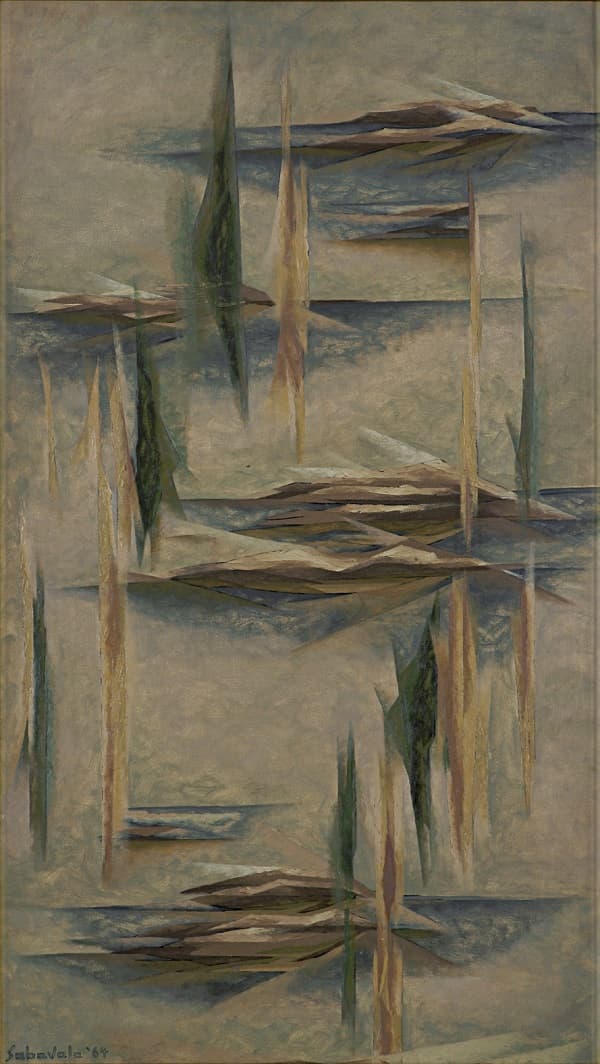
3. Jehangir Sabavala (1922–2011)
Sabavala studied under the French Cubist Andre Lhote, which gave his work a highly structured, academic foundation.
Style: His work is often described as "Crystalline Cubism." He painted serene, muted landscapes and seascapes where the sky, water, and earth are broken down into delicate, overlapping triangles and wedges.
Key Work: The Casuarina Line, Cobweb Cloud.
4. Ram Kumar (1924–2018)
A master of the Varanasi (Banaras) landscape, Ram Kumar moved from figurative art to a unique form of abstract Cubism.
Style: He deconstructed the city of Varanasi into a series of jagged, interlocking brown and ochre shapes. His work lacks human figures, focusing instead on the "architectural soul" of the city.
Key Work: Varanasi Series.
5. N.S. Bendre (1910–1992)
Bendre was instrumental in bringing modernism to the MS University in Baroda.
Style: He went through a significant Cubist phase where he simplified the human form into basic geometric volumes while maintaining a vibrant, Indian color palette.
Key Work: The Thorn.
Famous Cubism Paintings
• Les Demoiselles d'Avignon (1907) by Pablo Picasso: The revolutionary work that initiated Cubism, depicting five female figures with radically fragmented and distorted forms. Though not fully Cubist, this painting's brutal rejection of traditional representation opened possibilities that Cubism would explore.
• Houses at L'Estaque (1908) by Georges Braque: Landscape paintings that prompted critic Louis Vauxcelles's comment about "cubes," giving the movement its name. These works reduced buildings and trees to geometric essentials.
• Portrait of Ambroise Vollard (1910) by Pablo Picasso: Masterpiece of Analytical Cubism fragmenting the art dealer's face and figure into crystalline facets while maintaining psychological presence and recognizability.
• Man with a Guitar (1911-1912) by Georges Braque: Quintessential Analytical Cubist painting approaching abstraction through extreme fragmentation, yet maintaining suggestion of figure and instrument through subtle clues.
• Still Life with Chair Caning (1912) by Pablo Picasso: Revolutionary collage incorporating actual oilcloth printed with chair-caning pattern, initiating Synthetic Cubism and questioning boundaries between representation and reality.
• Guitar and Bottle (1913) by Juan Gris: Brilliant example of Synthetic Cubism's clarity, color, and systematic structure. Gris achieves perfect balance between geometric abstraction and legible representation.
• The City (1919) by Fernand Léger: Dynamic composition celebrating urban modernity through cylindrical forms, bold colors, and mechanical imagery characteristic of Léger's distinctive Cubist variant.
• Portrait of a Young Girl (1914) by Juan Gris: Demonstrates Synthetic Cubism's ability to create psychologically compelling portraits through geometric simplification and thoughtful color.
• Three Musicians (1921) by Pablo Picasso: Late Synthetic Cubist masterpiece featuring three commedia dell'arte figures in flattened, colorful geometric forms. The painting demonstrates Cubism's evolution toward clarity and decoration.
• Simultaneous Windows on the City (1912) by Robert Delaunay: Orphic Cubist work emphasizing prismatic color and light over geometric analysis, showing Cubism's colorful variant.
Significance
Cubism's significance extends far beyond its immediate artistic innovations:
• Revolutionized representation: Cubism fundamentally changed how artists could depict reality, liberating art from Renaissance perspective's five-century dominance. By demonstrating that objects could be represented from multiple viewpoints simultaneously, Cubism expanded possibilities for all subsequent art.
• Established modernist principles: Cubism's emphasis on flatness, fragmentation, abstraction, and self-referential formal concerns established principles that would define modernist art throughout the 20th century.
• Bridged representation and abstraction: By maintaining connections to recognizable objects while fragmenting them nearly beyond recognition, Cubism created a productive middle ground between traditional representation and pure abstraction, enabling subsequent abstract movements.
• Challenged perception itself: Cubism questioned how we see and understand reality, proposing that truth lies not in optical appearance but in intellectual comprehension of objects' complete structure and form.
• Democratized artistic materials: Through collage, Cubism incorporated everyday materials into high art, challenging traditional hierarchies between fine art and ordinary objects, anticipating later movements like Pop Art and appropriation art.
• Theoretical sophistication: Cubism prompted extensive theoretical writing by practitioners like Gleizes and Metzinger, critics like Apollinaire and Kahnweiler, and later scholars establishing art theory as essential to understanding modern art.
• Cross-disciplinary influence: Cubism influenced not just visual art but literature, music, architecture, and design, demonstrating how revolutionary artistic ideas could transform culture broadly.
Impact
Cubism's impact resonated across visual culture and beyond:
• On abstract art: Cubism directly enabled abstract art's development. By fragmenting objects nearly to abstraction while maintaining conceptual connections to reality, Cubism showed artists how to create meaningful works without representational subject matter. Kandinsky, Mondrian, Malevich, and other abstract pioneers built on Cubist foundations.
• On sculpture: Cubist sculpture by Picasso, Lipchitz, Archipenko, and others revolutionized three-dimensional art, introducing fragmentation, multiple materials, open forms, and void spaces as positive elements. Constructivism and subsequent sculptural developments drew on these innovations.
• On architecture: Cubism influenced modern architecture through shared interests in geometric forms, intersecting planes, and rejection of traditional ornament. Architects including Le Corbusier (himself a painter influenced by Cubism) incorporated Cubist principles into building design.
• On literature: Writers including Gertrude Stein experimented with literary equivalents to Cubist fragmentation and multiple perspectives. The novel's development toward stream-of-consciousness, fragmented narratives, and multiple viewpoints paralleled Cubist visual innovations.
• On photography and film: Cubism influenced photographers and filmmakers exploring multiple exposures, fragmented compositions, and non-linear narratives. Avant-garde cinema's montage techniques share conceptual ground with Cubist simultaneity.
• On graphic design: Cubism revolutionized typography and layout design, legitimizing experimental arrangements, geometric forms, and integration of text with images that became fundamental to modern graphic design.
• On fashion: Cubist geometric forms and fragmented patterns influenced fashion design, from Sonia Delaunay's Orphic-inspired textiles to subsequent designers incorporating angular, geometric patterns.
• On product design: Industrial designers adopted Cubism's geometric simplification and emphasis on essential forms, influencing everything from furniture to automobiles to consumer products.
Legacy and Influence
Cubism's legacy permeates contemporary visual culture so thoroughly that we often fail to recognize its influence:
• Art education: Cubism remains central to art education worldwide. Students study Cubist principles, analyze famous works, and create Cubist-inspired projects, ensuring the movement's concepts reach new generations.
• Museum collections: Major museums worldwide feature significant Cubist holdings, with institutions like MoMA, Centre Pompidou, and Museo Reina Sofía maintaining galleries dedicated to the movement. These permanent installations continuously expose audiences to Cubist innovations.
• Theoretical influence: Cubism established modernist art theory's foundational concepts; flatness, medium-specificity, abstraction, formal analysis that dominated 20th-century criticism and continue influencing contemporary discourse.
• Popular culture: Cubist aesthetics appear constantly in advertising, album covers, poster design, animation, and digital media. The geometric fragmentation and multiple perspectives instantly signal modernity, sophistication, and artistic seriousness.
• Digital art: Contemporary digital artists and programmers create works inspired by Cubist principles, using computational tools to generate algorithmic fragmentations and multiple perspective renderings that extend Cubist explorations into new media.
• Continued artistic practice: Contemporary artists continue engaging with Cubism, either building on its innovations or critically examining its assumptions, demonstrating the movement's enduring relevance.
Modern Revival and Global Reach
While Cubism never entirely disappeared, the 21st century has witnessed renewed interest and expanded global engagement:
• Scholarly reassessment: Contemporary scholarship explores previously marginalized aspects of Cubism, including women artists' contributions (Marie Laurencin, María Blanchard), colonialism's role in Cubism's appropriation of African art, and the movement's intersection with politics and social change.
• Global perspectives: Non-Western scholars and curators are reexamining Cubism, questioning Eurocentric narratives and exploring how the movement absorbed and transformed non-European artistic traditions. This critical engagement complicates simplistic celebration while deepening understanding.
• Digital humanities: Researchers use computational analysis to study Cubist works, examining formal relationships, compositional structures, and evolutionary patterns across the movement with unprecedented precision.
• Contemporary artistic engagement: Artists worldwide create works in dialogue with Cubism, from painters exploring geometric abstraction to digital artists generating Cubist-inspired algorithms to sculptors fragmenting forms in space.
• Popular design: Cubist aesthetics pervade contemporary graphic design, particularly in digital contexts. Mobile apps, websites, and user interfaces frequently employ geometric fragmentation, overlapping planes, and multiple perspectives derived from Cubist innovations.
• Fashion and textiles: Contemporary fashion designers regularly reference Cubism, creating garments with geometric patterns, fragmented forms, and angular silhouettes inspired by the movement.
• Street art and murals: Urban artists worldwide create large-scale murals employing Cubist fragmentation and multiple perspectives, bringing the movement's innovations to public spaces and diverse audiences.
Educational technology: Virtual reality and augmented reality applications exploring Cubism allow users to experience multiple perspectives simultaneously, creating immersive encounters with Cubist principles impossible in traditional media.
• Cross-cultural synthesis: Contemporary artists synthesize Cubist principles with diverse cultural traditions, creating hybrid practices that honor Cubism's innovations while grounding them in specific cultural contexts beyond European modernism.
Interesting Facts
• Pablo Picasso and Georges Braque worked so closely during Cubism's development that they sometimes couldn't distinguish their own paintings from each other's. Braque compared their collaboration to "two mountaineers roped together," supporting each other in dangerous artistic territory.
• The term "Cubism" was coined as an insult. When critic Louis Vauxcelles reviewed Georges Braque's 1908 exhibition, he dismissively wrote that Braque reduced everything to "geometric outlines, to cubes." The artists adopted the term, transforming criticism into identity.
• Picasso's Les Demoiselles d'Avignon, now recognized as initiating Cubism, was so shocking that he kept it rolled up in his studio for years. Even close friends found it disturbing. The painting wasn't publicly exhibited until 1916, nine years after completion.
• During World War I, Braque suffered a severe head wound that left him temporarily blind. After recovering, he returned to painting with slightly altered vision, which some scholars suggest influenced his later Cubist works' spatial complexity.
• The first book about Cubism, Du "Cubisme" by Albert Gleizes and Jean Metzinger (1912), was published before Picasso and Braque the movement's founders had exhibited their Cubist works publicly. The book was written by second-generation Cubists theorizing about a movement whose originators remained largely unknown to the general public.
• Guillaume Apollinaire, Cubism's greatest literary defender, died in 1918 from Spanish flu complicated by a war wound. His last words were allegedly "I want to live!" His death deprived Cubism of its most eloquent spokesman just as the movement was transitioning to new phases.
• Picasso created the first Cubist sculpture using unconventional materials, his Guitar (1912) was assembled from cardboard, paper, string, and wire, predating the movement's painted collages and revolutionizing sculpture by treating void spaces as positive elements.
• Gertrude Stein, the American writer and art collector, was among Cubism's earliest supporters. Her portrait by Picasso (1905-06, before full Cubism developed) required 90 sittings. She later claimed, "I was and still am satisfied with my portrait; for me, it is I, and it is the only reproduction of me which is always I, for me."
• The Soviet Union initially embraced Cubism as revolutionary art appropriate for revolutionary politics, but Stalin's regime later condemned it as "bourgeois formalism," forcing Russian Cubist artists into exile, silence, or stylistic compromise.
• When asked whether his Cubist portraits resembled their subjects, Picasso allegedly replied, "They will." This confident prediction suggested that once viewers learned to see differently, Cubist representation would seem as natural as Renaissance perspective, a prediction partially fulfilled by Cubism's subsequent influence on visual culture.
Conclusion
Cubism stands as one of the most revolutionary and influential movements in art history. Over the course of just seven intense years (1907-1914), Picasso, Braque, and their collaborators fundamentally reimagined how artists could represent reality, shattering Renaissance perspective's five-century dominance and establishing principles that would define modern and contemporary art for generations.
The movement's significance extends far beyond formal innovation. Cubism challenged perception itself, proposing that truth lies not in optical appearance from a single viewpoint but in intellectual comprehension of objects' complete structure and multiple aspects. This philosophical shift paralleled broader early 20th-century transformations in physics (relativity theory suggesting multiple valid perspectives on reality), psychology (recognition of consciousness's fragmentary nature), and society (modernization fracturing traditional unified worldviews).
Today, 118 years after its inception, Cubism's influence remains pervasive yet often invisible. Every time we encounter fragmented imagery, geometric abstraction, or multiple simultaneous perspectives in advertising, graphic design, digital interfaces, or contemporary art, we witness Cubism's legacy. The movement so thoroughly transformed visual culture that its once-shocking innovations now seem natural, even inevitable.
Yet Cubism retains power to challenge and inspire. Contemporary artists continue finding in its revolutionary principles resources for addressing current concerns, from digital culture's fragmented experience to globalization's multiple perspectives to ongoing questions about representation's nature and limits. Scholars continue discovering new dimensions to Cubism's historical development, political implications, and cultural resonances.
Perhaps Cubism's greatest legacy lies in demonstrating that artistic conventions representing themselves as natural or inevitable are actually choices that can be rejected, reimagined, and replaced. By showing that objects could be depicted from multiple viewpoints simultaneously, Cubism didn't just change painting, it transformed how humanity understands the relationship between seeing, knowing, and representing. In our contemporary moment of multiple truths, fragmented narratives, and competing perspectives, Cubism's vision of reality as complex, multifaceted, and irreducible to single viewpoints seems more relevant than ever. The revolution that began in a Paris studio over a century ago continues reverberating through contemporary visual culture, ensuring that Cubism remains not merely historical achievement but living presence shaping how we see and understand our endlessly complex world.

Collecting Gems Of Indian Modernism
18 Jun, 2021
Indian Art Market – The Dark Horse Of The Indian Economy.
19 Dec, 2019
Showcasing Indian Freedom Through Independence Day Art
25 Mar, 2021
AstaGuru Art Recall – 2019
7 Jan, 2020
European Academic Realism in India - Origins, Masters and Evolution
8 Apr, 2022
Modern Masterpieces: Highlights From The Upcoming ‘Masters Legacy’ Auction
20 Apr, 2023
International Yoga Day: A Visual Odyssey of Spirituality In Modern Indian Art
21 Jun, 2023
Spanning A Decade Of Modern Indian Art
17 Mar, 2020
From Bawa to Bendre: AstaGuru's 'Modern Odyssey' Auction Offers a Kaleidoscope of Indian Art
7 Dec, 2023
Exploring The Influence Of French Culture On Indian Artists
28 May, 2020
Astaguru June 2020 Modern Indian Art No Reserve Auction – An Overview.
19 Jun, 2020
An Insight Into Astaguru’s Modern Indian Art No Reserve Online Auction
25 Jun, 2020
Abanindranath Tagore's Influence On Future Generations Of Indian Artists
23 Aug, 2024
Artworks That Are Making Their Auction Debut In Astaguru’s Modern Indian Art Auction
11 Jul, 2020
Ascetic Depths Of F N Souza’s Still Life With Veronica's Veil
11 Dec, 2023
A Guide To Husain
31 Jul, 2020
Baiju Parthan - Painter Of Intermedia Art In India
6 Jun, 2025
20 Famous Paintings by Andy Warhol [American Visual Artist]
18 Jun, 2025
Pablo Picasso Paintings – History, Style & Insights
6 Jun, 2025
Mona Lisa Painting Protest: Why Activists Keep Targeting The Artwork
1 Feb, 2024
Jamini Roy - Inspiring Generations Of Indian Artists
11 Nov, 2024
Types Of Paintings To Make Your Living Room Stand Out
27 Jan, 2021
Artist Dhanraj Bhagat (1917–1988) : A Comprehensive Biography
18 Dec, 2024
Qing Dynasty Art: A Rich Tradition Of Craftsmanship & Imperial Patronage
10 Dec, 2024
Understanding The Depth In Tyeb Mehta's 'Bull' Paintings
16 Dec, 2024
Revisiting The Legacy Of The Bombay Progressive Artist Group
25 Aug, 2021
Artist Mohan Samant - Life Account, Inspirations & Paintings
26 Dec, 2024
Nandalal Bose - Modern Art Artist Who Painted Sati
12 Feb, 2025
Jogen Chowdhury - Artist Profile, History, Art Style & Paintings
24 Feb, 2025
Popular Culture In Indian Art
15 Nov, 2021
Bikash Bhattacharjee - Artist Profile, History, Art Style & Paintings
3 Mar, 2025
10 Things To Know: Bharti Kher
21 Mar, 2025
Dadaism – Explore The Anti Art Movement That Emerged In Zurich
15 Dec, 2022
Unseen Facets Of Indian Artists
16 Nov, 2021
Fauvism: The Movement That Turned Chaos Into Colour
19 Nov, 2021
The Power Of Feminine In The Works of India’s Women Artists
7 Mar, 2022
Sakti Burman: Mastering Pointillism & Marbling To Create Dreamlike Narratives
29 Sep, 2025
What Is Gouache In Art? (5 Key Artists)
19 Sep, 2022
A Guide To 16 Different Types Of Modern Art
11 Dec, 2022
The Evolution Of Modern Indian Art
13 Dec, 2021
Metamorphosis Of An Artistic Genius
20 Dec, 2021
The Vanishing Masters Of Madhubani Art
14 Aug, 2022
Baiga Art: Forest Tribe's Spiritual Art
4 Sep, 2022
What is Surrealism - and how André Breton & Salvador Dalí created it
27 Feb, 2022
Astaguru 2021: A Year In Rewind
1 Jan, 2022
Thomas Daniell - Taj Mahal (1801) Painting | Overview
22 Apr, 2022
Wonders Of Wildlife In Indian Art
3 Mar, 2022
The Pursuit of Happiness: What Makes Us Happy Through The Perspective of Indian Art
20 Mar, 2022
Pablo Picasso: Biography, Paintings, & Why He's Still Famous
28 Apr, 2022
Jamini Roy - Exploring The Quintessence Of India’s Folk Art
11 Apr, 2022
Lalita Lajmi - India's Oldest Woman Artist & Printmaker Passes Away
13 Feb, 2023
Exploring The Unique Heads And Faces In The Works Of F.N. Souza And Akbar Padamsee
12 Apr, 2022
Exploring The Legacy Of K.H. Ara’s Poetic Aesthetic
14 Apr, 2022
The Momentous Metamorphosis Of Portraiture Art In 20th Century India
13 Jun, 2022
Reinterpretation Of The Last Supper In Indian Art
14 Apr, 2022
Painting The Lord: Life And Times Of Christ In Modern Indian Art
25 Apr, 2022
Close To Home: Celebration Of Familial Bonds In Indian Art
16 May, 2022
International Iconic: Top Highlights From Astaguru’s First Standalone International Auction
25 Nov, 2022
Life & Legacy of Naziha Salim: Pioneer of Contemporary Iraqi Art
27 Dec, 2022
The Shining Stars: Celebrating The Gems Of Modern Indian Art
14 Jun, 2022
Georgia O'Keeffe - Mother Of Modern Art
7 Sep, 2022
Raja Ravi Varma - Woman Holding A Fruit | Overview
4 May, 2022
Modern Indian Artists And Their Faunal Muses
9 Sep, 2022
Anupam Sud - Between Vows and Words (1995) | Overview
7 May, 2025
Mythology & Religion Through The Lens Of Modern Indian Artists
16 Sep, 2022
Exploring East Asian Identity Through Contemporary Art
22 Nov, 2022
11 Major Types of Painting: From Realism to Fauvism
13 Jun, 2023
The Prolific Women Artists of Modern Indian Art
14 Jun, 2023
Romancing The Nude: How Iconic Western Artists Explored The Theme
23 Nov, 2022
The Master Of Mountains: Nicholas Roerich
12 Dec, 2022
The Raj Series: M.F Husain’s Colourful Journey To India’s Colonial Past
19 Dec, 2022
Exploring The Legacy of Lancelot Ribeiro
9 Dec, 2023
Townscape by Lancelot Ribeiro
9 Dec, 2023
10 Visionary Women Artists Reshaping Modern Indian Art
27 May, 2024
Lancelot Ribeiro: Painting Style and Recurring Motifs
21 Jun, 2024
Navarasa: Detailed Meanings Of The Nine Rasas
23 Mar, 2023
A Poetry of Inanimate Objects: The Beauty of Still Life Art
28 Mar, 2023
The Female Gaze - The Portrayal of Women By Indian Women Artists
8 Mar, 2023
Masters of Madras: Prominent Modernists Of The Madras Art Movement
21 Mar, 2023
Modern Indian Abstract Artist: K M Adimoolam
13 Jun, 2024
Influential Modernists and their Sculptural Works
27 Mar, 2023
The Indian Artist Study - Rameshwar Broota
25 Nov, 2024
Art Symbols – Common Symbols in Paintings & What They Mean
20 Oct, 2021
Bewitching Black: Prabhakar Barwe’s Tryst With Textile & Pop Art
20 Apr, 2023
Mystery of Vincent Van Gogh’s Ear: Myths vs Facts
18 Jun, 2024
Rene Magritte | Art for Sale, Auction Results & History
7 Jul, 2023
F N Souza - The Rebel Artist Of The Progressive Artists' Group
29 Aug, 2024
Gaganendranath Tagore | Unsung Hero Of Indian Cubism
17 Oct, 2024
Jogen Chowdhury’s Paintings - How Ink, Watercolor & Pastel Define His Unique Style
17 Oct, 2024
Decoding K.C.S. Paniker - The Enigmatic Language Of Abstract Metaphysical Art
17 Oct, 2024
Impressionism Art | Definition, Characteristics, Techniques
22 Feb, 2022
K Laxma Goud & The Art of Storytelling: How His Works Narrate Life Experiences
22 Nov, 2024
Mukul Chandra Dey - Visionary Artist Behind Iconic Mythological Paintings
22 Nov, 2024
Significance Of Saraswati Paintings
4 Jun, 2025
10 Things To Know About Thota Vaikuntam
23 Feb, 2021
Abstract Art - Meaning, Information & Complete Guide
1 Aug, 2024
Art Galleries vs Art Museums – Key Differences Every Visitor Should Know
1 Aug, 2025
Krishen Khanna at 100: A Century of Art, Memory & Modernism
5 Jul, 2025
Beyond The Masters: Unveiling The Gems Of Modern Indian Art
17 Dec, 2024
Appukuttan Achary (1925-1997) - A Prominent Indian Sculptor
17 Apr, 2025
A Celestial Convergence: Homi Bhabha's Artistic Homage To Music Maestro Mozart
21 Aug, 2023
Chronicling Mythos Through Modern Indian Art
25 Aug, 2023
Modern Treasures : Highlights from AstaGuru’s upcoming Modern Indian Art Auction
31 Aug, 2023
AstaGuru's 'Iconic Masters' Auction: A Journey Through Rare Gems by Revered Indian Modernists
20 Oct, 2023
International Iconic Auction: A Showcase of Masterpieces by Global Modern Art Visionaries
11 Nov, 2023
C Raja Raja Varma - The Artist and Scholar
7 Dec, 2023
The Vibrant Legacy Of Manu Parekh And His Landscapes
16 Feb, 2024
Artist Akbar Padamsee - Biography, Paintings & Achievements
28 Nov, 2024
Iconic Series of Modern Indian Art
28 Nov, 2024
Artist Laxman Pai: Artworks Inspired By Jaina Miniature
6 Jan, 2025
Artist Shobha Broota – Life, Inspirations & Paintings
21 Jan, 2025
Dimensions Defined: Highlights From AstaGuru’s Upcoming Auction
16 Feb, 2024
AstaGuru’s Collectors Choice Auction Highlights
18 Mar, 2024
Manjit Bawa - Journey & Life Of The Master In Figurative Art
18 Apr, 2024
S H Raza - Biography, Paintings, History & Achievements
27 Nov, 2024
Remembering Satish Gujral - Painter, Sculptor & Beyond
3 Dec, 2024
10 Known (and Lesser-Known) Abstract Art Paintings & Why They're Great
13 Jun, 2025
20 Famous Paintings by Henri Matisse [French Visual Artist]
8 Jul, 2025
Highlights from AstaGuru’s Upcoming 100th Auction - ‘Master’s Legacy’
23 Apr, 2024
Most Expensive Hitler Painting - Neuschwanstein Castle, Water Colors (1910)
1 Mar, 2022
Modern Indian Art Forms & Their Impact On Modern Art Scene
28 May, 2024
H. A. Gade - The Artist Who Painted The Unseen & Unfelt
4 Oct, 2024
Evolution Of Gieve Patel’s Art - From Early Works To Masterpieces
26 Dec, 2024
Rabindranath Tagore - Artist Profile, Biography, Art Style & Paintings
26 Jun, 2025
10 Pro Tips On How To Buy Art Online
7 Jun, 2024
Artist Featuring For The First Time In AstaGuru’s Upcoming Contemporary Art Auction
20 Jun, 2024
Bharti Kher's Exploration of Identity, Gender, and Societal Norms
28 Aug, 2024
Infuse Your Home With Style & Elegance Through Modern Indian Art Paintings
25 Jul, 2024
Decoding The Language - The Unspoken Messages In Modern Indian Art
1 Aug, 2024
Basic Tips To Be Kept In Mind Before You Buy Modern Art
7 Aug, 2024
Amrita Sher-Gil : Bridging East & West Through Art
13 Sep, 2024
The Influence of Indian Miniature Art on Amrita Sher-Gil
13 Aug, 2024
Ganesh Haloi - A Maverick Of Modern Indian Art
30 Aug, 2024
10 Famous Paintings Of Artist Tyeb Mehta
19 Dec, 2024
Buddha Paintings By Famous Artists: A Fusion Of Mythology & Aesthetics
24 Oct, 2021
Meera Mukherjee - Artist Profile, History, Art Style & Paintings
4 Apr, 2025
20 Famous Paintings by René Magritte [Belgian Artist]
5 Jun, 2025
Record Breaking Sales - The Most Expensive Arts Ever Auctioned In India
10 Sep, 2024
Anjolie Ela Menon - Revolutionary Artist Who Changed India's Art Scene With Her Brush Strokes
11 Oct, 2024
Manifest: Highlights From AstaGuru’s Upcoming Modern & Contemporary Indian Art Auction
13 Sep, 2024
N.S. Bendre - Homeward Bound (1954) | Overview
4 Dec, 2025
The Evolution Of Fine Art Auctions: From In-Person Bidding To Online Platforms
19 Sep, 2024
5 Impressive Figurative Artworks Depicting Modern & Traditional Techniques
23 Sep, 2024
Arpita Singh - Artist Profile, Life History, Paintings & Facts
21 Feb, 2025
20 Most Famous Raja Ravi Varma Paintings
30 Dec, 2024
Bengal Renaissance & Beyond: Meera Mukherjee’s Role In Indian Art
21 Jan, 2025
Modern Art | History, Style, Movement, Artists
27 Feb, 2021
Piraji Sagara - Artist Profile, Biography, Paintings & Art Style
10 Mar, 2025
Prabhakar Kolte - Profile, History, Paintings & Art Style
13 Mar, 2025
Tyeb Mehta’s Diagonal & The Birth Of A Modern Indian Masterpiece
16 Apr, 2025
Artist Laxman Aelay - Artworks, Life & History
18 Dec, 2024
10 Famous Paintings Of Artist M. F. Husain
26 Feb, 2021
Horses In Art – Symbolic Horse Paintings In Modern Art
11 Oct, 2024
Life & Legacy Of Raja Ravi Varma: A Pioneer of Indian Art
27 Dec, 2024
Anish Kapoor - Artist Profile, Art Style, Sculptures & Paintings
21 Feb, 2025
There Comes Papa - Raja Ravi Varma (1893) | Overview
19 Mar, 2021
K K Hebbar’s Brush - Capturing The Heartbeat Of Society Through Art
11 Oct, 2024
Rising Indian Art Collector: A Guide To Building A Indian Art Collection
2 Dec, 2024
Tracing The Oldest Paintings In India - Bhimbetka Cave Paintings
27 Oct, 2021
Jatin Das – Contemporary Artist, Painter, Sculptor & Muralist
30 Jan, 2025
Animal Art Paintings - A Look At Animals In Indian Art
25 Oct, 2021
Ardha Nareshwar Paintings by Famous Artists
9 Nov, 2022
What is Kinetic Art - A Pro Level Guide To This Art Terminology
1 May, 2022
When Is the Right Time to Sell Art at Auction? Understanding Context & Market Timing
7 Jan, 2026
Gond Art - Encyclopedic Guide To A Timeless Tribal Tradition
27 Jan, 2021
Gond Art - Celebrating Artist Jangarh Singh Shyam's Genius
21 Jan, 2025
Artist K.G. Subramanyan's Mural Works: Bridging Tradition & Modernity
21 Jan, 2025
10 Famous Landscape Paintings By Famous Artists
29 Oct, 2021
Important Art Movements Every Art Collector Should Know
17 Oct, 2024
Masters Of The Bengal School Of Art - Celebrating India's Artistic Renaissance
18 Oct, 2024
The Artistic Journey Of Thota Vaikuntam - From Rural Roots To International Recognition
17 Dec, 2024
The Inspiration Behind Janine Mongillats Dreamlike Landscapes
22 Jan, 2025
Artist Nandalal Bose - Artworks, Life & History
31 Jan, 2025
Artist Jehangir Sabavala - Profile, Life History, Paintings & Facts
4 Feb, 2025
A. Ramachandran, Indian Painter, Dies at 89
10 Feb, 2024
Exploring The Essence Of Landscapes In Akbar Padamsee's Paintings
18 Oct, 2024
India's Greatest Portrait Painters Of All Time
22 Oct, 2021
7 Horse Painting - Benefits, Vastu Importance & Placements
23 Feb, 2021
10 Famous Animal Paintings By World Famous Artists
25 Feb, 2021
Jyoti Bhatt - Artist Profile, History, Art Style & Paintings
3 Mar, 2025
Bani Thani Painting: 'The Indian Mona Lisa'
11 Apr, 2025
Iconic Masters: Sketches Featured In Our Upcoming Modern Indian Art Auction
30 Oct, 2024
Iconic Masters: Highlights From AstaGuru’s Upcoming Modern Indian Art Auction
30 Oct, 2024
K. Muralidharan & The Art of Storytelling Through Paintings
8 Nov, 2024
The Evolution Of Anant Joshi - Tracing His Artistic Journey From Early Works To Masterpieces
11 Nov, 2024
Arpita Singh - Pioneer Of Narrative Figuration In Indian Art
11 Nov, 2024
Rameshwar Broota - Helmet (2000) | Overview
27 May, 2025
What Is Modern Art? Definition & Meaning
30 May, 2025
Did You Know? Interesting Facts About René Magritte's Life
14 Jun, 2025
N. S. Bendre: Landscape Artist Par Excellence
8 Sep, 2025
Thangka Paintings: Traditional Religious Artworks From Tibetan Buddhism
14 Mar, 2022
David Hockney: Pop Art’s Pastelist, Color Conjurer & Multimedia Sage
11 Jul, 2022
Women & Village Life In Nandalal Bose's Paintings
11 Nov, 2024
Himmat Shah - A Lifelong Exploration In Sculpture & Innovation
11 Nov, 2024
From Banker To Artist - Krishen Khanna’s Unconventional Journey Into Art
6 Dec, 2024
Artist Nikhil Biswas - Artworks, Life & History
10 Dec, 2024
Thomas Daniell: The Artist Who Painted India’s Colonial Landscape
13 Dec, 2024
20 Famous Paintings by Pablo Picasso [Spanish Artist]
16 Jun, 2025
Famous Alumni of JJ School Of Art Who Changed The Art Scene
21 Jul, 2025
M. F. Husain - The Life & Legacy Of India's Picasso
28 Nov, 2024
Radha Krishna Paintings by Famous Artists
29 May, 2025
12 Beautiful Krishna Paintings To Invite Peace & Prosperity
9 Jun, 2021
N. S. Bendre: Master Craftsman of Landscape Painting
2 Apr, 2025
Artist Nandalal Bose - Celebrating His 142nd Birth Anniversary!
3 Dec, 2024
Artist Jatin Das (2 Dec 1941) - Marking His 83 Birth Anniversary
2 Dec, 2024
Gogi Saroj Pal (1945-2024) - Artist Biography
4 Dec, 2024
Artist K Damodaran - Biography, History & Paintings
9 Dec, 2024
Satish Gujral’s Artistic Response To Historical Trauma: Partition & Beyond
10 Dec, 2024
20 Famous Painters Of India & Their Best Painting
23 Jan, 2021
What Is A Triptych? Check Out 10 Famous Triptych Of All Time
22 Dec, 2022
From Nritta to Nritya: Expressive Abstraction in Shiavax Chavda’s Dance Inspired Art
4 Nov, 2025
Bikash Bhattacharjee - Morning (1990) | Overview
4 Mar, 2026
Artist Shilpa Gupta - How She’s Redefining Indian Art
14 Dec, 2024
Legacy Of Artist Ravinder Reddy: Influencing Future Generations
16 Dec, 2024
Global Recognition Of Artist Bhupen Khakhar: Showcasing Indian Art Internationally
10 Dec, 2024
Heirloom Collectibles Antiques & Silver: Highlights From AstaGuru’s Upcoming Auction
17 Dec, 2024
Artist Ram Kumar - India’s Pioneering Visual Metaphorist
8 Jan, 2025
Art Of Krishen Khanna - A Fauvist Lens On Modern India
7 Jan, 2025
The Navratnas: India’s Most Influential Modern Art Masters
9 Jan, 2025
Pablo Picasso Famous Paintings: Iconic Cubism Artworks
16 Jun, 2025
The Necessity of Art Restoration: Preserving Our Cultural Heritage
23 Jun, 2025
Did You Know? Interesting Facts About Salvador Dali's Life
19 Jun, 2025
Life & Legacy of K Laxma Goud - A Journey Through Art & Identity
9 Jan, 2025
Satish Gujral - Bridging Art & Architecture In Modern India
20 Jan, 2025
Modern Masters - Evolution Of Their Signature Art Styles
20 Jan, 2025
Building a Movement: Art Institutions and the Rise of Modern Indian Expression
13 Mar, 2025
Jagdish Swaminathan - A Prominent 20th Century Figure In Indian Art
22 Jan, 2025
Why M. F. Husain Horses Became A Symbol Of Power & Freedom In Art
22 Jan, 2025
Art in Everyday Life: Finding Inspiration in the Ordinary
23 Jan, 2025
Symbolism In Modern Indian Art: The Use Of Motifs
24 Jan, 2025
Importance Of Indian Art - What Makes Indian Art Stand Out
26 Oct, 2021
Pedagogical Legacy Of B. C. Sanyal: Influence On Indian Art Education
27 Jan, 2025
Impact Of Raja Ravi Varma's God & Goddess Paintings On Indian Art
28 Oct, 2021
10 Famous Paintings of Artist Ram Kumar
4 Feb, 2025
The Past, Present & Future Of Art Galleries In Mumbai
26 Oct, 2021
Nandalal Bose - His Journey From Student To National Art Icon
4 Feb, 2025
10 Emerging Indian Artists Of 2025
5 Feb, 2025
The Language Of Colour In Indian Art
6 Feb, 2025
Influence Of Japanese Art Styles On Indian Art
6 Feb, 2025
Krishna Paintings By Indian Artists That Continue To Inspire Art Lovers
25 Oct, 2021
M. F. Husain Paintings - Exploring His Most Googled Art Pieces
9 Jun, 2025
Understanding Form & Space in Piraji Sagara’s Wood Sculptures
1 Feb, 2026
25 Most Famous Impressionism Paintings In The World In 2026
5 Jan, 2026
Durga Paintings By Famous Artists
21 Oct, 2021
5 Famous Gond Artists You Should Know
27 Feb, 2021
Gieve Patel: The Quiet Master of Everyday Epiphanies in Paint & Poetry
17 Jun, 2025
A Guide To Understanding Somnath Hore Sculptures
8 Feb, 2025
20 Famous Paintings Of Artist Jamini Roy
8 Feb, 2025
M. V. Dhurandhar - Profile, Life History, Paintings & Facts
8 Feb, 2025
Explained: What is Folk Art? A Brief Overview
22 Sep, 2022
Exploring The Rich Legacy Of Paitkar Painting
12 Feb, 2022
History Of Persian Luri Carpets, From Its Origins Till Today
19 Feb, 2026
Mumbai Paintings: Capturing The Pulse Of City Life In Art
22 Feb, 2021
100 Most Famous Paintings in History: World's Best Art Pieces
14 Feb, 2025
Why Is Impressionism Hugely Popular - What's So Great About It?
19 Nov, 2022
Lippan Art - The Ancient Mud Relief Tradition of Kutch's Bhungas
16 May, 2022
10 Famous Canvas Paintings By Greatest Canvas Artists
24 Feb, 2021
Bimal Das Gupta: A Visionary of Seascapes and Abstraction
18 Feb, 2025
Somnath Hore - An Artist Who Captured Life's Struggles
20 Feb, 2025
Bhupen Khakhar - A Pioneer Of Narrative Painting
20 Feb, 2025
Ganesh Pyne - Bridging Tradition & Modernity In Art
20 Feb, 2025
Andy Warhol - Pioneer Of The Pop Art Movement
20 Feb, 2025
10 Famous Paintings Of Artist Jogen Chowdhury
25 Feb, 2025
10 Famous Paintings Of Artist Thota Vaikuntam
26 Feb, 2021
30 Famous Traditional Art Forms of India
7 May, 2025
Anupam Sud - An Artist's Journey Through Time
4 Mar, 2025
10 Things To Know About Bhupen Khakhar
7 Mar, 2025
Rajasthani Miniature Paintings - The Origin and the Great Masters
20 Mar, 2022
Jan Van Eyck: What Made Him The Father Of Oil Painting?
15 Feb, 2022
Peter Paul Rubens: Baroque Virtuoso
19 Mar, 2022
Tanjore Painting – A Rich Legacy of Gods, Gold & Grandeur
20 Mar, 2022
How Jean Antoine Watteau Painted Music Without Sound
11 May, 2022
20 Famous Paintings by Pierre Auguste Renoir [French Artist]
16 Jun, 2025
Jyoti Bhatt’s Enigmatic Devi Painting
20 Mar, 2025
Paul Gauguin [1848 – 1903] - The Artist Uncovered in 60 Seconds
20 Mar, 2022
G R Santosh’s Tantric Paintings: A Fusion Of Mysticism & Art
21 Mar, 2025
M. F. Husain 'Gram Yatra' Painting - Description, History & Facts
25 Mar, 2025
Women's Empowerment Paintings: Breaking Stereotypes Through Visual Art
29 Oct, 2021
Top 10 Books on Indian Art in 2025: Must-Reads for Art Fanatics
6 Jan, 2025
Importance Of Ganesha Paintings For Your Home
20 Oct, 2021
Subodh Gupta - Godfather Of Contemporary Art In India
28 Mar, 2025
Francis Newton Souza - Artist Biography, Paintings, Style & Facts
11 Apr, 2025
Birth Of An Island - The Genius Of Bimal Das Gupta
21 Apr, 2025
Why Do People Buy Art? Psychological Reasons Behind Art Purchases
1 Apr, 2025
Nandalal Bose - Artist Who Illustrated The Constitution Of India
3 Apr, 2025
10 Famous Religious Paintings In Indian Art (& Their Meaning)
3 Apr, 2025
The Role of Art Galleries in Mumbai in Promoting Indian Art
22 Feb, 2024
A Ramachandran 'Yayati' Series - A Tale Of Desire & Renunciation
28 Oct, 2021
Gurcharan Singh - Paintings, Life History, Achievements & Style
4 Apr, 2025
Importance Of Shiva Painting In Your Home
23 Oct, 2021
S H Raza - Arbre, Bindu, Cinq Elements (2008) | Overview
10 Jun, 2025
Ganesha Paintings: Symbolism, Styles & Spiritual Meaning
11 Oct, 2021
Paul Gauguin - Artist Profile, Biography, Paintings, Techniques, Style & Interesting Facts
22 Apr, 2022
Leonardo da Vinci’s Mona Lisa - The Most Valuable Painting In The World
30 Apr, 2022
Tyeb Mehta – Trussed Bull (1956) Painting
22 Oct, 2021
Shakuntala Painting (1898) by Raja Ravi Varma
19 Oct, 2021
Masters Legacy: Highlights From AstaGuru’s Upcoming Modern Indian Art Auction
15 Apr, 2025
Celebrating The 111th Birth Anniversary Of K H Ara
16 Apr, 2025
Raja Ravi Varma - Hamsa Damayanti (1899) Painting
11 Oct, 2021
Significance Of Lord Vishnu Paintings
9 Oct, 2021
Oil, Pastel, Fresco & More: Exploring Different Types of Paintings
21 Jan, 2021
Significance Of Hanuman Paintings
7 Oct, 2021
My Mother Painting (1993) by Arpita Singh
22 Apr, 2025
Tyeb Mehta - Mahishasura (1997) Painting
23 Apr, 2025
Somnath Hore - 'Wounds' Series
22 Apr, 2025
Shantiniketan: History, Founder, Significance & More
2 May, 2025
Pablo Picasso – Guernica (1937) | Overview
9 Jun, 2025
Atul Dodiya - Woman from Kabul (2001) | Overview
20 Jun, 2025
N S Bendre - Thorn (1955) Painting | Overview
2 May, 2025
Shiva Art – Spiritual Paintings Celebrating The Cosmic Dancer
5 Jun, 2021
Most Famous Landscape Paintings In The Last 100 Years
8 Jun, 2025
Sounds Of The Evening: Abstraction At Its Best By Bimal Dasgupta
18 Jul, 2025
Amrita Sher-Gil - The Story Teller Painting (1937) | Overview
13 May, 2025
Colour & Culture: Artistic Legacies of Andhra Pradesh & Telangana
13 May, 2025
Shiv Parvati Painting - Significance, Benefits & Ideal Placement
14 May, 2025
Jehangir Sabavala - The Journey Of The Magi (1963) | Overview
15 May, 2025
Amrita Sher Gil - Bride's Toilet (1937) | Overview
16 May, 2025
Dayanita Singh: Capturing The Landscape Of India Through Her Lens
23 May, 2025
Ganesh Pyne - Mahabharata (2007-2009) | Overview
23 May, 2025
Jamini Roy - Three Pujarins (1937) | Overview
23 May, 2025
Amrita Sher-Gil : South Indian Villagers Going To Market (1937) | Overview
27 May, 2025
Jogen Chowdhury - Ganesha | Overview
27 May, 2025
Tyeb Mehta - Kali (1997) | Overview
28 May, 2025
Bhupen Khakhar - Kali (1965) | Overview
29 May, 2025
Abanindranath Tagore - Bharat Mata (1905) | Overview
4 Jun, 2025
Shivaji Maharaj Painting By Famous Artists
4 Jun, 2025
Satish Gujral - Meera Bai (1999) | Overview
4 Jun, 2025
Madhvi Parekh - The Last Supper (2011) | Overview
5 Jun, 2025
Raja Ravi Varma - Saraswati (1886) | Overview
5 Jun, 2025
What Is Gond Painting? A Look Into Madhya Pradesh's Rich Artform
6 Jun, 2025
Herbert de Jager - Portrait of Chhatrapati Shivaji Maharaj (1677) | Overview
6 Jun, 2025
5 Most Popular Ram Sita Paintings & Their Spiritual Significance
10 Jun, 2025
Prabhakar Barwe: The Artist’s Search For Universal Abstraction
11 Jun, 2025
A Ramachandran - Mythological Inspired Naturalist Painter
11 Jun, 2025
10 Famous Folk Art Forms of India: Exploring Regional Traditions
13 Jun, 2025
The Decline and Revival of Patna Kalam Paintings
7 Jul, 2022
Famous Mughal Paintings: 10 Extraordinary Examples
7 Mar, 2022
Salvador Dali: 11 Outstanding Paintings By Surrealist Master
18 Jun, 2025
9 Famous Paintings Of Artist Arpita Singh
18 Jun, 2025
V S Gaitonde - Master Of Abstract Expressionism
19 Jun, 2025
Mrinalini Mukherjee - Visionary Who Transformed Fiber Into Art
10 Oct, 2021
5 Key Motifs In The Art Of Pablo Picasso
19 Jun, 2025
Krishna Paintings And The Connection To Spirituality
10 Oct, 2021
Contextual Modernism - The Art of Rabindranath Tagore
9 Jun, 2025
S. L. Haldankar: A Master of Quiet Beauty
26 Jun, 2025
Significance Of Ganpati Bappa Paintings - Ganesha Paintings
6 Oct, 2021
Sudhir Patwardhan - Urban Life Narrative Painter
23 Jun, 2025
Between Folk & Feminist Themes: The Unique Style of Madhvi Parekh
21 Aug, 2025
Brief History Of The Landscape Painting Genre In India
4 Jul, 2025
Fauvism: The Movement That Turned Chaos Into Colour
19 Apr, 2022
12 Beautiful Ganesha Paintings To Attract Wisdom & Success
8 Jul, 2025
Ancient Period of Indian Art: A Brief History & Timeline
18 Jul, 2021
From Albers To Mondrian: The Abstract Artists Who Painted Squares
18 Jul, 2021
12 Famous Abstract Artists Of All Time Who Revolutionized Art
25 Jul, 2025
12 Beautiful Shiva Paintings To Invite Strength & Serenity
11 Jul, 2025
Pithora Paintings - The Tribal Art Of Gujarat
19 Nov, 2023
10 Most Famous Persian Painting Masterpieces
1 Aug, 2025
Impressionism: History, Artists, Paintings & Styles Explained
27 Feb, 2021
10 Famous Female Impressionist Artists & Their Most Iconic Paintings
12 Feb, 2021
Benode Behari Mukherjee: The Life Story You May Not Know
17 Oct, 2022
Famous Village Paintings: Featuring Dutch, Countryside & More
5 Mar, 2022
10 Famous Dutch Artists Who Achieved Greatness
14 Dec, 2022
Rogan Painting - A 400 Year Old Art From Kutch
16 Dec, 2022
From Tribal Homes to Canvas: The Tale of Warli Painting
20 Apr, 2022
12 Beautiful Durga Painting To Bring Courage & Energy Home
1 Aug, 2022
Rare J.J. School of Art Masterpieces Sold at AstaGuru Auction
23 Jul, 2025
Maqbool Fida Husain - Mughals (1944) Painting | Overview
18 Sep, 2022
Sudarshan Shetty: From Painting to Kinetic Art
24 Jul, 2025
Akbar Padamsee - Greek Landscape (1960) | Overview
30 Jul, 2025
Raja Ravi Varma – Maharani Indira Devi | Overview
18 Oct, 2022
Mario Miranda – Famous Blue Pottery (Treasures of Macau) | Overview
7 Feb, 2022
Baburao Sadwelkar - Sir J. J. School of Art | Overview
5 Aug, 2022
10 Most Expensive Painting In The World That Shook The Art World
5 Sep, 2022
10 Types of Paintings That Show How Rich Indian Culture Is
9 Nov, 2023
Navrasa - Exploring The 9 Emotions of Art
17 Aug, 2022
4 Main Types of Abstract Art That Changed the Art World
3 Aug, 2025
10 Famous Mother & Child Paintings: Motherhood on Canvas
18 Aug, 2025
K S Kulkarni: The Artist As A Chronicler Of His Time
11 Sep, 2025
What Is Gouache? Check Out 10 Famous Gouache Paintings Of All Time
11 Nov, 2022
Impressionism: The Genre Explained in 10 Facts & 10 Artworks
17 Jul, 2024
Pichwai: Narratives of Lord Krishna in Art
1 Feb, 2022
Types of Paintings in India: A Journey Through Heritage & Culture
3 Aug, 2025
100 Fascinating Facts About Famous Mona Lisa Painting
1 Feb, 2022
Famous Indian Artists Who Created Independence Day Paintings
15 Aug, 2025
10 Easiest Flower Painting Ideas for Beginners in 2025
12 Jan, 2025
Edvard Munch - Biography, Paintings, Style & Facts
15 Apr, 2022
Marcel Duchamp - Biography, Paintings, Style & Facts
21 Apr, 2022
Jamini Roy - Mary and Jesus (circa 1960) | Overview
10 Sep, 2025
Piet Mondrian Spotlighted in 5 Famous Masterpieces
14 Mar, 2022
Delhi Shilpi Chakra - Overview
20 Mar, 2022
10 Famous Flower Paintings by Renowned Artists
7 Jul, 2022
10 Famous Floral Paintings That Bring Timeless Art to Canvas
1 May, 2025
Why Is The Mona Lisa So Famous? Fascinating Facts & Trivia
11 Nov, 2024
Famous Moon Paintings: 10 Significant Artworks Over the Centuries
12 Aug, 2024
Bhuri Bai - Ped Aur Jungle Jivan (2021) | Overview
24 Sep, 2025
Vaikuntam Nakash - Cheriyal Scroll Painting | Overview
7 Nov, 2023
Notable Woman Madhubani Painting Artists
7 May, 2023
Major Schools of Indian Miniature Paintings & Their Key Features
5 Jan, 2022
Sfumato: Definition (Art Glossary)
13 Sep, 2022
Benode Behari Mukherjee - Life of Medieval Saints (1946–47) | Overview
2 Mar, 2022
Patna Kalam - History, Characteristics & Features; Discussed In Detail
6 Dec, 2022
Gustave Courbet (1819-1877) - Father of Realism Painting
11 Sep, 2022
James Rennell - Father of Cartography in India
12 Dec, 2022
Exploring 15+ Famous Lotus Paintings and Artists
3 Mar, 2023
Who Was Edvard Munch? The Norwegian Painter Explained
13 Mar, 2022
Why Girl with a Pearl Earring Is Known as the 'Mona Lisa of the North'
21 Apr, 2022
Jamini Roy - Black Horse (Kalo Ghora) | Overview
10 Sep, 2025
Seema Kohli - Tree of Life (2021) | Overview
5 Sep, 2025
Wassily Kandinsky: The Father of Abstraction
9 Mar, 2023
Madhubani Paintings: The Geometric Folk Symphony of Bihar
5 May, 2022
Henri Matisse | Art for Sale, Auction, Profile & Biography
18 Jul, 2022
Alphonse Mucha - Artist Profile, Biography, Paintings, Techniques, Style & Interesting Facts
19 Mar, 2022
Nathdwara Painting: History & Beginner's Guide
12 Nov, 2022
Art Forms of Maharashtra: Warli, Dashavatara & Gomti Paintings
7 Nov, 2022
Vincent van Gogh - The Potato Eaters (1885) | Overview
15 Jul, 2022
Gouache - (Intro to Art) - Definition, Meaning, History, Technique
15 Mar, 2022
Dada Art: History, Characteristics, Famous Paintings & Artists
7 Jul, 2022
100 Years Of Cubism: How Indian Artists Reinterpreted The Art Movement
11 Jan, 2022
What Modern Designers Can Learn from Impressionism: 5 Key Takeaways
9 Nov, 2022
10 Most Famous Oil Paintings in History: The Best Art of All Time
8 Sep, 2022
Hilma af Klint – Esoteric Artist & Mother of Abstraction
14 Oct, 2022
Georges Mathieu: Tachisme Artist & Father of Lyrical Abstraction
12 Jun, 2022
Jivya Soma Mashe: Father of Warli Art
18 Jul, 2023
Tenebrism: The Art of Spotlight and Shadow
15 Aug, 2023
What Is Tempera in Art? (5 Key Artists)
1 Jan, 2022
Jagdish Chandra Jha: Father of Madhubani Painting
11 Mar, 2023
Ragamala Paintings: Personifications of Ragas in Color & Form
19 Mar, 2023
Famous Paintings: Most Recognized Portraits Around the World
20 Mar, 2023
10 Timeless Mother & Son Paintings That Capture Pure Love
21 Sep, 2025
7 Artists Who Have Used Sfumato In Gorgeous Ways
4 Feb, 2022
Turkish Miniature Paintings | History of Turkey
10 Mar, 2022
Gaganendranath Tagore - Mother & Son (1928) | Overview
23 Sep, 2025
Your Ultimate Guide To Miniature Painting Of Bengal
13 Mar, 2022
Gond Chitrakari: Eco-Friendly Practices in Tribal Art
12 Mar, 2022
Monochrome Painting: Exploring The Emotional Power Of A Single Hue
14 Mar, 2022
Pichwai Lotus Painting - Symbolism of Purity & Enlightenment
12 Dec, 2022
10 Famous Stolen Paintings & Their Mysterious Disappearances
19 Mar, 2022
Akbar Padamsee - Prophet Series | Overview
4 Dec, 2025
G R Santosh - Pyramid (1968) | Overview
28 Nov, 2025
Marcel Duchamp: The Chess Player Who Painted Motion
16 Mar, 2025
Pierre Auguste Renoir | Paintings for Sale, Auction Results & History
30 Dec, 2023
10 Quotes from Marcel Duchamp
4 Mar, 2022
5 Important Warli Artists Who Are Promoting The Tribal Art Form
11 Nov, 2023
Piet Mondrian Spotlighted in 5 Famous Paintings
16 Apr, 2022
Cholamandal Artists' Village - Lesser Known Art Village In India
17 Mar, 2022
Your Ultimate Guide To Mughal Miniature Painting
19 Mar, 2022
Mughal Paintings During Jahangir Time
15 Jul, 2022
Overview of Mughal Paintings During Jahangir Time
16 Dec, 2022
Andy Warhol: The Life Story You May Not Know
13 Mar, 2022
10 Impressionist Artists Who Aren’t Claude Monet
25 Apr, 2022
What Is Cubism And Who Pioneered It?
1 Feb, 2023
A Guide To The Different Types Of Sculptures With Names
10 Jul, 2022
Cows and Their Appearance in Art
23 May, 2022
What Is Mithila Art? Know About Its Importance In 2025
21 May, 2022
10 Surrealist Artists Blurring Boundaries Between Fantasy & Art
1 Sep, 2025
What Are The 5 Most Beautiful Paintings By Marcel Duchamp?
15 Apr, 2022
Piet Mondrian - Composition with Red, Blue and Yellow (1930) | Overview
21 Apr, 2022
Alpana Art: History, Symbolism, Techniques & Cultural Significance
4 Apr, 2022
Famous Art Groups in India That Every Art Lover Should Know About
5 Feb, 2022
A Beginner's Guide On Pichwai Paintings – History, Types & Artists
1 Dec, 2022
Kala Bhavana: From Tagore’s Dream To A Global Art Institution
2 Dec, 2022
Manjusha Paintings: History, Symbolism, Techniques & Significance
4 Dec, 2022
Celebrated Baiga Painter Jodhaiya Bai Baiga Passes Away at 86
15 Dec, 2024
Amdavad ni Gufa: The Cave Gallery That Houses M F Husain’s Paintings
11 Jul, 2022
A Brief History of Johannes Vermeer’s Girl with a Pearl Earring
29 Dec, 2022
Sohrai Paintings: Detailed History, Artistry & Cultural Significance
19 May, 2022
Famous Tiger Paintings & What They Teach Us About Wildlife Art
15 Dec, 2022
From Allahabad Royalty to Canvas: V.P. Singh's Photographic Roots in Painting
15 Dec, 2025
A Deep Dive Into The History & Evolution of Safavid Miniature Paintings
19 Apr, 2022
Fernando Botero: The Master of Volume and Proportion
19 Jan, 2026
Why Did René Magritte Hide Faces In His Paintings?
1 Dec, 2022
Krishnaji Howlaji Ara - Still Life With Fruits (1964)
12 Nov, 2025
Amrita Sher-Gil Portrait of Mother (1930)
12 Nov, 2025
K. G. Subramanyan Birth Of The Black Boy (2008)
7 Nov, 2025
Decoding The Bandwalla Motif In Krishen Khanna’s Oeuvre
6 Nov, 2025
M F Husain - Intellectual (1981) | Overview
12 Dec, 2025
Pichwai Cow Paintings: Symbolism of Abundance & Purity
11 Feb, 2022
Somnath Hore - Wounds 43 (1979) | Overview
1 Dec, 2025
5 Distinct Types Of Madhubani Painting & Their Unique Characteristics
7 Jan, 2022
Sukumari Devi & Revival of Alpona: Bengal’s Traditional Folk Art
18 Nov, 2025
A. Perumal & The Democratization Of Art For Tribal Communities
7 Nov, 2025
The Influence Of European Modernism On Sadanand Bakre’s Art
19 Nov, 2025
Unseen Sketches Of Raja Ravi Varma: A Glimpse Into The Master’s Creative Process
20 Nov, 2025
What Is A Diptych? Check Out 10 Famous Diptych Of All Time
5 Dec, 2022
M Reddeppa Naidu: The Unsung Pioneer Of South Indian Modernism
25 Nov, 2025
5 Manjusha Artists of India Whose Artworks Reign Supreme
21 Aug, 2022
Why Is Vincent van Gogh The Starry Night Considered A Masterpiece?
3 Mar, 2022
12 Most Famous Butterfly Paintings From The Last Quincentenary
28 May, 2022
Patua Painting - The Storytelling Scroll Art of Bengal
7 Feb, 2022
Jean Michel Basquiat: Neo Expressionism Visionary
14 Feb, 2022
4 Famous Batik Artists in India & Their Artistic Contributions
12 Mar, 2022
S H Raza - Naga Encounter (1995) | Overview
3 Dec, 2025
Krishen Khanna - Benediction on a Battlefield | Overview
4 Dec, 2025
M F Husain - Mother And Krishna (Circa 1990) | Overview
29 Nov, 2025
Krishen Khanna - The Last Supper | Overview
4 Dec, 2025
Jehangir Sabavala - Conspirators (1996) | Overview
2 Dec, 2025
K G Subramanyan - The Beast and The Goddess | Overview
1 Dec, 2025
K H Ara - Still Life With Fish (Circa 1950) | Overview
29 Nov, 2025
10 Things You Didn’t Know About… Cubism
7 May, 2022
Vincent van Gogh - The Starry Night (1889) | Overview
1 Apr, 2022
Sanjhi Art: Techniques of Paper Stencilling & Rangoli Creation
1 Aug, 2022
Ram Kumar - Birds (1990) | Overview
25 Feb, 2026
Rabindranath Tagore - From Across The Dark (1937) | Overview
15 Dec, 2025
10 Paintings Inspired By Night
19 Sep, 2022
Three Girls - Amrita Sher-Gil (1935) | Overview
7 Dec, 2021
Why Is The Last Supper by Leonardo So Famous? Lets Find Out!
2 Feb, 2022
Tyeb Mehta - Gesture (1977) | Overview
8 Dec, 2025
M F Husain - Mother Teresa Series Overview
7 Aug, 2025
S H Raza - Kundalini (1999) Overview
22 Sep, 2024
Praneet Soi’s Use of Anamorphosis & Distorted Imagery
15 Jan, 2026
From Trees to Triangles: Tracing Piet Mondrian’s Journey to Abstraction
12 Jan, 2026
Most Famous Dog Paintings Of All Time (From Stubbs to Koons)
1 Feb, 2022
What Is Baroque Art — History, Characteristics & Major Artists
10 May, 2022
The Life & Legacy of Rini Dhumal: A Pioneer in Indian Printmaking
7 Jan, 2026
Art, Urine and Irony: The Conceptual Depth of Andy Warhol’s Oxidation Paintings
16 Jan, 2026
5 Most Popular Themes in Pahari Miniature Paintings
8 Mar, 2022
10 Famous Artist Who Paint With Fire
22 Feb, 2022
The Spiritual Geometry of S H Raza’s Panchtatva Paintings
28 Jan, 2026
Damien Hirst: The Artist Of Life, Death & Everything In Between
6 Feb, 2026
S H Raza - Bouge (1978) | Overview
2 Mar, 2026
S H Raza - Oval (2001) | Overview
27 Feb, 2026
Sadanand Bakre - Still Life (1963) | Overview
26 Feb, 2026
Jeff Koons: The King of Kitsch or the Master of Meaning?
6 Mar, 2026
Keith Haring: Artist Who Turned Dance, Love & Protest Into Lines
4 Mar, 2026
Bikash Bhattacharjee - Salvationist (1997) | Overview
2 Mar, 2026
F N Souza - Garden City (1969) | Overview
5 Mar, 2026
M F Husain - Grandfather (2000) | Overview
5 Mar, 2026
S H Raza - Castillon VIII (1967) | Overview
6 Mar, 2026
Shail Choyal - Krishna's Miracle (2018) | Overview
9 Mar, 2026
Niren Sengupta - Initiation (2005) | Overview
2 Mar, 2026
T Vaikuntam - Govardhandhari | Overview
5 Mar, 2026
Phad Painting – The Grand Storytelling Art Of Rajasthan
11 Nov, 2022
K H Ara - The Dance Of Life (1950) | Overview
2 Mar, 2026
Ramkinkar Baij - Father & Son | Overview
3 Mar, 2026
Xu Beihong - Galloping Horse (1947) | Overview
5 Mar, 2026
Vidya Bhushan - Man & Woman (1958) | Overview
13 Mar, 2026
Xu Beihong: What Made Him The Father Of Modern Chinese Painting
12 Dec, 2025
Claude Monet | The World Famous Painter From France
13 Feb, 2022
How Nalini Malani's Reverse Painting Subverts Traditional Art Making
16 Mar, 2026
S L Haldankar - Glow of Hope (1945-46) | Overview
12 Feb, 2022
Tyeb Mehta - Celebration Triptych (1995) | Overview
13 May, 2022
Banaras Ghat Painting - A Reflection of Life Along the Ganges
24 Mar, 2022
10 Artists Who Celebrate Monsoon Through Their Work
28 May, 2022
25 Famous Christian Paintings That Shaped Religious Imagery
30 Mar, 2022
Shahabuddin Ahmed: A Pioneer of Bangladeshi Contemporary Art
25 Mar, 2026
Latika Katt: Chiseling Through Barriers In A Man's Art World
24 Mar, 2026
Remembering Latika Katt (1948–2025): A Year Without a Sculptural Visionary
25 Jan, 2026
V S Gaitonde: Transforming Paint With The Lift-Off Technique
27 Mar, 2026
Nature and Art: Capturing Earth’s Beauty in Indian Paintings
22 Mar, 2022
Jean Antoine Watteau: What Made Him The Father Of Rococo Art
25 Mar, 2022
7 Famous Indian Painting Styles & What Makes Them Extraordinary
26 Mar, 2022
Thanjavur Paintings: From 16th-Century Temples to Maratha Glory
20 Jul, 2022
KNOW MORE
Buy
Sell
Request an Estimate
FAQs
Seller Terms
Store Terms
SERVICES
Client Advisory
Restoration
DOWNLOAD THE APP


Copyright 2026 AstaGuru. All Rights Reserved