The Legacy of S. Nandagopal at Cholamandal Artists' Village
The story of modern Indian art in southern India cannot be told without acknowledging the profound influence of the Cholamandal Artists' Village—a pioneering artists’ commune that redefined artistic practice, community living, and self-sustenance. Among the many artists who shaped its identity, S. Nandagopal stands out as a towering figure whose artistic vision and institutional commitment helped sustain and expand the legacy of the Madras Art Movement well into the late twentieth and early twenty-first centuries.
Origins of Cholamandal and the Madras Movement
Cholamandal, conceived as a radical experiment, was established in 1966 under the leadership of K C S Panikar. In an era when Indian artists were fighting for patronage and acceptance, Paniker and his contemporaries founded a self-contained community where artists could live, work, and sell their art collectively. This project was a product of the ideals of the Madras Art Movement, which aimed to develop a uniquely Indian language that drew inspiration from Indian traditions rather than European ones. The artists of Cholamandal followed an 'art meets craft' model and made handicrafts which could be sold to sustain their art economically. This model not only gave them financial independence but also brought a sense of community. Cholamandal eventually became one of the biggest and most important centres of art in India.
S Nandagopal: The Heir and Innovator
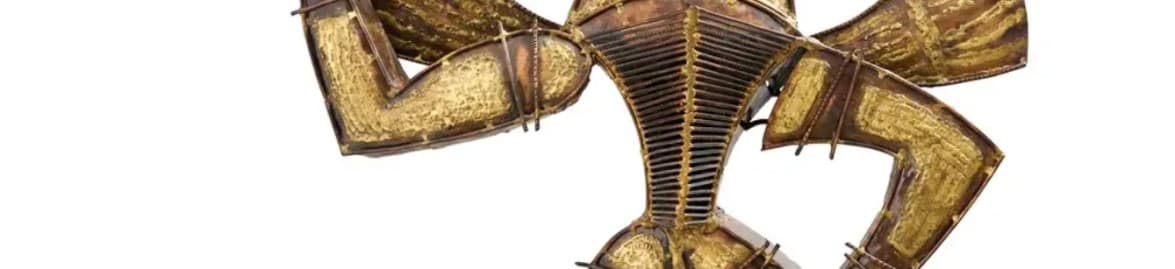
S Nandagopal, born in 1946, was both a product of this environment and a force that transformed it. As the son of Paniker, Nandagopal had grown in the intellectual and artistic currents that defined the Madras Movement. His legacy is not only one of inheritance but also one of reinvention. Nandagopal's background in physics before he took up fine arts gave him a unique approach to his craft. Nandagopal's sculptures, done mainly in copper, brass, and bronze, are characterised by their linear quality, narrative potential, and symbolism. Nandagopal drew his inspiration mainly from the temple traditions of South India, particularly the use of the bas-relief form.
Unlike many sculptors of his time, Nandagopal established a visual vocabulary that was both structured and fluid. His sculptures seemed to have been drawn in space, linear in their approach, both figurative and abstract in their quality. Nandagopal's fusion of the traditional and the modern made him one of the most prominent modern sculptors in India.
A Pillar of Cholamandal
Nandagopal settled in Cholamandal in the early 1970s and became one of the most important inhabitants and eventually the custodian of this village. He was not just an artist working there but an institution builder. His contributions are not just to his own art but to the infrastructure and cultural growth of Cholamandal itself. He has made a major contribution to the strengthening of the exhibition infrastructure in Cholamandal, giving more visibility to established and new artists.
In an era that has seen many artist-led initiatives struggle to stay afloat, Nandagopal’s contributions ensured that Cholamandal remained self-sustaining and remained relevant. His ability to connect with collectors, institutions, and corporate patrons has given visibility and financial support to this commune.
Sculpting a Cultural Ecosystem
 One of the significant aspects of him is his role as a cultural mediator. He realised that art is not something that exists in isolation but lives in a network of dialogue, patronage, and engagement.
Through his initiatives, Cholamandal has moved from being a secluded artists’ retreat to a thriving hub of cultural activity. The addition of galleries, an open-air theatre, and later the Cholamandal Centre for Contemporary Art has transformed this village into a thriving hub of activity.
Another important aspect emphasised by Nandagopal was documentation and archiving. Realising that the history of the Madras Movement was worth preserving, he supported documentation, publication, and exhibition of the works of artists associated with Cholamandal. This has meant that this movement has continued to thrive and is a very important part of Indian art history.
Artistic Philosophy and Practice
However, the crux of his legacy is the philosophy behind his works, a perfect blend of traditional and modern elements. Although his works include images of mythological figures and animals, they cannot be taken literally and are rather appreciated on multiple levels—formal, narrative, and philosophical. There is a specific significance in his use of metal as a medium for his sculptures. In the history of Indian art, metal has been associated with temples and other ritual objects. Nandagopal’s metalworks can be regarded as a revival of the same in modern terms.
Furthermore, the fact that Nandagopal had a background in the field of science has also played a significant role in the development of the forms and structures of the works created by him. This is because the precision of the compositions and the balance of the lines in the works of Nandagopal reflect the application of the principles of physics.
Guardian of a Movement
After the death of Paniker in 1977, it was upon the next generation to carry on the task of sustaining Cholamandal and the ideals of the Madras Movement. Nandagopal was one of its most committed custodians. He carried on with the ideals of self-reliance, living in a community, and artistic integrity in an era where the commercialisation of art and globalisation were taking centre stage. He ensured that Cholamandal retained its unique identity as an artist-driven initiative.
His leadership was not dictatorial. He worked in partnership with his fellow artists, fostering a sense of shared purpose. This cooperation is one of the key defining elements of Cholamandal today.
Recognition and Legacy
Nandagopal’s work had been acknowledged and honoured in India and abroad. A two-time Lalit Kala Akademi Award and Jindal Stainless Steel Award for Sculpture recipient, Nandagopal earned widespread accolades for his artistic works. His works had been showcased in some of the most prestigious national and international art exhibitions in Europe and Asia. These exhibitions had not only earned him accolades but had also put the spotlight on Cholamandal and the Madras Movement in the art ecosystem.
S. Nandagopal passed away in 2017 at his home in Cholamandal, marking the end of an era. Nevertheless, his legacy does not only live through his work; it also lives on in the frameworks he helped create. Today, Cholamandal remains a thriving artist commune, one of only a few remaining in the world. This is a living testimony to the vision of its founders and to the work of artists like Nandagopal who helped sustain it over the years.