


the power of feminine in the works of india’s women artists
Celebrating International women's day
Women artists have been instrumental in not only shaping the narrative of art in India but with their groundbreaking works have expressed the complexities and issues that exist around them. Even when it comes to the imagery of the nude, women artists have gone beyond merely perfect depiction in terms of female beauty and form and have dwelled deeper into the hard realities and dilemmas that women face.
Known as ‘one of the greatest avant-garde women artists of the early 20th century,’ and a ‘pioneer in modern Indian art,’ Amrita Sher-Gil literally and metaphorically changed the trajectory of modern Indian art and put it on the global stage. Born in Hungry in 1931, Sher-Gil started to draw at an early age and her oeuvre heavily inspired by women around her became the cornerstone of her art practice. Drawing from a myriad of experiences, she gave an insight into the lives of women from across social, economic, and cultural strata through the agency of her art.

While in Europe she had acquainted herself with practices of European style painting by creating numerous portraits and studies of nudes with academic pictorial and compositional rules. Heavily influenced by the women around her, she created a large oeuvre of such portraits, often using her friends as sitters to honestly capture them in their vulnerable state. The work that set her path to extraordinary fame and glory was also a similar portrait. Created during the time she was studying at Ecole Nationale des Beaux-Arts in Paris, the work titled ‘Young Girls' depicted her sister Indira and her friend Denise Proutaux in a semi-nude state. With her choice to portray Indira in a dress and her friend Denise topless, Sher-Gil drew a contrast between boldness and demureness in women.

A part of the national collection now, this work won her several accolades including a gold medal at the Grand Salon in Paris. She also became the youngest and the only Asian member ever to join the Salon. Moreover, Sher-Gil painted a number of nude self-portraits. The unabashed confidence with which she portrayed herself and other women in various moods inspired a host of female artists from the coming generations.
One of these is seminal artist Arpita Singh who is known for her vivacious colourful figurative paintings. Born in 1937 in undivided Bengal, Arpita Singh joined Delhi Polytechnic College in 1954 and studied under the tutelage of artists like Biren De, Jaya Appaswany, Sailoz Mukherjee, and B C Sanyal. After completing her diploma in 1959, she co-founded ‘The Unknown’ group in 1960. During this decade, she also worked at weaver’s centre which led to a close observation of India’s indigenous textile traditions.

Starting with black and white abstract works, her visual lexicon witnessed the progression of style and mediums, including a dramatic shift from watercolour to oil. With each composition telling a story of its own, the topography of Singh canvases brims with a complex web of elements drawn from various sources mythology, fiction, Bengali folklore, as well as simple daily life objects. The crisscrossing of these whimsical components often renders a dreamlike feeling to Arpita Singh’s work.
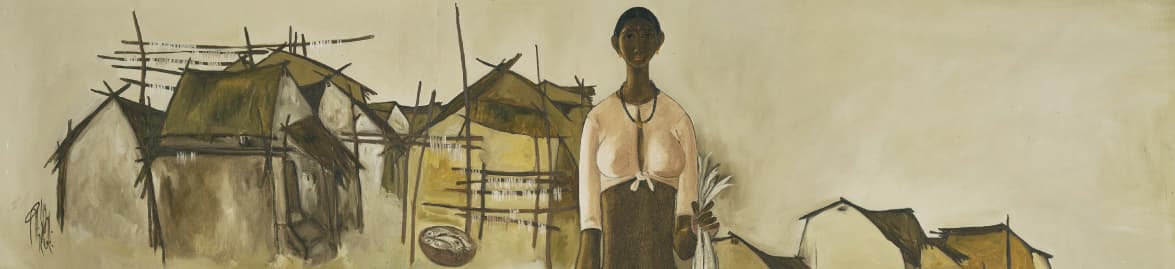
Born in a small village in Maharashtra in 1933, B. Prabha entered the Indian art world when there were few practicing women artists. She first studied at the Nagpur School of Arts and then moved to Mumbai to complete her education at J.J. School of Art.

Dabbling with different mediums before settling on her preferred medium of oil, B Prabha through her career painted on a range of subjects spanning from landscapes to various societal issues like drought, hunger, and homelessness. However, her career was defined by the depiction of women, especially fisherwomen which became the artist’s perennial leitmotif and continuously featured in her work. With their graceful elongated figure, stoic expressions and melancholic gaze, the women featured in B Prabha’s work were evocative of the hardships faced by women in India as they went about living their lives with a dignified silence beguiling their plight. “I have yet to see one happy woman,” she famously said in a 2006 interview. Showcasing her works in more than 50 exhibitions in India and abroad, B Prabha established herself as an iconic female artist of India.

One of the leading artists of India, Anjolie had her first solo exhibition when she was merely 18. Her early influences came from historic western artists such as Van Gogh and Modigliani. Among Indian artists, she was highly inspired by Amrita Sher-Gil and M. F. Husain. Initially studying at the J.J. School of Arts, she moved to Europe in 1959 to study at the Ecole Nationale des Beaux Art in Paris. During her stay, she travelled extensively in Europe exploring Romanesque and Byzantine art. Anjolie Ela Menon is best known for her vibrantly coloured portraits, religious-themed works, and nudes.

Themes of gender and identity form the cornerstone of the art practice by self-professed feminist artist Rekha Rodwittiya. Her nude figures with their unflinching gaze and frontal postures become an ode to the indomitable strength and wisdom of the feminine. The bold and protective demeanour of her female nudes demands from the viewer the acknowledgement of female strength and fragility at the same time.

Bharti Kher's art practice spans over three decades where she has employed a myriad of mediums and materials that are truly unique. She has come to be most famous for her signature style works executed with the use of traditional Indian ‘Bindi’. Since appearing in her work in the year 1995 for the first time, ‘Bindi’ has experienced a subliminal transformation through her art practice. It has become a recurrent motif in her work, through which she connects to the world. One of these works titled “A Letter to My Love,’ is executed with board horizontal lines alternating between strips of shimmering bindis and black matte patches.
Owing to the diversity of their art practices, the women artists have been highly recognised and acclaimed for their works. The works have been showcased in exhibitions at several prestigious museums and galleries across the world. They also continue to be some of the most sought-after artists by seasoned collectors of Modern Indian Art.

With 20 solo shows in India and abroad to her credit, Anju Dodiya has emerged to be a distinguished woman contemporary artist of India. Born in Mumbai in 1964, she started her career with abstract paintings and then found her ultimate inspiration in an inspection of the self. Anju Dodiya’s works draw inspiration from various artistic legacies such as Japanese Ukiyo-e prints, poetry, miniature paintings, mediaeval Renaissance masters as well as European cinema. Renowned for her ‘fictional self-portraits,’ Dodiya creates works that are often autobiographical in nature. Rendered on different textures including mattresses which have come to be the artist's leitmotif, her works give the viewer a glimpse into the life of the protagonist and reveal a process of self-discovery and introspection.




