townscape by lancelot ribeiro
Lancelot Ribeiro is posthumously recognized for his unique experimental approach to his materials. His experimentation with early polyvinyl acetate and conventional oil paints, the forerunners of modern acrylic paints positioned him as “the godfather of generations of artists using acrylics as an alternative to oils.” (The Times, 2011). His work, produced over six decades of an artistic career, embodies a wide range of expressive artworks. It includes surrealist drawings, wood sculptures, miniatures, compositional townscapes, ceramics and graphic art often seeking to convey a literary message.
Lot 109 | Untitled (Townscape)
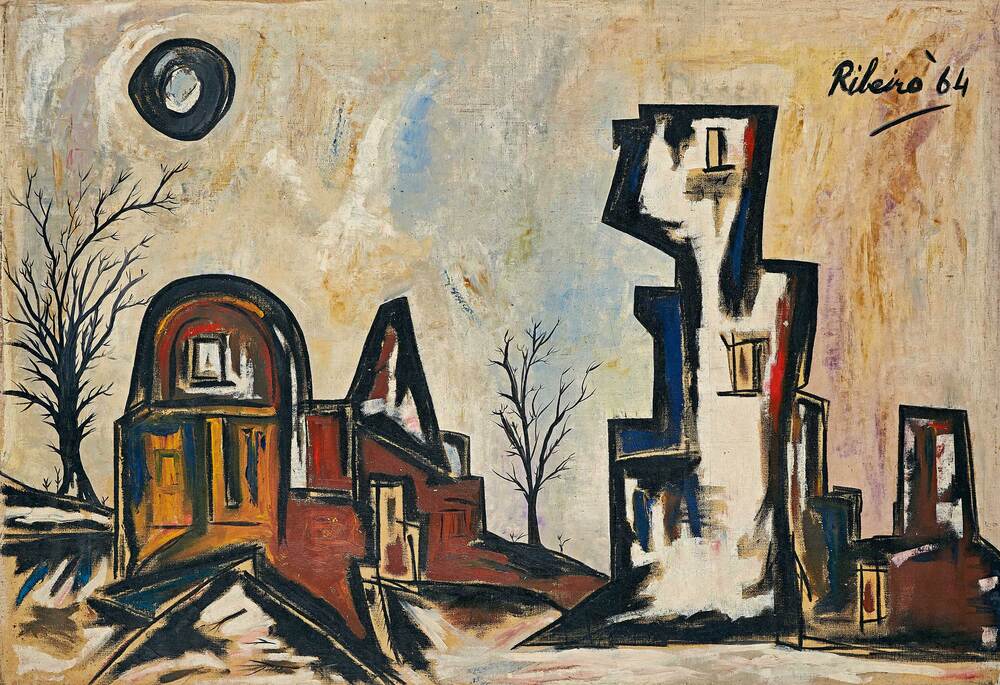
Executed in 1964, a year of prolific experimentation for Ribeiro, this artwork features recurrent motifs one sees in Ribeiro’s landscapes: distinctive Church spires and domes, towers, roofs, and geometric blocks outlined in bold black strokes, with a prominent black sun overhead. The work is a brilliant example of his artistic style. While many of Ribeiro’s later landscapes depicted cities exuding brightness and humour, characterised by oddly angled, teetering cities, his earlier landscapes project a sombre atmosphere with dark, empty surroundings and jagged features, accompanied by spiky, leafless trees.
Lancelot Ribeiro's artistic journey is a compelling narrative of evolution and experimentation, traversing the realms of varied mediums and styles that reflect the depth of his creative exploration. His artistic oeuvre, spanning six decades, was a testament to his relentless pursuit of pushing the boundaries of artistic expression. Lot 109, executed in the prolific year of 1964, captures the essence of Ribeiro's earlier landscape compositions. This artwork stands as a testament to his proficiency in capturing a distinctive ambiance—an atmosphere shrouded in introspection and imbued with a somber tonality. The stark contrast of dark, vacuous spaces populated with angular, jagged features, punctuated by the striking imagery of leafless trees, evokes a sense of isolation and contemplation. The bold strokes delineating Church spires, domes, rooftops, and geometric blocks manifest Ribeiro's signature style, showcasing his mastery in creating complex cityscapes fraught with emotion. Ribeiro's evolution as an artist is perceptible in the transition from these darker, contemplative landscapes to the exuberant vibrancy that characterizes his later works. His artistic journey traversed landscapes that morphed from desolation to a kaleidoscope of whimsical arrangements, teetering cities infused with brightness and humor. This evolution underscores his artistic versatility, where his earlier compositions embodied a mood of melancholy reflection, while his later works pulsated with dynamic energy and playful compositions. Ribeiro's lasting legacy transcends his artistic prowess. He left an indelible imprint on the art world by pioneering the use of materials, particularly his experimentation with early polyvinyl acetate and conventional oil paints, which laid the foundation for the emergence of modern acrylic paints. His innovative spirit and unwavering dedication to artistic experimentation continue to inspire successive generations of artists, positioning him as an iconic figure in the annals of art history. In essence, Lot 109 serves as a poignant encapsulation of Ribeiro's artistic metamorphosis—a bridge between the contemplative melancholy of his earlier works and the vibrant exuberance that defined his later artistic expressions. It stands as a testament to the breadth and depth of Ribeiro's creative journey, inviting viewers into the profound landscapes of his imagination while showcasing his enduring influence on the artistic landscape.
Notably, the influence of Goa's religious architecture is evident in several landscapes featuring squat, broad-fronted churches. It is worth noting that Ribeiro, himself, explained his landscapes were not of actual places but drew inspiration from Europe ‘via the Roman Catholic Church’:
“My first influences were the Churches and Statuary of the Catholic Church in Goa along with the symbolic ritual that went with it.”