victorian tureens: history, use & care tips
.jpg&w=3840&q=75)
Few objects from the Victorian era capture the spirit of that remarkable age quite as eloquently as the tureen. Grand in scale, exquisite in craftsmanship, and deeply embedded in the social rituals of 19th century life, the tureen was far more than a simple serving vessel. It was a statement of taste, wealth, and domestic refinement, a centerpiece of the Victorian dining table that spoke volumes about the household it graced. Today, Victorian tureens are cherished by collectors and antique enthusiasts around the world, prized for their beauty, their historical significance, and the window they offer into a fascinating period of social and artistic history.
History
The tureen as a form predates the Victorian era by well over a century, with its origins traceable to the early 18th century in France. The word itself is believed to derive from the French word "terrine" referring to an earthenware vessel used for cooking and serving. By the early 1700s, silversmiths and potters across Europe were producing large, lidded serving vessels designed specifically for soups and stews, and these pieces quickly became essential elements of the formal dining service among the aristocracy and wealthy merchant classes. The tureen arrived in England during the Georgian period and was enthusiastically adopted by fashionable society, where it became a fixture of the elaborate multi-course dinners that characterised upper-class entertaining.
By the time Queen Victoria ascended to the throne in 1837, the tureen was already a well-established and highly refined object with a century of design evolution behind it. What the Victorian era brought to the tureen was a characteristic exuberance of decoration, an expansion of the materials from which it was made, and a broadening of the social classes that aspired to own and use it. The combination of industrial manufacturing advances, growing middle-class prosperity, and the Victorian passion for elaborate domestic ritual created the perfect conditions for the tureen to flourish as never before.
The Victorian Tureen in Social Context
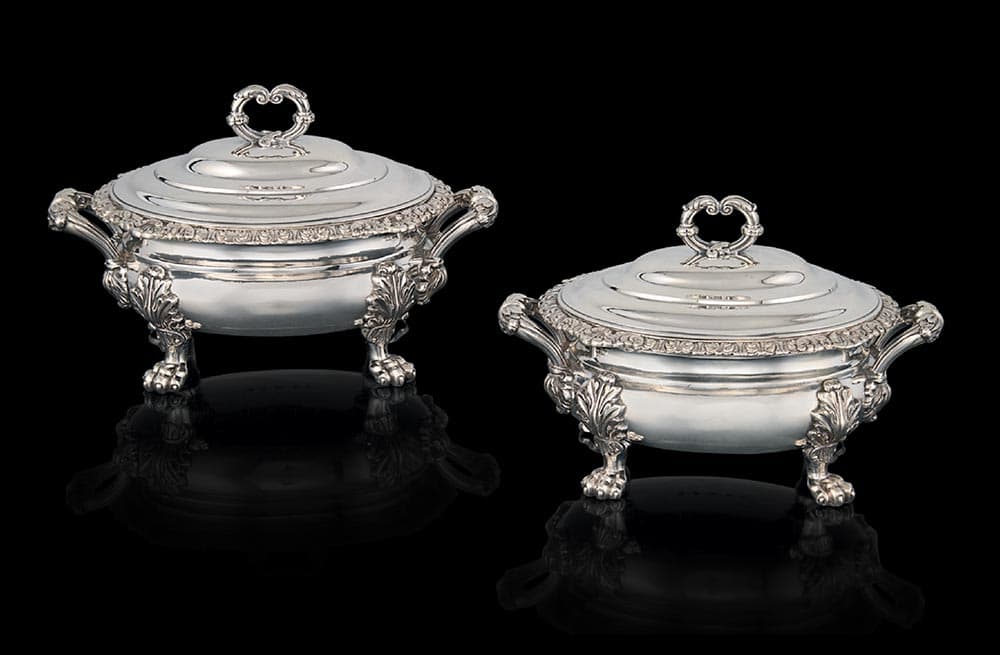 To fully appreciate the Victorian tureen, it is essential to understand the central role that dining played in Victorian social life. For the Victorian middle and upper classes, the dinner table was one of the primary arenas of social performance. The quality of the food, the elegance of the table setting, the refinement of the serving pieces, and the smooth choreography of the meal were all understood as reflections of the household's standing, taste, and moral character. In this context, the tureen occupied a position of particular importance, as it was typically the first substantial serving piece to appear on the table and was expected to make a strong impression.
The Victorian dinner service was a highly codified affair, governed by elaborate rules of etiquette that dictated everything from the order in which dishes were served to the precise manner in which a tureen should be presented and its contents ladled. Soup was invariably among the first courses of a formal Victorian dinner, and the tureen in which it was served was therefore one of the first objects to draw the attention and judgment of guests. A handsome, well-chosen tureen signalled that the meal ahead would be worthy of their presence, while an inadequate or poorly maintained piece could reflect poorly on the entire household.
Materials and Makers
Victorian tureens were produced in a wide variety of materials, reflecting both the diverse tastes of the era and the significant advances in manufacturing technology that characterised the 19th century. Silver and silver plate were among the most prestigious materials, and the great silversmiths of the Victorian period produced tureens of extraordinary quality and ambition. Firms such as Elkington and Company, who pioneered the electroplating process in the 1840s, made it possible for households of more modest means to own tureens with the appearance of solid silver at a fraction of the cost, dramatically expanding the market for these pieces.
Porcelain and ceramics were equally important in the Victorian tureen tradition. The great English pottery manufacturers of the period, including Minton, Royal Worcester, Copeland, and Wedgwood, produced tureens of exceptional beauty and technical accomplishment. These pieces ranged from relatively simple white ironstone examples intended for everyday use to elaborately decorated showpieces featuring hand-painted scenes, gilded borders, and naturalistic modelling of the highest quality. Continental manufacturers, particularly those from Meissen in Germany and Sèvres in France, also produced tureens that were eagerly collected by wealthy Victorian households with a taste for European luxury goods.
Sheffield plate and later electroplated nickel silver, commonly known as EPNS, made presentable tureens accessible to the expanding Victorian middle class. These pieces, while lacking the intrinsic value of solid silver, were often very well made and attractively designed, and they allowed families of comfortable but not extravagant means to participate in the culture of refined dining that was so central to Victorian social aspiration.
Design and Decoration
The design of Victorian tureens reflects the broader decorative tendencies of the era, which were characterised by a rich eclecticism and a love of historical revival styles. The early Victorian period saw a continued enthusiasm for the classical forms that had dominated the Georgian era, with tureens featuring clean oval or circular bodies, elegant loop handles, and restrained decorative borders derived from ancient Greek and Roman ornament. As the Victorian era progressed, however, tastes shifted towards increasingly elaborate decoration, and tureens began to reflect the various historical revival styles that succeeded one another in fashionable Victorian interiors.
The Rococo revival, which reached its height in the 1840s and 1850s, produced tureens of extraordinary exuberance, with sinuously curved bodies, elaborate naturalistic handles formed as branches or animals, and surfaces covered with richly modelled floral and foliate ornament. The Gothic revival brought pointed forms, medieval-inspired tracery, and a more sombre palette to some tureen designs, while the Renaissance revival of the later Victorian period introduced bold sculptural elements, grotesque masks, and strapwork decoration inspired by 16th century metalwork.
The influence of Japanese art, which swept through British decorative arts following the International Exhibition of 1862 and Japan's participation in subsequent international exhibitions, brought a new aesthetic sensibility to tureen design. Pieces inspired by Japanese forms and ornament featured asymmetrical compositions, stylised natural motifs such as bamboo, cherry blossom, and cranes, and a palette of colours quite different from the rich, saturated tones of earlier Victorian decoration. This Aesthetic Movement influence produced some of the most distinctive and visually striking tureens of the entire Victorian period.
Characteristics
Victorian tureens often featured:
• Ornate handles shaped like scrolls, shells, or foliage
• Finials (lid knobs) modeled as fruits, flowers, or animals
• Floral motifs, pastoral scenes, or classical patterns
• Gilded accents and embossed details
• Matching underplates or stands
Materials commonly included bone china, porcelain, and ironstone. Wealthier households favored hand-painted porcelain, while ironstone became popular for its durability and practicality.
Form and Function: How They Were Used
Victorian dining was a marathon, not a sprint. The tureen played a starring role in Service à la Française, where all dishes were placed on the table at once, and later in Service à la Russe, where courses were served sequentially.
• The Soup Tureen: The largest of the family, often accompanied by a matching platter (undertray) to catch drips and protect the table linens.
• The Sauce Tureen: Smaller, often appearing in pairs, these held gravies or specialized sauces to accompany the roast.
• The Presentation: The host or hostess would ceremoniously lift the heavy lid, a signal that the meal had officially begun.
The Decline of the Tureen and Its Rediscovery
The elaborate ritual of the Victorian formal dinner, and with it the central role of the tureen, began to decline in the late 19th and early 20th centuries as social customs changed, domestic service became harder to maintain, and simpler, less ceremonious styles of entertaining became fashionable. The two World Wars accelerated this process dramatically, and by the mid-20th century the grand Victorian tureen had largely retreated from everyday use into the realm of the antique and the collectible.
It is in this role that the Victorian tureen has found a new and enthusiastic audience. Collectors and antique enthusiasts have recognised in these pieces a combination of historical interest, artistic quality, and practical beauty that makes them deeply rewarding objects to own and study. The finest Victorian tureens by notable makers command significant prices at auction, while more modest examples in good condition remain accessible to collectors at a wide range of budgets.
Identifying Authentic Victorian Tureens
For collectors and antique enthusiasts, distinguishing authentic Victorian pieces from later reproductions is essential.
Key Identification Features
• Maker’s Marks - Look for backstamps on the underside. Names like Royal Worcester and Spode often included stamps indicating the year of manufacture.
• Material and Weight - Genuine Victorian ironstone tends to be heavier than modern ceramics.
• Hand-Painted Details - Slight variations in brushwork can indicate authenticity.
• Wear Consistent with Age - Light crazing (fine surface cracks in the glaze) and minor wear on gilding are common signs of age.
When in doubt, consulting an experienced antiques dealer or appraiser is advisable.
Care Tips for Victorian Tureens
Owning a Victorian tureen is a privilege and a responsibility. These are objects that have often survived well over a century of use and storage, and with appropriate care they can continue to give pleasure for many generations to come. The following guidance covers the key aspects of caring for Victorian tureens in the most common materials.
• Silver and Silver Plate. Silver tureens should be cleaned regularly to prevent the build-up of tarnish, which can become increasingly difficult to remove if allowed to develop over a long period. Use a good quality silver polish applied with a soft cloth, working gently in the direction of any surface decoration to avoid obscuring fine detail. After polishing, rinse thoroughly with warm water and dry completely with a soft, lint-free cloth, paying particular attention to any crevices or recessed areas where moisture can collect and cause damage. Silver plate requires the same care as solid silver but should be handled more gently, as aggressive polishing can wear through the plating to expose the base metal beneath. Store silver tureens wrapped in acid-free tissue or in anti-tarnish bags to slow the tarnishing process between uses.
• Porcelain and Ceramic Tureens. Porcelain tureens should be handled with great care, particularly around handles, finials, and any applied decorative elements, which are the most vulnerable parts and the most likely to have been repaired at some point in the piece's history. Wash by hand in warm water with a mild detergent, never in a dishwasher, and dry thoroughly before storage. Avoid sudden changes in temperature, which can cause thermal shock and cracking. When displaying porcelain tureens, ensure they are placed on stable, padded surfaces and away from areas where they might be knocked or vibrated. If a piece shows evidence of old restoration, seek the advice of a professional conservator before attempting any cleaning, as some cleaning agents can dissolve or discolour restoration materials.
• Electroplated Tureens. EPNS and other electroplated tureens should be cleaned in the same manner as silver plate, with particular care taken to avoid abrasive polishes or cloths that could damage the plating. These pieces are generally more robust than fine porcelain but should still be handled and stored with care. Check periodically for signs of the plating lifting or wearing through, particularly on high-contact areas such as handles and rims, and consult a specialist if replating is being considered.
• Storage and Display. Whatever the material, Victorian tureens benefit from being stored and displayed thoughtfully. Avoid direct sunlight, which can fade colours and damage gilding over time. Ensure that lids are stored safely, either resting on the tureen itself with appropriate padding between lid and body, or stored separately in a padded container. When moving tureens, always support the body rather than lifting by the handles, which may be more fragile than they appear, particularly on older or previously repaired pieces.
• Professional Conservation. For pieces of significant value or with existing damage, the advice and assistance of a professional conservator is always worthwhile. A qualified conservator can assess the condition of a piece, carry out sympathetic cleaning and stabilisation work, and advise on the best long-term care and storage strategies. Attempting to repair damage or carry out intrusive cleaning without professional guidance can cause irreversible harm to pieces that may be both financially valuable and historically irreplaceable.
With appropriate care and attention, a Victorian tureen can remain a source of beauty, historical interest, and genuine pleasure for many years to come, continuing the long tradition of admiration that these remarkable objects have inspired since they first graced the dining tables of Victorian England.
Why Victorian Tureens Still Matter
Victorian tureens embody the intersection of art, industry, and social ritual. They reflect a period when dining was ceremonial and craftsmanship was celebrated. Whether displayed in a china cabinet or used at a modern dinner table, these pieces continue to tell stories of tradition and elegance. For collectors, decorators or history enthusiasts, a Victorian tureen offers a tangible connection to a richly detailed past, one where even a simple bowl of soup was an occasion for beauty and ceremony.