


viewing the mahatma through a contemporary lens
Mohandas Karamchand Gandhi, a global icon for peace, was without a doubt an enigma. He garnered admiration with respect and humility and led millions in their fight for freedom. Not only did he inspire a generation of leaders like Martin Luther King and Nelson Mandela, but also served as a remarkable muse for various artists in India and across the world. Their veneration for Gandhi, propelled by their personal interactions and interpretations of him have led to the creation of several works of art and sculptures that continue to celebrate his legacy.
 Nandalal Bose, a pioneer of Indian modernism shared a close relationship with Gandhi. He recognized that Gandhi’s image had the power to unify the country during the freedom struggle and created one of the most iconic portraits of Gandhi at the time. A. Ramachandran’s seven-foot plus bronze sculpture of Gandhi is a poignant depiction of his last moments. On its back, the sculpture has a bullet hole and Gandhi’s famous parting phrase ‘Hey Ram’ engraved. Modern masters like M.F.Husain, S.H.Raza and Ramkinkar Baij have also paid tribute to the Mahatma through their works.
His charismatic appeal continues to stay relevant to the socio-political dynamics of the modern world. At the same time, it permeates the artistic sensibilities of thinkers, artists and influencers alike, who look up to him for insight and leadership.
Gandhi’s extraordinary persona has been an inspiration to several contemporary artists like Atul Dodiya, Debanjan Roy, Debraj Goswami and Shahabuddin Ahmed, whose Gandhi-inspired works will be featured at AstaGuru’s upcoming Present-Future auction, India’s largest Contemporary Art auction slated to be held on the 10th & 11th of February this year. Atul Dodiya is one of India’s senior-most contemporary artists and has created various works with Gandhi as his muse. Part of our upcoming auction is a work from the year 2006, titled ‘Fallen Leaves-A Stroll #5. The lot (No.72) features a portrait of Gandhi alongside other prominent political figures like Winston Churchill and Nelson Mandela, in a series of works painted in oil on dried leaf. The presented lot was a part of his exhibition titled: Hungry God India Contemporary Art at Arario Beijing, and published in its catalogue.
As a matter of fact, it was his series of watercolour paintings of Mahatma Gandhi’s forgotten biography in 1999 that shot him to prominence in the contemporary art scene, which makes Gandhi a subject of immense importance to the artist.
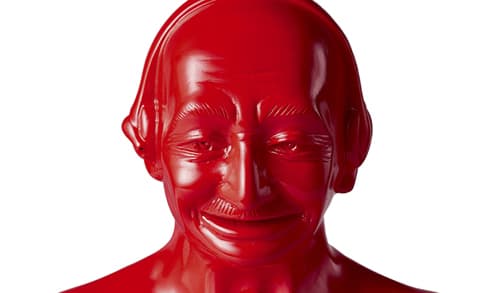
Gandhi is not just limited to a painted surface, but has also inspired sculptors alike. Debanjan Roy, famously known for his Gandhi sculptures, has featured Bapu in his works throughout his career. The featured lot (No.10) showcases M.K.Gandhi with a pair of Bluetooth headphones. The freedom fighter was famously known to shun technology as harmful and oppressive. The sculpture, therefore acts as a juxtaposition of Gandhi’s memory in today’s hyper-technological environment. Roy has painted the sculpture in red, equating it with our inner primal energy which is raw and fierce. It therefore, serves as an irony, since Gandhi stood for ahimsa.
 A painting by artist Shahabuddin Ahmed, featuring the father of the nation will also be presented at the auction (Lot No.101). As opposed to using his signature brushwork technique where his subjects are often in motion, Shahabuddin instils a sense of calm into this work which acts as a reflection of Gandhi’s peaceful demeanour. It is not often that Shahabuddin Ahmed paints iconic personalities, which makes this piece a rare offering and, in some ways, acts as a testament of Gandhi’s impact and reach on the art world outside India.
Another work representing Gandhi is an artwork titled: Gandhipin by Debraj Goswami. An artist from West Bengal, Goswami constructs images in a photorealistic manner to convey serious messages using metaphors. The presented lot (No.36) depicts the father of the nation standing on the clip of a safety pin, while he takes support of the needle as though it functions as his walking stick.
Mahatma Gandhi possessed a strong sense of aesthetics, he had a refined artistic way of doing things, whether it was the choice of his clothes or the architecture of his ashram. There was a poignant depth to his ‘’minimalist’’ way of living which strongly resonates with the aesthetic sensibilities of art and make him a loved, revered and an immensely respected icon to millions around the world.
View our catalogue to see these evocative works and register to bid in the auction today




