


what is mithila art? know about its importance in 2025
Your Ultimate Information Guide to Mithila Painting of Bihar
Mithila art, commonly known outside India as Madhubani painting, is a vibrant folk art tradition originating in the Mithila region of northern Bihar (India) and parts of Nepal. Characterized by bold lines, dense patterns, bright natural colors and strong narrative content, Mithila art has been practiced for centuries, traditionally by women on the walls and floors of village homes to mark rituals, life cycle events, and seasonal festivals. Over time it has moved from domestic surfaces to paper, cloth, and canvas, gaining national and international recognition for its visual richness and cultural depth.
History & Origin
Mithila art traces its roots to ancient Mithila (also called Videha), a historical and cultural region referenced in early Hindu texts and epics. According to local tradition, the practice of wall and floor painting in Mithila is at least as old as the kingdom of Janaka, Sita’s birthplace in the Ramayana, where brides were said to paint their natal homes. Historically, these paintings were integral to domestic ritual: decorating houses during weddings, births, agricultural festivals, and religious observances. Passed down generation to generation through women’s practice, the art encoded social memory, religious belief, and communal identity.
1934 Earthquake and Paper Revolution
A pivotal moment in the modern history of Mithila art occurred after the 1934 Bihar earthquake. The disaster damaged many dwellings, prompting relief efforts and new interactions between local artists and outsiders. British and Indian social reformers, along with art historians and craft promoters, encouraged Mithila women to transfer their murals from walls to portable supports, especially handmade paper. This transition enabled the art to be exhibited, sold, and preserved beyond village boundaries. The paper revolution both safeguarded an indigenous art form and altered its social economy: women could now earn income from selling paintings, which broadened the art’s audience and led to the emergence of named artisans and collective studios.
Styles
Mithila art encompasses several distinct stylistic schools that vary by region, community, and the social function of the painting. Major recognized styles include:
• Bharni: Known for its bold use of color to fill areas, often used in narrative scenes and devotional images.
• Katchni: Characterized by intricate line work and cross-hatching; minimal use of color, with emphasis on detailed patterns.
• Tantrik: Focuses on religious and esoteric imagery, yantras, deities, and iconography associated with Tantra and ritual practice.
• Godhri: Raw, rustic style from certain rural pockets emphasizing naive figures and strong outlines.
• Kohbar: Specific to wedding chamber (kohbar) paintings; highly symbolic and ritualized imagery celebrating fertility and marital bliss.
These styles sometimes overlap and are not rigidly bounded, and artists may combine approaches depending on subject and commission.
Characteristics
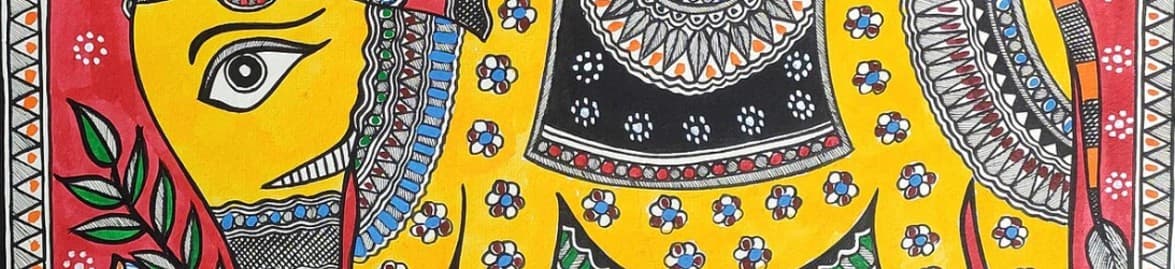
• Horror Vacui: The artist leaves no space empty; gaps are filled with flowers, birds, or geometric designs.
• Two-Dimensional: The paintings lack depth or shading, giving them a flat, iconic appearance.
• Double Outlines: Figures are almost always enclosed in double lines, with the space between filled with fine strokes.
Themes
Thematically, Mithila art spans sacred and secular spheres:
• Religious and mythological narratives: Scenes from the Ramayana, Mahabharata, Krishna lore, and local deities.
• Ritual and life cycle events: Births, naming ceremonies, weddings (kohbar), and mourning rites.
• Nature and everyday life: Agriculture, animals, birds, domestic scenes, festivals.
• Cosmological and fertility symbolism: Yantras and symbolic depictions of creation, fertility, and prosperity.
• Contemporary concerns: In modern practice, artists increasingly depict social issues, women’s rights, environmental themes, political events, and health awareness.
Motifs
Certain motifs recur across Mithila paintings, each carrying cultural meaning:
• Fish: Fertility and prosperity, also a common wedding motif.
• Parrots and peacocks: Love, beauty, seasonal change.
• Lotus: Purity, spiritual awakening.
• Elephants and horses: Power, royal connection, auspiciousness.
• Tree of life: Life, continuity, and ancestral connections.
• Sun, moon, and geometric yantras: Cosmic order and auspiciousness.
• Scenes of domestic rituals: Brides, grooms, and familial gatherings, especially in kohbar panels.
Painting Techniques
Traditional technique begins with surface preparation and linear drawing, then moves to filling and embellishment:
• Surface: Historically earthen walls and floors; post 1930s, handmade paper, cloth, canvas, and board.
• Outlining: Artists sketch primary motifs with twigs, brushes, or pen like tools; black outlines produced with soot, lampblack, or ink.
• Pigments: Derived from local materials such as turmeric (yellow), indigo (blue), powdered red earth or vermilion (red), soot (black), cow dung or clay washes (base coats). Later, commercial paints and synthetic dyes have been adopted by many artists.
• Filling: Flat blocks of color fill outlined shapes. In katchni, fine parallel or cross hatching replaces color blocks to create texture.
• Detailing: Backgrounds and empty spaces are filled with repetitive ornamental patterns, dots, lines, checks, and floral motifs, creating the art’s signature dense texture.
• Tools: Brushes made from bamboo pens, twigs, or modern brushes and nibs; sometimes earthen implements for texture.
Famous Artists
While Mithila art was historically anonymous and collective, several artists have become prominent in the modern era. Names below are illustrative, and many local artists have achieved recognition through exhibitions and awards:
• Mahasundari Devi: A National Awardee known for her devotional and kohbar paintings and for promoting Mithila techniques.
• Sita Devi: One of the earliest women painters to gain national attention in the 1960s and 1970s.
• Ganga Devi: Celebrated for large scale narrative works and for blending tradition with personal expression.
• Baua Devi: Recognized internationally; represented Mithila art in exhibitions and helped preserve traditional motifs.
Famous Paintings
While many works are individual interpretations, certain compositions are iconic:
• Kohbar: The wedding chamber mural featuring a central lotus and bamboo stalk.
• Krishna Leela: Depictions of Lord Krishna playing the flute or dancing with the Gopis.
• Ram-Sita Swayamvar: The scene of the divine wedding that mirrors the art's own origin story.
Significance
Mithila art is significant on multiple levels:
• Cultural identity: It is a living repository of Mithila’s myths, rituals, and social history.
• Gendered labor and empowerment: Historically practiced by women within domestic spaces, its commercialization post 1934 provided income opportunities and public recognition for women artists.
• Artistic value: The art’s formal sophistication, its use of pattern, color, and narrative economy, places it as a major Indian folk art tradition.
• Anthropological and linguistic value: Paintings function as visual documents that record local customs, dress, festival practices, and social values.
Legacy and Influence
Mithila art has influenced and been referenced in various cultural domains:
• Contemporary art: Modern Indian artists have drawn inspiration from Mithila’s lines, motifs, and narrative forms.
• Applied arts and design: Motifs adapted to textiles, home decor, fashion, and commercial products.
• Cultural diplomacy: Exhibitions and cultural exchange programs have promoted Mithila painting internationally.
• Education and scholarship: Growing academic interest has led to documentation, conservation efforts, and museum collections that preserve older works.
Modern Revival and Global Reach
Since the mid 20th century, Mithila art experienced revival and adaptation:
• Institutional support: NGOs, government craft boards, and cooperatives helped train artists, standardize paper production, and market works.
• Festivals and exhibitions: International shows in Europe, North America, and Asia have showcased Mithila paintings, increasing global appreciation.
• Fusion and innovation: Contemporary artists experiment with new media such as acrylics and digital prints, larger formats, and cross cultural themes while retaining core motifs.
• Commercialization: Tourists, collectors, and design markets now support a substantial cottage industry, though this brings challenges of authenticity, mass production, and fair compensation.
• Digital presence: Online platforms and social media connect artists to global buyers and enable virtual exhibitions.
Interesting Facts
• Traditionally, Mithila painting was strictly a female domain; men only began to participate in the 20th century as the art moved into commercial markets.
• Many Mithila artists continue to use natural pigments prepared from household or locally sourced materials, though synthetic colors are widespread today.
• The kohbar chamber paintings for weddings follow strict symbolic codes, and certain motifs such as fish, lotus, and bamboo are preferred for their auspicious connotations.
• UNESCO has recognized the cultural importance of Madhubani practices in some programs and by supporting cultural initiatives, though official listings vary by program.
• Artists sometimes paint entire scenes in continuous narrative strips, akin to a visual storytelling scroll, recounting episodes from epics or local myths.
• The 1934 earthquake is often credited with catalyzing the shift from ephemeral wall art to portable works on paper, enabling Mithila art’s modern preservation and market.
Conclusion
Mithila art is a living, adaptive folk tradition that bridges ritual and commerce, domestic practice and public recognition. Rooted in the cultural world of Mithila, its myths, festivals, and household rhythms, it expresses complex social meanings through deceptively simple visual grammar: bold outlines, dense patterns, vivid color, and narrative clarity. From village kohbar walls to international galleries, Mithila painting continues to evolve, sustaining its heritage while engaging new audiences and media. Its story is one of artistic resilience, an intimate, communal practice that became a symbol of regional identity and a canvas for women’s creativity on the world stage.
Image Credit:
“Craft-3-from-Sunaina-Thakur”, Shrishej, via Wikimedia Commons
– Public Domain.




