xu beihong - galloping horse (1947) | overview
.jpg&w=3840&q=75)
The painting Galloping Horse (1947) is one of the celebrated works by the Chinese modern artist Xu Beihong. The artist is widely known for his expressive depictions of horses, which became a defining theme in his artistic career. Through these paintings, Xu combined traditional Chinese ink painting with Western realist techniques, creating powerful images that convey energy, movement, and vitality. His horse paintings are often interpreted as symbols of strength and national spirit.
Artist Background
Xu Beihong is widely regarded as one of the founders of modern Chinese art. Born in Jiangsu Province in 1895, he received early training in calligraphy and traditional Chinese painting from his father. Later, he studied in Europe, especially in France, where he learned Western academic realism and sketching techniques.
After returning to China in 1927, Xu devoted himself to art education and artistic reform. His goal was to modernize Chinese painting by integrating Western methods of anatomy, perspective, and shading while maintaining the expressive qualities of Chinese ink traditions.
Artwork Details
• Artist: Xu Beihong
• Title: Galloping Horse
• Year: 1947
• Medium: Ink on paper
• Size: 43 × 24 in (109.2 × 61 cm)
The painting is executed using ink on paper, a traditional medium in Chinese painting. The work presents a dynamic horse captured in mid-gallop, with its hooves lifted and its mane flowing as if propelled by speed. The minimal background emphasizes the movement and muscular structure of the horse, drawing the viewer’s attention entirely to the animal’s energy and form.
Description and Composition
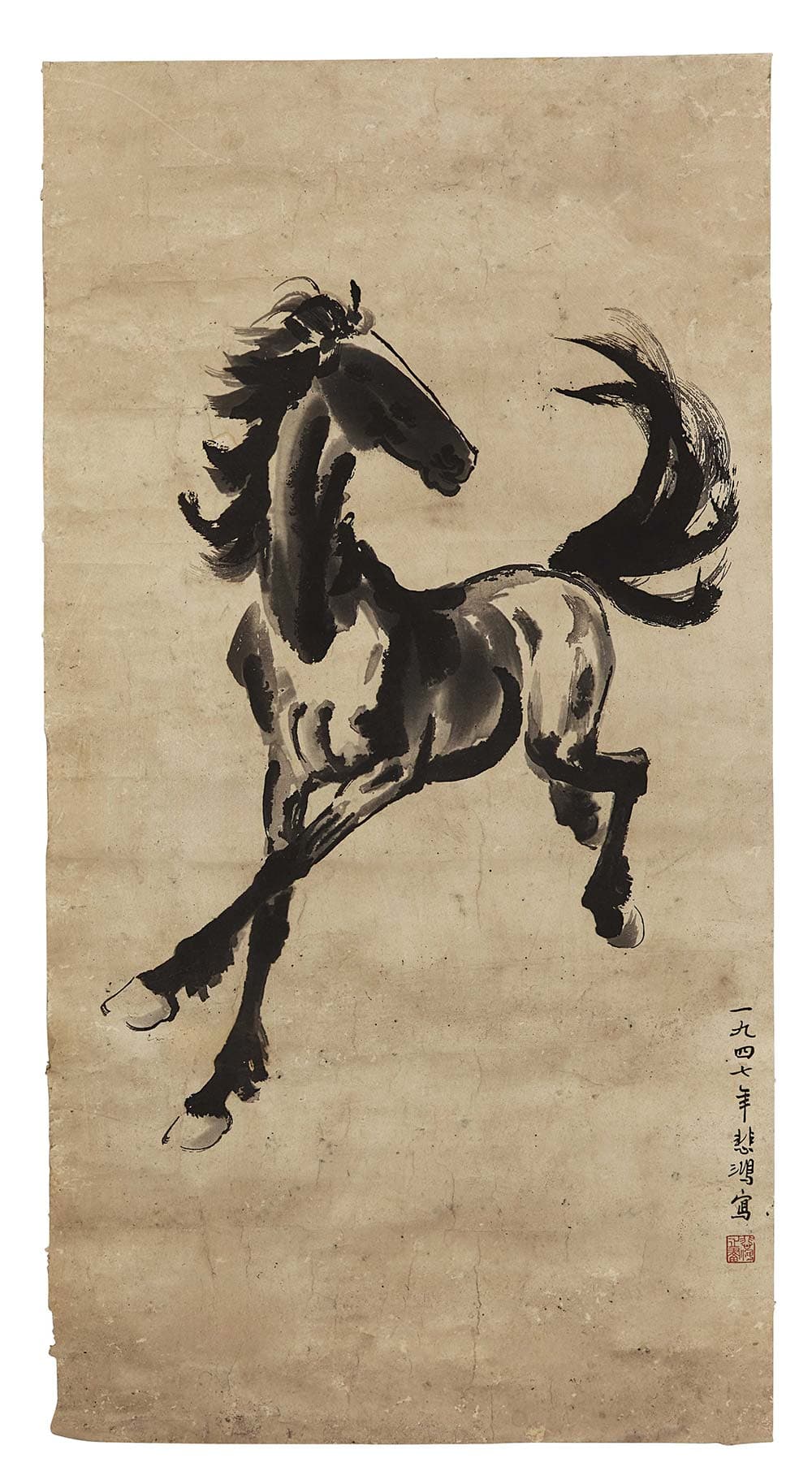 In Galloping Horse, Xu Beihong uses bold, fluid brushstrokes to shape the body of the horse. The dark ink lines define the animal’s powerful anatomy, while variations in tone create depth and movement. The horse appears suspended in motion, conveying both elegance and strength.
The composition is deliberately simple. Rather than filling the background with scenery, Xu leaves much of the space blank. This technique, common in Chinese ink painting, directs attention to the subject and enhances the sense of speed and vitality. The painting also includes the artist’s inscription and seal, traditional elements that authenticate the work and connect it to Chinese calligraphic traditions.
Artistic Style
Xu Beihong’s artistic style reflects a unique synthesis of Eastern and Western traditions. During his studies in Europe, particularly in France, he learned academic drawing techniques and realism. After returning to China, he applied these methods to traditional Chinese brush painting.
As a result, his horse paintings demonstrate both careful anatomical observation and expressive brushwork. The strong lines and simplified forms show the influence of Chinese ink painting, while the accurate musculature and sense of motion reveal Western realist training.
Symbolism
Horses in Chinese culture often symbolize courage, endurance, and power. Xu Beihong used the image of the galloping horse as a metaphor for resilience and determination. Many of his horse paintings were created during times of political and social upheaval in China, and they came to represent the spirit of perseverance and national vitality.
Significance
The Galloping Horse series remains one of the most iconic subjects in modern Chinese art. Xu Beihong’s paintings of horses are admired for their expressive energy, technical mastery, and symbolic meaning. Today, these works are highly valued in museums and international art auctions, reflecting the artist’s lasting influence on twentieth-century Chinese painting.
Overall, the 1947 Galloping Horse exemplifies Xu Beihong’s ability to combine tradition and innovation. Through the simple yet powerful image of a horse in motion, the artist created a timeless representation of strength, freedom, and artistic vitality.