


xu beihong: what made him the father of modern chinese painting
.jpg&w=3840&q=75)
Who is the father of Chinese painting?
"Xu Beihong is called the father of modern Chinese painting because he transformed the tradition, integrated Western techniques & trained a generation of artists."
In the turbulent early decades of the twentieth century, as China grappled with dynastic collapse, foreign invasion & the urgent search for a new national identity, one man picked up a brush & changed everything. Xu Beihong, painter, teacher, reformer & patriot, did not merely create art. He reimagined what Chinese painting could be, what it should say & who it should speak to.
Born into poverty in 1895 and dead by 1953, Xu Beihong lived barely fifty-eight years. Yet in that time he produced thousands of paintings, trained a generation of China's most important artists, and laid the foundations for an entirely new tradition. Today his name is synonymous with modern Chinese art, and his galloping horses remain among the most recognizable images in the world. But the story of how a poor boy from Jiangsu province became the father of modern Chinese painting is far more dramatic, and far more meaningful, than his fame alone suggests.
"He did not merely create art. He reimagined what Chinese painting could be, what it should say, and who it should speak to."
A Childhood Forged in Hardship
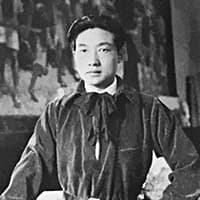 Xu Beihong was born on July 19, 1895, in Yixing, a small town in Jiangsu Province. His father, Xu Dazhang, was a self-taught painter who scraped a living teaching calligraphy and art to the local gentry. It was from his father that young Beihong received his earliest lessons: learning to grind ink, to hold a brush, and to understand that art was not a luxury but a discipline demanding total commitment.
The family was chronically poor, and by his early teens Xu Beihong was already helping to support them by selling his own paintings. At the age of seventeen, his father fell ill, and Xu Beihong shouldered the full weight of the household, painting portraits, teaching children, and working wherever he could find employment. When his father died in 1915, he was left entirely on his own, a young man of twenty with prodigious talent and almost nothing else.
This early experience of hardship was not merely biographical background. It shaped the core of Xu Beihong's artistic vision. He understood suffering, not abstractly but viscerally, and he would spend the rest of his life making art that connected with ordinary human experience. His was never going to be an art of pure formal refinement, detached from the world. It was always going to be an art with something urgent to say.
Shanghai, Paris, and the Encounter with Europe
In 1915, Xu Beihong made his way to Shanghai, then the most cosmopolitan city in China and the gateway to the wider world. He enrolled briefly at Tongji University but found his way more decisively into the city's artistic circles, eventually attracting the patronage of Cai Yuanpei, one of China's greatest educators and the future president of Peking University. It was Cai who would prove instrumental in sending Xu Beihong abroad.
After a brief and frustrating stint in Japan, Xu Beihong arrived in Paris in 1919, where he would spend the better part of a decade. He enrolled at the prestigious École nationale supérieure des Beaux-Arts, immersed himself in the Western tradition, and worked with relentless, almost obsessive discipline. He studied the great masters, including Rembrandt, Velázquez, and Rubens, and trained rigorously in academic oil painting, life drawing, and the technical principles of European realism.
This was a deliberate strategic choice, not mere admiration. Xu Beihong had looked at the state of Chinese art and concluded that it had grown rigid and formulaic. The literati tradition, for all its refinement, had become locked in repetition, with painters copying old masters, reproducing approved subjects in approved styles, with little room for the fresh observation of nature or the direct expression of human feeling. What China needed, he believed, was a transfusion of rigorous technical training and the Western commitment to depicting reality with honest precision.
Yet Xu Beihong was never simply captivated by Europe. He remained profoundly Chinese in his sensibility, and he returned from Paris not as a convert to Western art but as a synthesizer, a man who had absorbed what he needed and was determined to bring it home to serve China's own artistic tradition.
"He had absorbed what he needed and was determined to bring it home: not to replace Chinese tradition, but to renew it."
The Synthesis: East Meets West on the Painter's Canvas
The great achievement of Xu Beihong's mature art was his fusion of Chinese and Western traditions into something wholly original. He applied the observational rigor of European academic painting, including careful study of anatomy, attention to perspective, and mastery of light and shadow, to subjects and media drawn from the Chinese tradition. His ink paintings of horses, eagles, and lions have the muscular vitality of Western life studies but are executed with the fluid, spontaneous brushwork of the Chinese literati.
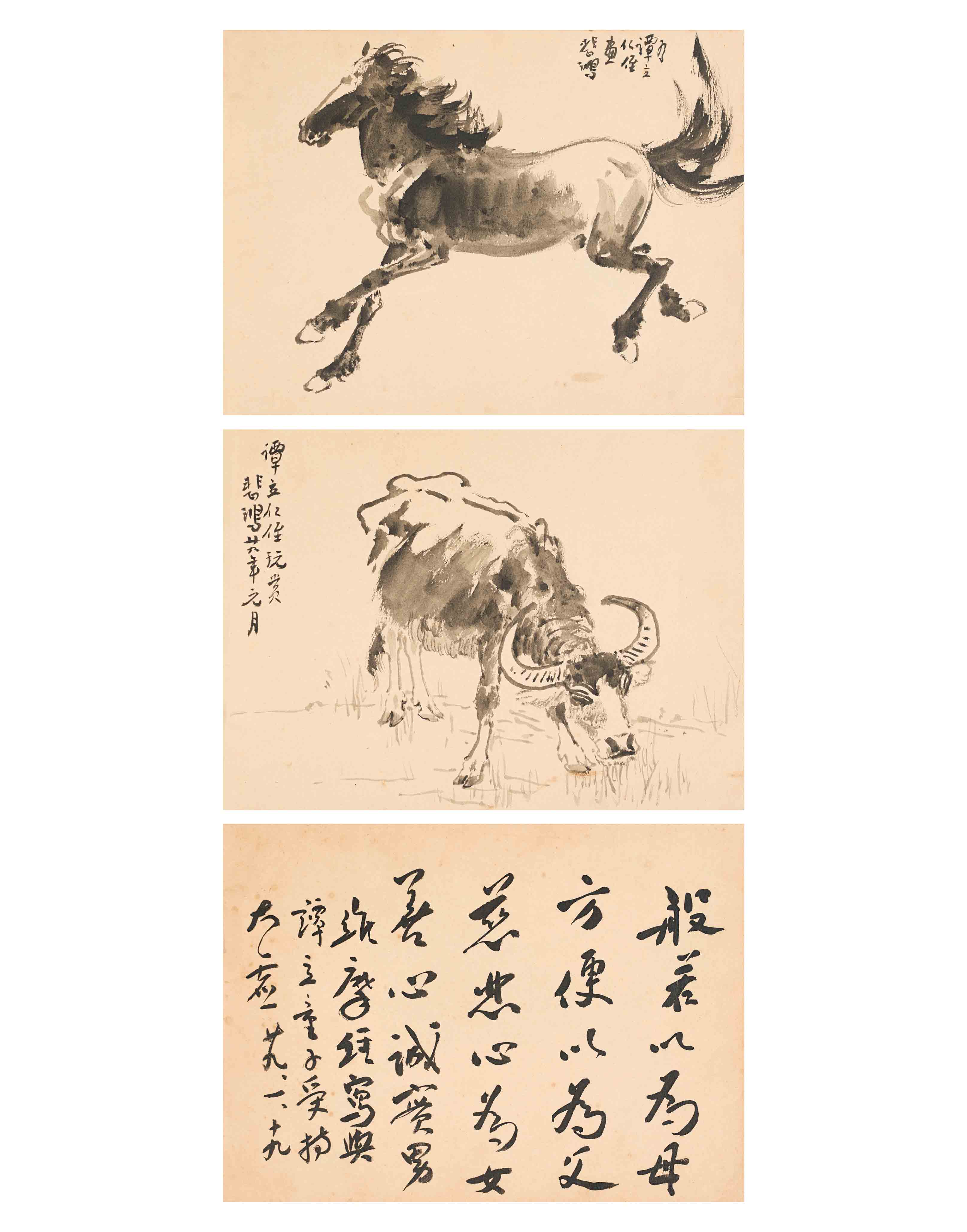 His horses, in particular, became iconic. Painted with extraordinary economy and energy, they convey the impression of raw power and freedom with just a few decisive strokes. They are not photographic in their accuracy but rather expressive in their essence, capturing the spirit of the animal rather than a mere likeness. These were not decorative objects for the scholar's study. They were images of life, energy, and will, speaking directly to a people yearning for national regeneration.
Alongside his ink paintings, Xu Beihong produced major figurative works in oil on a scale and ambition that had simply no precedent in Chinese art. His enormous historical canvases, depicting scenes from Chinese myth, history, and contemporary life, brought the compositional grandeur of European painting to Chinese subjects. Works such as 'Tian Heng and His Five Hundred Warriors' and 'The Foolish Old Man Who Removed the Mountains' combined Western technical mastery with deeply Chinese moral and philosophical content.
In this way, Xu Beihong did something genuinely new: he created a form of modern Chinese painting that was neither a simple imitation of the West nor a retreat into traditional forms, but a genuine synthesis, confident enough to draw on both traditions and strong enough to transcend them both.
Reformer and Educator: Rebuilding Chinese Art from the Ground Up
If Xu Beihong's paintings alone had been his legacy, he would still be remembered as one of the great artists of the twentieth century. But his impact was multiplied many times over by his extraordinary work as an educator and institutional reformer.
Returning from Europe in the late 1920s, Xu Beihong threw himself into the project of reforming Chinese art education. He became dean of the Art Department at the Central University in Nanjing, and later, after the founding of the People's Republic, the first president of the Central Academy of Fine Arts in Beijing, a position he held until his death. At both institutions, he championed rigorous training in life drawing and observational skills, insisting that Chinese artists must learn to truly see before they could truly paint.
He was often controversial. His insistence on incorporating Western academic methods put him in conflict with more conservative colleagues who believed the Chinese tradition was sufficient in itself. He responded to his critics with characteristic bluntness, arguing that Chinese art had stagnated precisely because it had become too inward-looking, too comfortable with inherited formulas. To revive it, he insisted, Chinese painters must be willing to learn from the world.
The students he trained, and they numbered in the thousands over his long career, went on to become the foundational figures of modern Chinese art. His pedagogical vision shaped not just a generation but an entire national tradition. In this sense, calling him the father of modern Chinese painting is not merely a title of honor. It is a statement of literal fact.
Art in the Service of the Nation
Xu Beihong's life unfolded against the backdrop of one of the most turbulent periods in Chinese history. He lived through the fall of the Qing dynasty, the chaos of the warlord era, the Japanese invasion, World War II, and the Communist revolution. Throughout all of it, he understood his art as fundamentally connected to the fate of his country.
During the Second Sino-Japanese War, Xu Beihong traveled to Southeast Asia and India, holding exhibitions and auctions to raise funds for Chinese war relief. In Singapore, Penang, and Kuala Lumpur, he sold paintings and donated the proceeds, demonstrating that art could be a form of patriotic action as direct and practical as any other.
His paintings from this period reflect his anguish at China's suffering. The image of the galloping horse, always his most personal subject, took on new meaning in the context of war and occupation. The horse, in Chinese tradition, symbolizes freedom, nobility, and the heroic spirit. For Xu Beihong, painting horses in those years was a way of asserting that China's spirit could not be broken, that beneath the suffering there remained an irrepressible vitality waiting to run free again.
"The horse, in Chinese tradition, symbolizes freedom and the heroic spirit. For Xu Beihong, painting them was an act of defiance."
The Museum, the Collection, and the Legacy
Xu Beihong was also an extraordinary collector. Throughout his life, wherever he had the means to do so, he acquired works of Chinese art, including ancient bronzes, calligraphy, and paintings, that he feared might otherwise be lost or sold abroad. He regarded this collecting not as personal accumulation but as a form of cultural stewardship, preserving China's artistic heritage for future generations.
After his death in 1953, his widow Liao Jingwen donated the entirety of his personal collection, along with more than a thousand of his own works, to the Chinese government. This collection became the foundation of the Xu Beihong Museum in Beijing, which opened in 1954 and remains one of the most important art institutions in China today. It is a fitting monument to a man whose vision was always larger than himself.
His legacy extends far beyond any single museum, however. The principles he established, including the integration of Western technical discipline with Chinese artistic values, the insistence on direct observation of nature, and the belief that art must serve the people and speak to their deepest aspirations, became the bedrock of modern Chinese painting. His influence is visible in the work of artists across China to this day, whether they acknowledge it explicitly or not.
Why He Endures
In an era of rapid change and fierce debate about what Chinese culture should become, Xu Beihong offers a model that remains remarkably relevant. He showed that tradition and modernity are not opposites. He demonstrated that learning from the world does not require abandoning one's roots. He proved that rigorous technical discipline and passionate emotional expression are not in conflict but can reinforce each other.
His horses still gallop across gallery walls with the same urgent energy they had when he first painted them nearly a century ago. They carry within them the longing for freedom, the love of one's homeland, and the conviction that beauty, even in the darkest times, is worth fighting for. For all of this, Xu Beihong deserves his title. He was not simply the best Chinese painter of his generation. He was the man who, through his art and his life, made modern Chinese painting possible.




