a ramachandran yayati series - a tale of desire & renunciation

A Ramachandran's interpretation of the mythological figure Yayati offers a profound exploration of human desires, the consequences of indulgence and the ultimate quest for spiritual redemption. This article delves into the significance of Yayati in Hindu mythology and how Ramachandran's artistic vision brings this ancient tale to life.
The Myth of Yayati
King Yayati is a significant figure in Hindu mythology, known for his complex journey from indulgence to renunciation. He is the son of King Nahusha and Queen Viraja, belonging to the Chandravanshi (Lunar Dynasty) lineage. Yayati's story is narrated in the Mahabharata, Bhagavata Purana, and Matsya Purana, highlighting his pursuit of worldly pleasures and the eventual realization of their futility.
The Story of Yayati
Yayati married Devayani, the daughter of Shukracharya, the guru of the Asuras (demons), and also took Sharmishtha, a princess and Devayani's maidservant, as his mistress. This relationship led to a curse from Shukracharya, who condemned Yayati to premature old age. In a desperate attempt to regain his youth, Yayati asked his sons to bear his old age in exchange for their youth. Only Puru, the youngest and most virtuous, agreed to this sacrifice.
With his youth restored, Yayati indulged in worldly pleasures but eventually realized that desires are insatiable. He famously remarked, "Desire is never satisfied by indulgence, just as fire is never quenched by pouring ghee". This realization marked his spiritual awakening, leading him to return Puru's youth and abdicate the throne in favor of a life of penance and spiritual growth.
Philosophical Significance
Yayati's story is a profound allegory for human existence, illustrating the insatiability of desire and the importance of spiritual growth. The tale serves as a moral compass, reminding individuals of the perils of excessive desire and the virtues of self-restraint. Ramachandran's artistic interpretation of Yayati further underscores these themes, making the ancient myth relevant to contemporary audiences.
Cultural Impact
The story of Yayati has inspired countless retellings in Indian literature and art. It serves as a moral compass, reminding individuals of the perils of excessive desire and the virtues of self-restraint. Ramachandran's interpretation adds a new dimension to this timeless narrative, highlighting the interconnectedness of duty, sacrifice, and spiritual growth in achieving a balanced life.
A Ramachandran's Artistic Vision of Yayati
A Ramachandran, a renowned Indian artist, has captured the essence of Yayati's story through his art. Ramachandran's works often explore themes of desire, power, and the human condition, making Yayati a fitting subject for his artistic exploration. His interpretation of Yayati not only highlights the mythological narrative but also delves into the psychological and emotional complexities of the character.
A Ramachandran's portrayal of Yayati emphasizes the duality of human nature—the struggle between desire and duty, indulgence and renunciation. Through his art, Ramachandran invites viewers to reflect on their own desires and the consequences of unchecked indulgence.
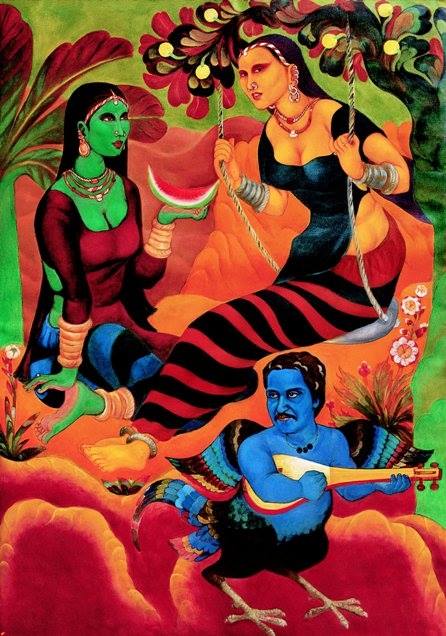
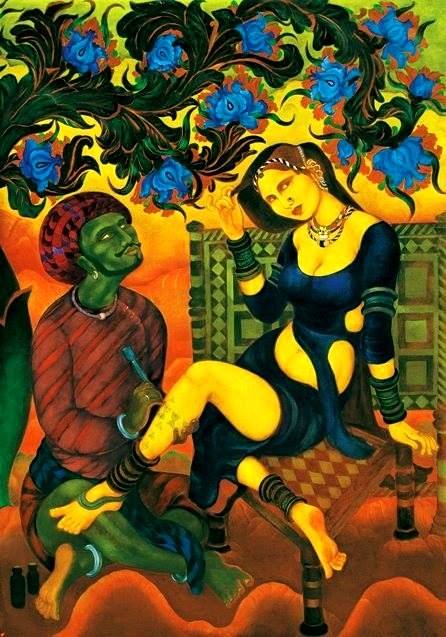
A. Ramachandran's "Yayati" stands as a monumental work in contemporary Indian art, marking a pivotal transition in the artist's creative journey. Completed between 1984 and 1986, this expansive installation comprises twelve painted panels, each measuring 60 feet in length and 8 feet in width, accompanied by a central ensemble of thirteen bronze sculptures. The twelve panels are organized into three segments, each representing a distinct phase of life: Ushas (dawn), Madhyanya (midday) and Sandhya (evening). This tripartite division mirrors the human life cycle, emphasizing the transient nature of existence and the universal journey from youth to old age.
The installation not only exemplifies Ramachandran's mastery over form and color but also his ability to intertwine narrative depth with visual grandeur. By integrating painting and sculpture, he creates an immersive experience that invites viewers to reflect on the cyclical nature of desire and the inevitable passage of time. "Yayati" remains a testament to Ramachandran's innovative spirit and his contribution to modern Indian art.

Why Did Ramachandran Paint Yayati?
A Ramachandran, known for his deep engagement with Indian cultural themes and bold visual storytelling, used Yayati’s tale to comment on the eternal struggle between indulgence and renunciation. Through his painting, Ramachandran invites viewers to reflect on the moral lessons embedded in ancient stories and to consider their relevance to modern life.
Conclusion
A Ramachandran's Yayati series is more than just an artistic rendition of a mythological tale. It is a profound exploration of human desires, the consequences of indulgence, and the ultimate quest for spiritual redemption. Through his art, A Ramachandran invites viewers to reflect on their own lives, encouraging them to seek higher spiritual goals over material pleasures.