


anish kapoor - artist profile, art style, sculptures & paintings

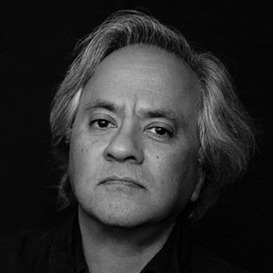 Anish Kapoor (born 12 March 1954) in Mumbai India, is a British-Indian sculptor renowned for his innovative and monumental works that challenge the boundaries of art and perception. After moving to London in the early 1970s, Kapoor honed his artistic vision at Hornsey College of Art and Chelsea School of Art, where he developed a unique style characterized by abstract biomorphic forms and a masterful use of color and material. Kapoor's ability to explore themes of space, void and identity has established him as one of the most influential artists of his generation, earning him numerous accolades, including the Turner Prize and a knighthood for his contributions to the visual arts. Throughout his four-decade career, he has continuously pushed artistic and technological boundaries, cementing his position as one of the most influential sculptors of our time.
Family
Anish Kapoor was born into a culturally diverse family. His father was a Punjabi Hindu and served as a hydrographer in the Indian Navy, while his mother was of Iraqi-Jewish descent and the daughter of the cantor of the Pune synagogue. He has a brother, Ilan Kapoor, who is a professor at York University in Toronto, Canada. Kapoor has three children: a son and a daughter from his first marriage to German-born medieval art historian Susanne Spicale (1995–2013), and a toddler daughter with his second wife, garden designer Sophie Walker (2016–2023). In 2023, he married his third wife, Oumaima Boumoussaoui.
Education
Anish Kapoor received his early education at The Doon School, an elite all-boys boarding school in Dehradun, India. In 1971, he moved to Israel, where he lived on a kibbutz and briefly studied electrical engineering, but discontinued his studies after six months due to challenges with mathematics. In 1973, he relocated to the United Kingdom to pursue a Bachelor of Arts in Fine Art at Hornsey College of Art. He then continued his education at Chelsea School of Art and Design, where he earned a Master of Arts in Fine Art in 1978.
Art Style & Techniques
Anish Kapoor is known for his abstract, large-scale sculptures that explore form, materiality, and spatial perception. His work often features highly reflective surfaces, deep voids and vibrant pigments, creating illusions of depth and infinity. He frequently uses materials such as stainless steel, wax, stone and fiberglass. Notable for site-specific installations that transform architectural spaces, his sculptures maintain a consistent dialogue between material physicality and immaterial concepts. Kapoor is also recognized for his innovative use of color, particularly his exclusive rights to Vantablack, one of the darkest substances known.
Best 5 Sculptures
Anish Kapoor has made some of the most awe-inspiring sculptures of all time. Here are five of his most famous sculptures:
1. Descent into Limbo (1992)
Location: Various locations, including Documenta IX, Kassel, Germany.
Material: Black pigment and resin.
Dimensions: Varies, typically around 10 feet in diameter.
Description: "Descent into Limbo" is a circular, black hole-like structure that appears to be a void in the ground. The sculpture is created by coating the floor with a thick layer of black pigment, giving the impression of an endless abyss. Viewers are invited to step to the edge and peer into the darkness, experiencing a sense of vertigo and existential contemplation.
2. Sky Mirror (2001)
Location: Various locations, including Rockefeller Center, New York City, USA.
Material: Polished stainless steel.
Dimensions: Various sizes, typically around 20 feet in diameter.
Description: This convex mirror reflects the sky above and surrounding environment, creating an illusion of infinite space. It challenges viewers' perceptions of reality and space. It has been exhibited in various locations, including the Rockefeller Center in New York and Kensington Gardens in London. The sculpture's appearance changes with its environment, offering a unique experience each time.
3. Marsyas (2002)
Location: Turbine Hall, Tate Modern, London, UK.
Material: Steel and PVC.
Dimensions: Approximately 150 feet long and 50 feet high.
Description: "Marsyas" is a massive, trumpet-like structure that spans the entire length of the Turbine Hall at the Tate Modern. The sculpture is made of three steel rings connected by a single, stretched PVC membrane. The name "Marsyas" refers to the satyr from Greek mythology who was flayed alive for challenging the god Apollo to a musical contest. Kapoor's sculpture evokes themes of suffering, transformation, and the human condition.
4. Cloud Gate (2004)
Location: Millennium Park, Chicago, USA.
Material: Stainless steel.
Dimensions: Approximately 33 x 66 x 42 feet.
Description: Commonly colloquially as "The Bean," this iconic sculpture is a defining feature of Chicago's Millennium Park and is made of 168 stainless steel plates welded together to create a seamless, mirror-like surface. It encourages interaction by reflecting the surroundings and visitors in distorted ways, creating a dynamic public art experience
5. Leviathan (2011)
Location: Grand Palais, Paris, France.
Material: PVC fabric.
Dimensions: Approximately 98 feet high and 295 feet wide.
Description: Created for the Monumenta exhibition at Paris's Grand Palais, it's a massive inflatable structure made of PVC. Visitors could walk inside the sculpture, experiencing its cathedral-like interior. Anish Kapoor described it as a "monster" that evokes both awe and terror.
Characteristic Features Of His Sculptures
Anish Kapoor's sculptures are distinguished by their monumental scale, seamless surfaces, and powerful manipulation of space and perception. His works often feature highly polished reflective materials that distort and transform the surrounding environment, creating visual paradoxes where boundaries between object and viewer blur. Kapoor frequently employs deeply saturated pigments—most famously his exclusive use of Vantablack, the world's darkest substance—alongside concave forms that seem to recede endlessly into space, evoking sensations of the void. His sculptures typically avoid literal representation in favor of abstract, often biomorphic shapes that engage with fundamental human experiences of materiality, presence, and absence. Whether working with stainless steel, stone, wax, or pure pigment, Kapoor's creations challenge conventional perceptions of solidity and emptiness while maintaining a meditative quality that invites contemplation of both physical space and metaphysical concepts.
Most Famous Art Works
One of Anish Kapoor’s most iconic structures is Cloud Gate, affectionately called "The Bean" in Chicago's Millennium Park. Made from polished stainless steel, it reflects the city skyline and sky, creating a unique and interactive experience for viewers. This public artwork has become a beloved symbol of the city and one of the most photographed sculptures worldwide.
Vantablack Controversy
Anish Kapoor sparked significant controversy when he acquired exclusive rights to Vantablack, one of the blackest artificial substances ever created. This material absorbs 99.965% of visible light, creating an intense sense of void in any form it coats. While Kapoor's exclusive use of Vantablack intrigued many, it also drew criticism from other artists who argued it was limiting access to an innovative material that could revolutionize the art world.
Films
Artist Anish Kapoor’s work has been featured in various movies where he discusses his approach to art and the philosophy behind his installations. Documentaries provide insights into his creative processes and the technical challenges he faces with his ambitious, large-scale pieces.
• Into Yourself, Fall (2018): This was a VR film project where Anish Kapoor created an immersive, surreal experience simulating the feeling of falling into one’s own body. Through virtual reality, viewers were taken on a journey down a virtual esophagus, representing Kapoor’s exploration of the inner and psychological spaces that mimic his fascination with the void in his sculptures.
• Blood Cinema: This short film also draws from Anish Kapoor’s fascination with the color red and his exploration of organic, visceral spaces. Though less widely circulated than some of his other projects, it continues his exploration of color and form.
Anish Kapoor's films are more of an extension of his artistry than standalone cinematic works. They are generally received as explorations that complement his sculptures, contributing to an expanded understanding of his themes. While not as famous as his large-scale sculptures like Cloud Gate or his reflective mirrors, his films have been appreciated in exhibitions and art spaces as complementary pieces that deepen his exploration of physical and metaphysical spaces.
Accomplishments - Awards Won
Artist Anish Kapoor has received numerous awards, including the Turner Prize in 1991 and the prestigious Praemium Imperiale Award in 2011. He was also knighted in 2013 for his contributions to the arts, a recognition of his impact on contemporary art on a global scale.
5 Lesser-Known Facts
Here are five lesser-known facts about Anish Kapoor, the celebrated sculptor known for his monumental and reflective works:
1. His Early Works Were Inspired by Pigments
• Before working with metal and large-scale installations, Kapoor created sculptures using pure pigment powders, inspired by Indian traditions and colors.
• His "1000 Names" series (1979–1980) used bright pigments to explore shape and form.
2. Deep Interest in the Void and Darkness
• Many of his works, like "Descent into Limbo" (1992), explore the concept of the "void"—a seemingly infinite black space.
• His fascination with emptiness and depth is a recurring theme in his art.
3. Exclusive Rights to Vantablack
• In 2016, Anish Kapoor acquired exclusive artistic rights to Vantablack, one of the darkest substances known, absorbing 99.96% of light.
• This sparked controversy among artists, particularly British painter Stuart Semple, who later created the “Pinkest Pink” pigment in protest.
4. Created the UK’s Tallest Sculpture
• Anish Kapoor designed the ArcelorMittal Orbit (2012), a 115-meter-high observation tower for the London Olympics.
• It remains the tallest sculpture in the UK.
5. Worked with Musician Brian Eno
• In 2016, Anish Kapoor collaborated with Brian Eno, the influential musician and producer, on an immersive exhibition at the Red Hot Arts Centre in Alice Springs, Australia.
Conclusion
As Anish Kapoor continues to challenge perceptual boundaries in the third decade of the 21st century, his legacy stands as a testament to art's power to transform not just physical space, but our fundamental understanding of how we experience reality. From the reflective surfaces of "Cloud Gate" to the void-like depths of "Descent into Limbo," Kapoor's work transcends cultural boundaries while remaining deeply connected to his Indian heritage and British artistic training.
By manipulating material, space, and light in increasingly innovative ways, he invites viewers to question what they see and feel, creating experiences that are simultaneously universal and intensely personal. In a fragmented world searching for meaning, Kapoor's sculptures remain essential landmarks—not just in the cities where they physically reside, but in the evolving landscape of contemporary art itself, where his influence continues to expand like the seemingly infinite reflections in his mirrored works.
This article only scratches the surface! For a deeper look into Anish Kapoor, take a moment to read our other article on him - here




