artist akbar padamsee - biography, paintings & achievements
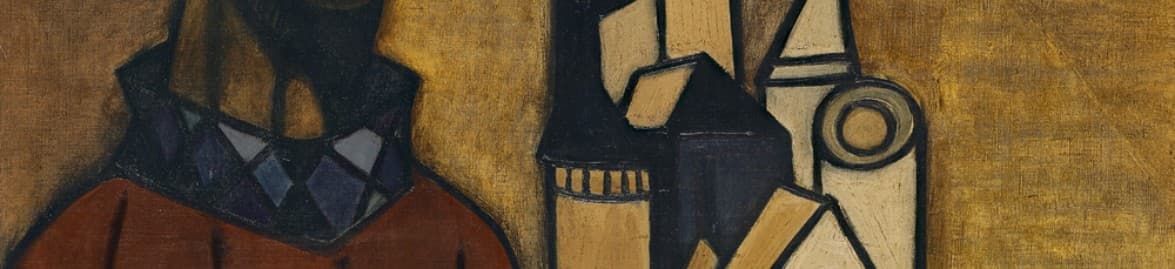
Akbar Padamsee (1928–2020) was a prominent Indian modernist artist, known for his innovative paintings, sculptures & multimedia works. His artwork spans various genres, including paintings, drawings, photography and even film. Known for his introspective and abstract style, Akbar Padamsee's contributions to Indian art have been profound and lasting, establishing him as a key player in the Progressive Artists' Group, which played a pivotal role in transforming Indian art in the 20th century. Akbar Padamsee paintings characterized by their somber tones, nuanced color palettes and philosophical undertones continue to captivate audiences worldwide.
Early Life & Background
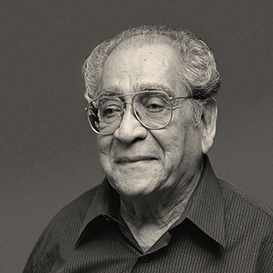 Akbar Padamsee was born in Bombay (now Mumbai), into a Khoja Muslim family with a strong artistic background. Growing up in a cosmopolitan city like Bombay during British rule and later during the independence movement, Padamsee was exposed to a myriad of cultural influences that would shape his worldview and inspire his artistic expression. This blend of Eastern and Western influences became a hallmark of his work.
Later Life
Akbar Padamsee spent much of his life exploring and experimenting with various media and artistic forms. He traveled extensively between India and Europe especially Paris, which had a profound impact on his artistic style. Even in his later years, he continued to paint, reflect, and contribute to the Indian art scene until his passing on January 6, 2020. His relentless dedication to his craft and his contemplative approach to life marked his later years, earning him both admiration and reverence among art circles and his followers.
Family
Akbar Padamsee was born into a culturally rich and well-to-do Khoja Muslim family. Originally, the family bore the surname "Charanyas," a testament to their ancestry as court poets. The title "Padamsee," a form of "Padmashree," was bestowed to them after they selflessly offered their entire granary to their village during a famine. Akbar's father, Hassan Padamsee, was a successful investor who ran a thriving furniture & glassware business. His mother, Jenabhai Padamsee, was a homemaker who nurtured the family of eight siblings. One of Padamsee's cousins is Alyque Padamsee, who later gained fame as a prominent actor and theater personality.
In 1954, Akbar Padamsee married Solange Gounelle in Paris, where he spent several formative years. The couple had a daughter, Raisa Padamsee (film actress) whose name was given by legendary artist M.F. Husain. Raisa later married filmmaker Laurent Brégeat. In 1968, Akbar Padamsee returned to Mumbai and spent his later years with his second wife, Bhanumati Padamsee, establishing a home where his artistic pursuits flourished.
The Padamsee family’s rich history of cultural refinement and intellectual vibrancy profoundly influenced Akbar’s artistic journey. His upbringing, steeped in tradition yet forward-looking, played a critical role in shaping his philosophical and experimental approach to art, which continues to inspire the world of Indian modernism.
Education
Akbar Padamsee’s journey in education was deeply intertwined with his personal challenges and artistic growth. As a young boy in primary school, his talent for drawing became evident when he would sketch intricate caricatures on the blackboard before the teacher arrived. His classmates, awed by his skill, would point him out when the teacher inquired, but she often refused to believe such mature work could come from someone so young. At the age of 11, however, a traumatic injury left a lasting impact on him. After accidentally stepping on a rusted nail, the physical wound healed, but the psychological aftermath caused him to stop speaking entirely. For nine years, he remained silent, channeling his energy into art to express himself. Despite being ridiculed for his speech impediment, Padamsee persisted with the help of his elder brother, who supported his education and shielded him from the conventional schooling system that often alienated him.
Padamsee’s artistic education formally began under the guidance of his first mentor, drawing teacher Shirsat, a skilled watercolorist who helped him prepare for admission to the Sir J.J. School of Art. Such was his talent and preparation that he was admitted directly into the third year of the program. At J.J. School of Art, Professor Shankar Palshikar introduced him to the intricate world of Indian miniature paintings and encouraged him to study Sanskrit. The influence of these classical traditions became pivotal in shaping Padamsee’s artistic philosophy and thought process. His education at J.J. School of Art, both formal and informal, laid the foundation for his innovative approach, combining Indian aesthetics with a modernist ethos, a hallmark of his distinguished career.
After graduating, Padamsee's artistic journey took him to France, where he was mentored by surrealist artist Stanley Hayter. This experience broadened his artistic horizons and led to his first solo exhibition in Paris in 1952. His exposure to European modernism profoundly impacted his work, allowing him to experiment with various mediums such as oil painting, watercolors, and later, computer graphics. Throughout his career, Padamsee's art evolved from traditional portraiture and landscapes to more abstract forms known as "inscapes," reflecting deeper psychological and philosophical themes. His education laid the groundwork for a prolific career that spanned nearly seven decades, during which he received numerous accolades, including the Padma Bhushan in 2010 for his contributions to Indian art.
Artistic Journey & Development
Akbar Padamsee’s journey as an artist began with his association with the Progressive Artists' Group. After relocating to Paris in the early 1950s, he was introduced to Western modernism and its new forms of expression. Unlike his contemporaries who explored more vibrant and expressive styles, Padamsee delved into a more subdued and contemplative approach. His works—often monochromatic in color—explored human emotions and psychological depth. His subjects spanned landscapes, nudes, and heads, each portrayed with a sense of introspection and stillness.
Padamsee was also an early adopter of technology in art, experimenting with computer graphics and creating "Mirror Images," a series that explored symmetry and form. His continuous innovation and exploration of various media solidified his place as an artist unafraid to take risks.
Artist Philosophy
Padamsee believed art should evoke an inner journey for both the artist and the viewer. His works reflect an ongoing search for meaning, employing a minimalist yet profound approach to expression. For Padamsee, art was not about creating beauty but about capturing emotions, human psyche, and philosophical inquiry. Akbar Padamsee's artwork often avoided narrative structure, instead using color and form to delve into introspective themes and abstractions.
Quotes
“Art is not a pastime; it’s a way of life.”
“In painting, you are forever alone. Painting is a solo game; it’s one-on-one with the canvas.”
“My work is a journey within; I create art to reflect what I feel about the world and myself.”
Painting Style & Techniques
Akbar Padamsee's painting style was characterized by his use of muted colors, monochromatic palettes and a heavy influence of abstraction. His artistic oeuvre was marked by a formal exploration of a select range of themes and genres, including heads, couples, still-life, grey works, metascapes & mirror-images. Early in his career, Padamsee’s portraits and landscapes in painting, drawing and etching demonstrated a quasi-spiritual approach, with an emphasis on introspection and metaphysical inquiry. By contrast, his drawings exude a serene grace, revealing his meticulous attention to line and form.
Padamsee’s art was not only an aesthetic endeavor but also a philosophical exploration of existence, duality and universal truths. Whether through the luminous richness of his oils or the meditative simplicity of his drawings, his works reflect a deeply contemplative and intellectual pursuit. His ability to traverse multiple genres and mediums with equal finesse cemented his legacy as one of India’s most innovative and influential modern artists.
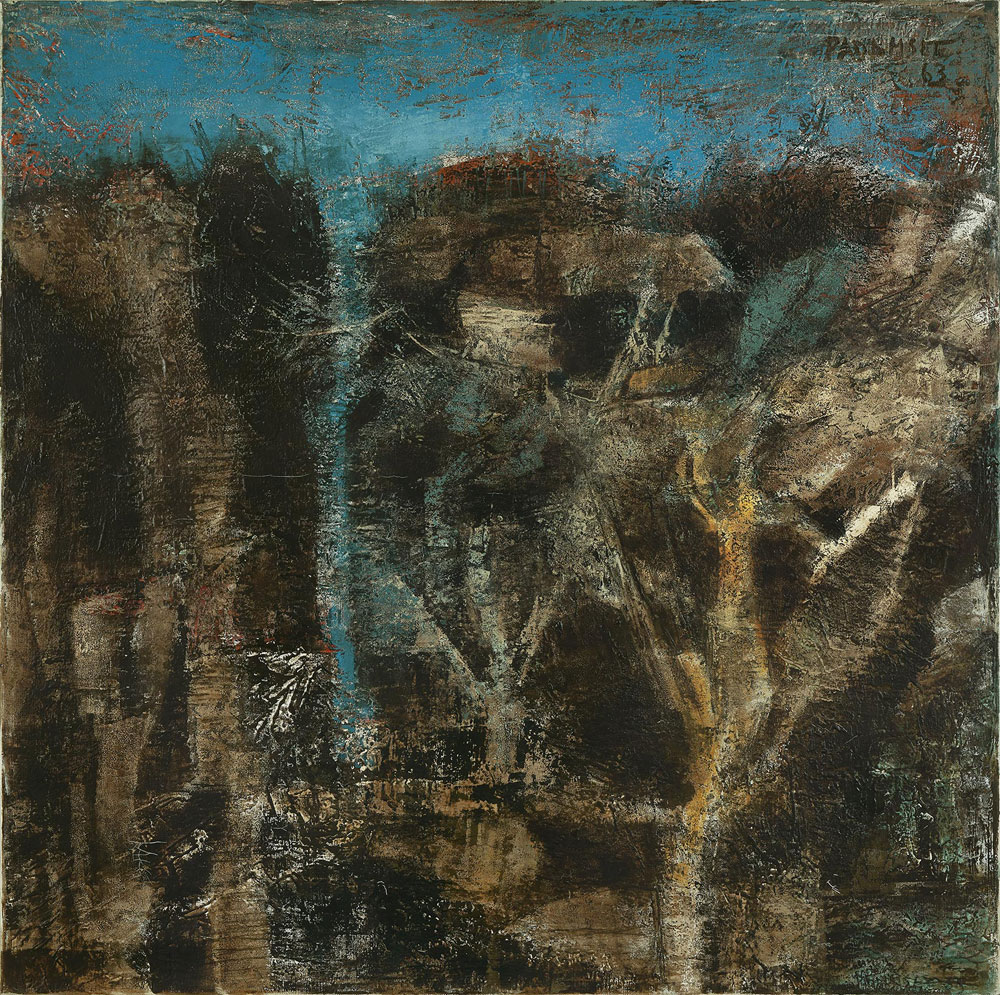
Akbar Padamsee's painting techniques varied over the years, but he often relied on bold brushstrokes, carefully layered textures, and a deep understanding of light and shadow to create mood and emotion in his pieces. His later works, particularly in the "Metascapes" and "Mirror Images" series, demonstrated his evolution into more abstract and conceptual realms. The "Grey Series," with its haunting use of shades of grey, showcased his mastery in tonal variation, using color to convey depth and somber introspection.
Notable Paintings
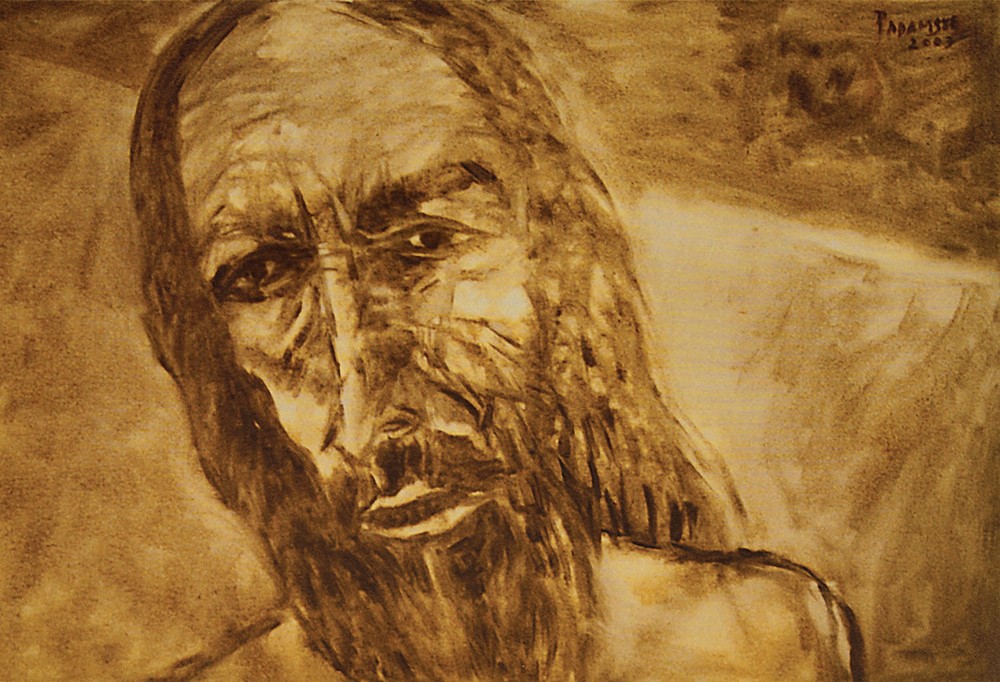
• "Prophet" Series – A series exploring religious and spiritual themes, focusing on the portrayal of prophets.
• "Head" Series – Depictions of human heads, often abstracted and symbolic, reflecting the complexity of human identity.
• "Couples" Series – Abstract representations of couples, exploring themes of love, intimacy, and human connection.
• "Grey Works" – A series of monochromatic works, characterized by the use of greyscapes to convey mood and depth.
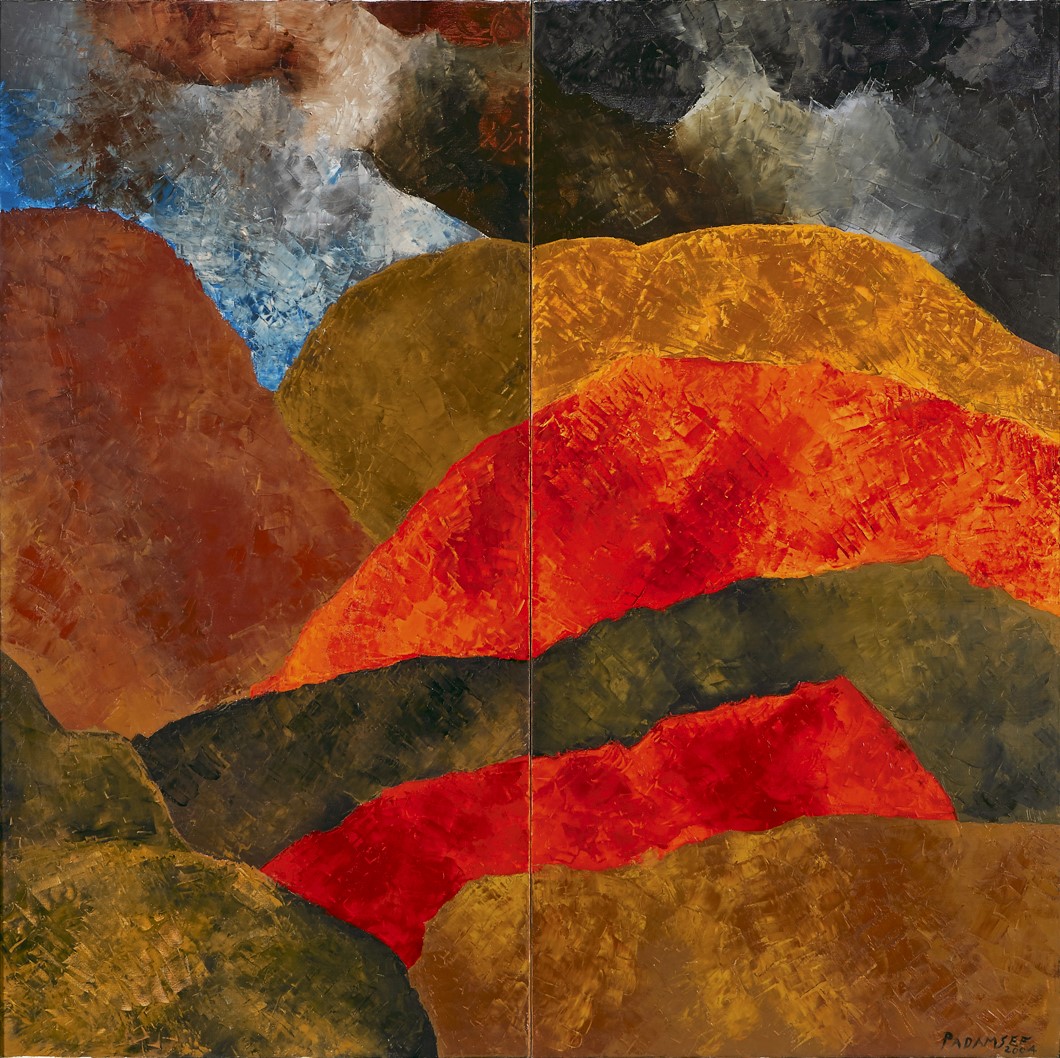
• "Metascapes" – Abstract landscapes that blend the physical and metaphysical, often seen as a search for universal truths.
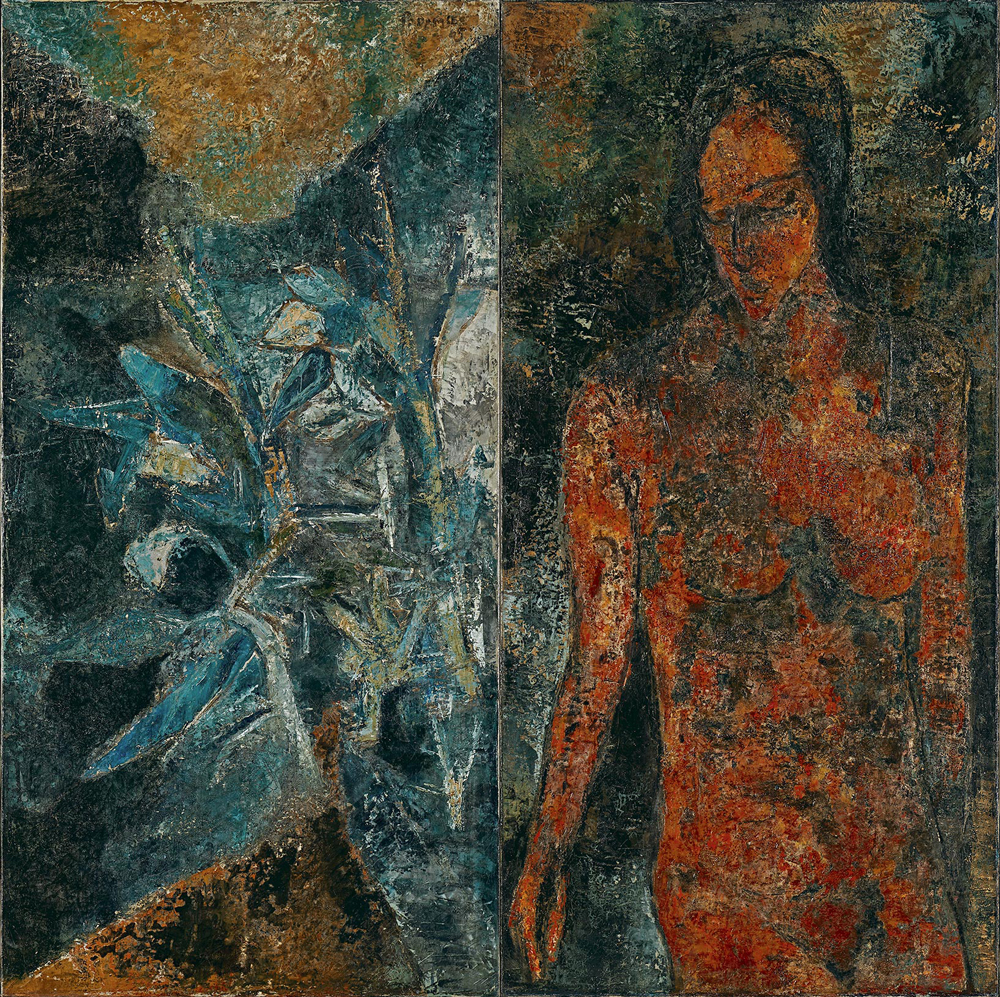
• "Mirror Images" – Works that explore the concept of reflection, often playing with symmetry and the idea of duality.
• "Tertiaries" – A series that delves into the use of tertiary colors and the interplay of various hues and tones.
• "Nudes" – A significant body of work focusing on the human form, blending figuration with abstraction.
• "Landscape" Series – Padamsee’s landscapes, often abstracted and painted with an emphasis on light, shadow, and depth.
• "Still Life" Series – His exploration of everyday objects, rendered in a way that imbues them with spiritual significance.
Famous Paintings
Among his many famous paintings, "Reclining Nude" "Rooftops" and "Greek Landscape" stand out as significant pieces that showcase his mastery of form, color and abstraction.
1. Reclining Nude
• Description: This painting showcases Padamsee's exploration of the human form, depicting a nude figure in a relaxed posture. The composition emphasizes the elegance of the body and often plays with light and shadow.
• Style: The work reflects a blend of realism and abstraction, focusing on the aesthetic qualities of the human figure.
• Significance: "Reclining Nude" illustrates Padamsee's mastery in capturing the sensuality and grace of the human body, a recurring theme in his oeuvre.
This painting was sold for an impressive USD 1.4 million at a Sotheby’s auction in New York in March 2011, marking it as one of the highest sales for modern Indian art at that time
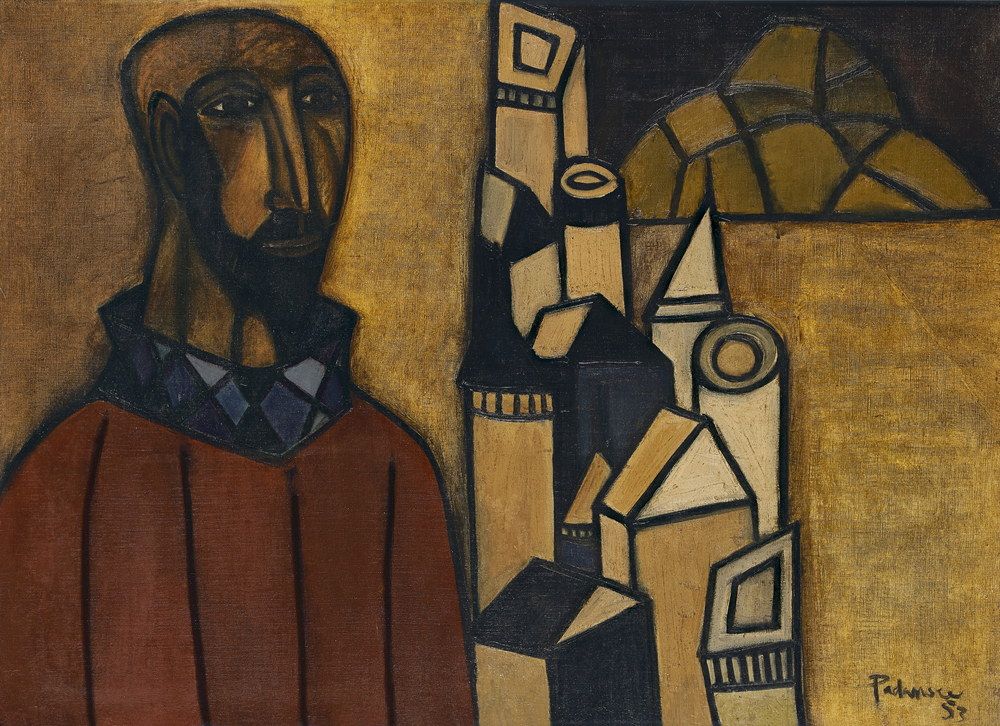
2. Rooftops
• Description: "Rooftops" features a panoramic view of urban architecture, highlighting the rooftops of buildings. The painting captures the essence of city life, with a focus on geometric shapes and vibrant colors.
• Style: This piece is characterized by a more abstract and cubist approach, emphasizing form and structure over detailed representation.
• Significance: The work reflects Padamsee's interest in urban landscapes and the interplay between man-made structures and the environment.
This painting received critical acclaim when it was exhibited at the Jehangir Art Gallery in 1960.
3. Greek Landscape
• Description: This painting depicts the serene and picturesque landscapes of Greece, showcasing rolling hills, ancient ruins, and vibrant skies. It often features a harmonious blend of nature and architecture.
• Style: The style is a mix of impressionism and abstraction, using color and form to evoke the beauty of the landscape rather than focusing on realistic details.
• Significance: "Greek Landscape" highlights Padamsee's fascination with the natural world and his ability to capture its essence through color and composition.
This work was sold for Rs. 19.19 crores (approximately USD 2.9 million) at an auction in September 2016, highlighting its value within the art market.
In conclusion, Akbar Padamsee's famous paintings—"Reclining Nude" "Rooftops" and "Greek Landscape"—demonstrate his exceptional talent and innovative approach to art. Each painting reflects his unique ability to capture the essence of his subjects while pushing the boundaries of form and color.
Controversial Paintings
Padamsee seldom shied away from exploring complex themes in his work. One of his early nudes in Paris was once confiscated by Indian authorities under obscenity laws, sparking debates about censorship and artistic freedom. His commitment to artistic honesty, regardless of potential controversy, exemplified his dedication to his craft.
Characteristic Features of His Paintings
Akbar Padamsee’s paintings are known for their:
- Monochromatic and minimalistic color palette
- Emphasis on introspective themes and emotional depth
- Exploration of symmetry and abstraction
- Focus on existential and philosophical questions
- Layered textures and subtle tonal variations
Sculptures
Akbar Padamsee's bronze sculptures, including his torsos and heads, represent a significant yet less commonly explored facet of his artistic oeuvre. Although primarily celebrated for his paintings, Padamsee turned to sculpture more earnestly in the mid-1980s. His bronze works, such as the Head series, were showcased in exhibitions in New Delhi and in Mumbai during the mid-1980s. These pieces are marked by their profound engagement with material and form, creating a bridge between abstraction and figuration.
Akbar Padamsee's Bronze Torso is a remarkable example of his sculptural artistry, embodying his distinctive handling of form and material. Crafted in the 1980s the sculpture measures 8.75 inches (22.5 cm) in height, 6.25 inches (16 cm) in width, and 5 inches (13 cm) in depth, making it a compact yet visually compelling interpretation of the human form. Made of bronze, Padamsee skillfully manipulates the medium to balance a sense of solidity with dynamic fluidity. Mounted on a wooden base measuring 14 x 5.25 x 5 inches (36 x 13 x 12.5 cm), the piece commands attention as a self-contained work of art.
Books
Some notable books published on the works and legacy of Akbar Padamsee:
• Akbar Padamsee: Work in Language - Edited by Bhanu Padamsee and Annapurna Garimella, this book provides a comprehensive exploration of Padamsee’s career, covering over five decades of his artistic contributions. It includes essays by art historians, critics, and artists, alongside over 370 illustrations of his works, such as paintings, sketches, and photographs.
• Akbar Padamsee: Sounds in the Wilderness - This publication delves into Padamsee’s interdisciplinary approach and his experiments with diverse media, including painting, film, and photography. It highlights his philosophical and conceptual explorations.
• Akbar Padamsee: Works on Paper – Critical Boundaries - Focused on his works on paper, this book examines his use of different mediums like charcoal, ink, and watercolor, showcasing his precision and boundary-pushing creativity.
• Akbar Padamsee: Where the Lines Fall - This is another notable book dedicated to Akbar Padamsee's art. It presents a curated exploration of his diverse body of work, emphasizing his experiments with form and abstraction. The book includes critical essays and high-quality reproductions of his creations, offering readers insights into his artistic philosophy and his relentless inquiry into space, form, and human expression.
Accomplishments - Awards Won
Akbar Padamsee's illustrious career earned him several prestigious awards, including:
- Padma Bhushan (2010), one of India's highest civilian awards.
- Lalit Kala Akademi Fellowship for lifetime achievement in the arts.
- Kalidas Samman from the Madhya Pradesh government.
- Vasudeo Gaitonde Kala Jeevan Puraskar.
- Multiple awards at exhibitions such as the Sao Paulo Biennale.
Contributions & Impact On Indian Art
Akbar Padamsee's legacy in Indian art is monumental. As a founding member of the Progressive Artists' Group, he challenged the conventional norms of Indian art, paving the way for future generations of Indian modernists. His work bridged the traditional with the modern, the East with the West, creating a unique, introspective style that influenced both peers and successors. His philosophy of painting as a journey of self-exploration continues to inspire young Indian artists to explore deeper, psychological themes.
Depth & Dimension In His Landscape Paintings
Akbar Padamsee’s landscape paintings, particularly his celebrated Metascapes, are profound explorations of depth and dimension that transcend traditional representations of natural scenery. Rather than capturing specific geographic locations, Padamsee’s landscapes are abstract, psychological spaces that invite viewers into an immersive, almost meditative experience. Using a muted yet evocative color palette, he masterfully layered textures and tones to create an illusion of vastness and depth, guiding the eye through sweeping horizons, shadowed valleys, and luminous skies. His landscapes often lack a defined foreground or background, drawing the viewer into a unified field of color and form that suggests an eternal, boundless space. This deliberate ambiguity creates a timeless, introspective quality, with light and shadow used not just for realism but to evoke the mysteries of existence. In these works, Padamsee merges the physical with the metaphysical, encouraging a contemplative engagement that reveals new dimensions and layers with each viewing.
Influences
Akbar Padamsee’s artistic development was influenced by a wide range of artists from different generations, both senior and contemporary. Among the senior artists whose works Padamsee admired were Jogen Chowdhury, Sudhir Patwardhan and Atul Dodiya. Chowdhury’s expressive line work and emotive figures resonated with Padamsee, particularly in their shared interest in exploring the human condition. Patwardhan’s socio-political themes and his nuanced approach to urban life also left an impression on Padamsee, inspiring him to engage with deeper social concerns in his own art. Atul Dodiya, with his vibrant and sometimes ironic portrayals of contemporary life, influenced Padamsee’s ability to balance traditional artistic practices with modern sensibilities. These senior artists, who all pushed boundaries in their own unique ways, played an important role in Padamsee’s exploration of both realism and abstraction.
Akbar Padamsee also held the works of younger artists in high regard, admiring their innovative approaches to contemporary art. Among the younger generation, he expressed admiration for the works of Subodh Gupta, Jitish Kallat and Bharti Kher. Gupta’s use of everyday objects to address themes of identity and transformation resonated with Padamsee’s own interest in symbolic and conceptual art. Kallat’s dynamic exploration of time, space, and the human experience similarly inspired Padamsee’s philosophical engagement with art. Bharti Kher’s integration of diverse media and her ability to blend contemporary themes with traditional symbolism also struck a chord with Padamsee, inspiring him to continually evolve his artistic practice. The works of these younger artists, with their bold experimentation and intellectual depth, encouraged Padamsee to remain engaged with contemporary art and to reflect on its role in addressing both personal and global concerns.
Movies / Films
Akbar Padamsee made a significant contribution to the world of cinema through his filmmaking endeavors. One of his notable films is "Syzygy", an experimental short film that explores the relationship between images and sound. Syzygy an eleven-minute silent, black and white film, shot on 35mm (later transferred to 16mm). Syzygy is a 16-minute animation film with no narrative, sound, or colour; just lines evoking shapes. The movie consists of nearly 1,000 drawings and explores concepts of geometry and mathematics, illustrating the union of opposites—a theme reflected in its title, which has both philosophical and astronomical connotations. It was created with the help of animator Ram Mohan. It was released at a UNESCO screening in Paris in 1969, by then chief producer of the Films Division Jehangir Jean Bhownagary.
Another notable movie by Padamsee is "Events in a Cloud Chamber", a short film that delves into the realm of abstract narrative. This six-minute film was inspired by one of Padamsee's oil paintings and employed innovative techniques such as superimposing shapes with a slide projector. The film featured an electronic soundtrack composed by Geeta Sarabhai, marking her as one of the first female electronic musicians in India. Although it received limited screenings before disappearing, efforts were made years later to reconstruct it from memory, leading to a new version directed by filmmaker Ashim Ahluwalia that premiered at the Venice Film Festival
Both "Syzygy" and "Events in a Cloud Chamber" have been recognized for their artistic merit and are considered important works in the Indian experimental cinema canon.
Resilience
Akbar Padamsee's resilience and artistic dedication set him apart from other Indian artists. Despite being confined to bed for over a month following a hip surgery in 2013 and recovering from a fall in 2014, Padamsee’s commitment to his craft never wavered. He continued to wield the brush even in the face of physical adversity, demonstrating his deep passion for art and the therapeutic power of creation.
Death
Akbar Padamsee passed away on January 6, 2020, at the age of 91. He died at the Isha Yoga Centre in Coimbatore, where he had been residing for the past few years with his wife, Bhanu. Padamsee had been battling prolonged illness, which included surviving cancer and heart ailments earlier in his life. His death was attributed to natural causes, marking the end of a remarkable artistic journey that spanned over seven decades. Padamsee's death was met with an outpouring of tributes and condolences from the art world and beyond. He is remembered for his contributions to Indian modern art, as well as his role as a teacher and mentor to many young artists.
Conclusion
Artist Akbar Padamsee's contributions to Indian art remain unparalleled. His exploration of monochromatic tones, existential themes, and mastery over both traditional and digital media created a unique and lasting impact on the world of art. Akbar Padamsee artworks—whether seen in beautiful oil paintings on canvas, limited-edition prints, or displayed at high-profile auctions—reflects a deeply philosophical, yet universal, artistic vision. Akbar Padamsee paintings continue to draw art collectors and admirers, their prices and demand remaining high at art auctions. Through his remarkable legacy, Padamsee will forever be remembered for his innovative, introspective, and thought-provoking creations in the world of Indian modern art.
As we conclude our journey through the remarkable world of Akbar Padamsee, we invite you to explore his original paintings in greater depth. Click here to discover the stories behind the brushstrokes and the emotions that bring his art to life.
If this exploration intrigued you, don’t miss the opportunity to dive into another article on Akbar Padamsee here — Exploring The Essence Of Landscapes In Akbar Padamsee's Paintings