


atul dodiya - gandhi series | overview
.jpg&w=3840&q=75)
Atul Dodiya, one of India's most celebrated contemporary artists, is renowned for his thought-provoking and politically charged works. Among his most notable series is the Gandhi Series, which pays homage to Mahatma Gandhi, the father of the Indian nation. The Gandhi Series is a testament to Atul Dodiya's deep admiration for Mahatma Gandhi and his principles of non-violence, truth and simplicity. Through this series, Dodiya seeks to reinterpret Gandhi's legacy in the context of contemporary India, exploring the relevance of his teachings in today's world.
The Gandhi Series: An Overview
The Gandhi Series comprises a collection of paintings, installations, and mixed media works that collectively offer a multifaceted portrayal of Gandhi's life and philosophy. Dodiya employs a variety of artistic techniques and styles, including photorealism, abstraction and collage, to create a rich and layered visual narrative.
Origins and Evolution
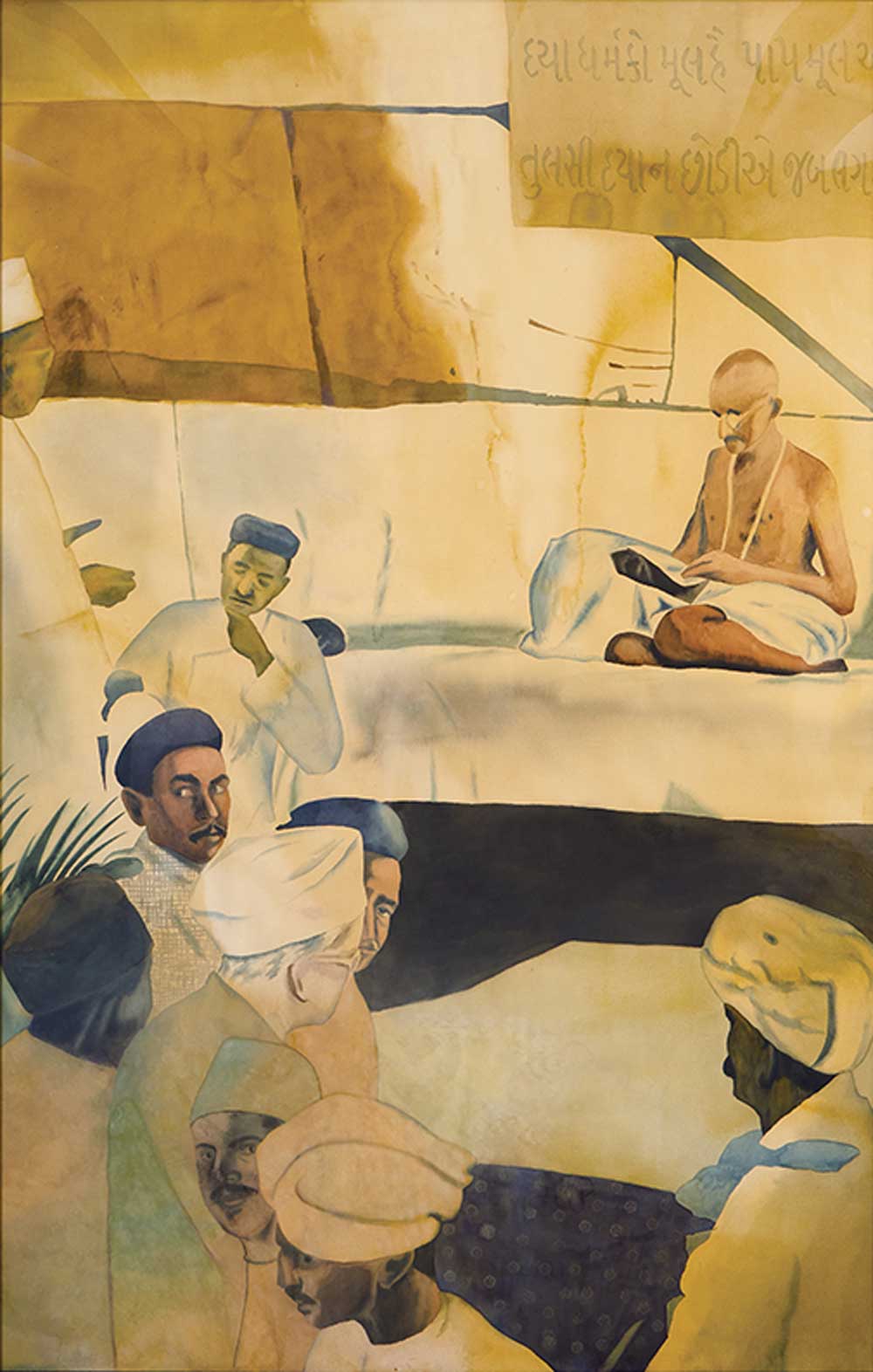 Atul Dodiya’s engagement with Gandhi began in the late 1990s, a period marked by social and political upheaval in India. In response to rising violence and fundamentalism, Dodiya turned to Gandhi-a symbol of peace, secularism, and non-violence-as a central figure in his art. This resulted in a succession of works, most notably the 1999 series An Artist of Non-Violence, where Dodiya chronicled Gandhi’s life not through grand historical episodes but through the minutiae of receipts, diary pages, and everyday objects. These works animate fragments of Gandhi’s quotidian existence, merging biography with history and reflecting Dodiya’s own Gujarati heritage.
Artistic Techniques and Symbolism
In his Gandhi-themed works, Atul Dodiya employs a distinctive palette and mixed media to evoke emotional resonance. The use of burnt sienna imparts a warmth to Gandhi's depiction, while shades of Payne's grey and yellowish-white create a spectral ambiance, reflecting the spiritual and philosophical depth of Gandhi's persona. In works like Mahatma Gandhi Getting Out of a Car, Bombay, 1944, he combines photorealistic painting with abstract elements, layering historical photographs with motifs inspired by Rabindranath Tagore. This fusion of styles serves to bridge the gap between historical documentation and artistic interpretation.
The installation Broken Branches (2003), inspired by Gandhi’s ancestral home in Porbandar, features wooden cabinets filled with prosthetic limbs, construction tools and found objects. This assemblage evokes the concept of the Wunderkammer or cabinet of curiosities, symbolizing the fragmentation and preservation of memory amidst societal upheaval.
Key Works and Installations
• An Artist of Non-Violence (1999): This pivotal series merges Gandhi’s biography with historical fragments, focusing on everyday details to humanize the Mahatma.
• Re-Imagining Bapu (1999): A suite of watercolours inspired by events from Gandhi’s life, blending historical moments with references from diverse sources.
• Bako Exists. Imagine (2011): An installation based on the fictional interactions between Gandhi and a schoolboy, Bako, exploring childhood innocence and Gandhian ideals.
• Cabinet Installations: Works like Broken Branches (2003) and Meditation (with open eyes) (2011) use archival display methods to evoke Gandhi’s legacy and the broader history of non-violence.
Impact and Reception
The Gandhi Series has garnered significant attention within the art world and beyond. Critics and audiences alike appreciate Dodiya’s ability to reinterpret Gandhi's legacy through a contemporary lens. The series has been showcased in various exhibitions, sparking discussions about the relevance of Gandhi’s teachings in addressing current global issues, such as violence, inequality, and environmental challenges.
Educational and Social Commentary
Beyond its artistic merit, the Gandhi Series serves an educational purpose. It invites viewers to reconsider Gandhi's philosophies and their application in today's society. Dodiya’s work encourages a critical examination of non-violence as a strategy for social change, prompting discussions about its effectiveness in modern activism.
Conclusion
Atul Dodiya’s Gandhi Series stands as a powerful tribute to Mahatma Gandhi, reflecting on his legacy while exploring its relevance in contemporary society. Through innovative artistic techniques and rich symbolism, Atul Dodiya invites audiences to engage with important themes of peace, justice, and cultural identity. The series not only celebrates Gandhi’s contributions to India’s independence but also challenges us to reflect on our roles in continuing his vision for a more equitable world.




