f n souza - the rebel artist of the progressive artists group
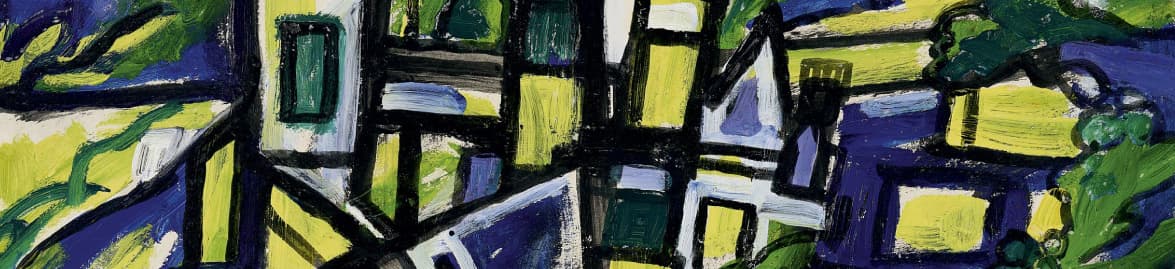
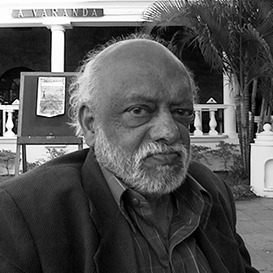 F N Souza i.e Francis Newton Souza (12 April 1924 – 28 March 2002) was a trailblazer artist in the Indian modernist movement. As the founding member of the Progressive Artists' Group, he played a crucial role in breaking away from traditional Indian art forms and embracing modernist approaches. F N Souza's paintings were pivotal in introducing and popularizing modernist techniques and themes in India. In addition to being a prolific painter, Souza expressed himself through words as a writer, poet & reflective philosopher.
Family Background
He was raised in a Roman Catholic family and faced early adversity with the loss of his father i.e Victor Newton de Souza. His first marriage was to a woman named Maria Souza, but the relationship ended due to differences and his lifestyle. He later had other romantic relationships, including a marriage to Barbara Zinkant, an American woman with whom he lived in New York for a time. Souza's children include Keren Souza, who has shared insights about his work and personal history, preserving his legacy. Another daughter, Helena Souza, has also participated in exhibitions and conversations around Souza's art, though much of his personal relationships remained complicated.
Early Life & Education
F.N. Souza grew up in the vibrant culture and traditional art of Goa, which had a lasting impact on his artistic sensibilities. His early experiences inspired many of his works. He initially studied at the art school in Bombay, where he began to develop his distinctive style. He was influenced by both traditional Indian art and Western modernism. He later joined Sir J.J. School of Art in Bombay, a historic institution that played a crucial role in his development as an artist, providing him with formal training in various techniques and exposing him to new ideas. This early exposure to diverse artistic influences and his formal education laid the groundwork for the evolution of F.N. Souza's art style, which combined elements of Indian art with modernist trends from Europe and the broader Western art world.
Life & Work In The UK
In the late 1950s, Souza moved to London with his wife, Maria Figueiredo, in the hopes of seeking significant recognition for his art. Exposure to the works of Western artists such as Picasso, Amedeo Modigliani, and Rembrandt, refined F N Souza's art techniques. His work was exhibited in major galleries and art spaces across Europe. During this time, Souza's work continued to evolve, characterized by bold colours, exaggerated forms, and an exploration of religious and sexual themes, as seen in "Eros Killing Thanatos" and "The Lovers." His "Supper at Emmaus with the Believer and the Sceptic" & "Two Saints in a Landscape" paintings often generated controversy.
After struggling between the years 1949 and 1954, in 1955, he held several shows in London, including a solo show at Gallery One. He penned his autobiographical essay, "Nirvana of a Maggot" published by his friend, Stephen Spender. The next four years were a golden period for his art and himself as he didn’t have to worry about finances. Recurring motifs during this time included religious themes and heads, with works such as "Still Life with Sewing Machine" reflecting his unique blend of Western and Eastern influences. Two decades later, F N Souza returned to India in the 1970s and started painting landscapes & cityscapes like "The Red Road" and continued to exhibit his work both domestically and internationally.
Autobiography
Francis Newton Souza did not write a full-fledged autobiography. However, insights into his life, art and philosophy can be found in several writings and interviews. His candid reflections are best captured in:
"Nirvana of a Maggot" (1955):
This essay by Souza serves as a semi-autobiographical piece where he discusses his early life, struggles, and artistic journey with brutal honesty. He reflects on his experiences as a child in Goa, his education at Sir J.J. School of Art in Bombay, and his association with the Progressive Artists' Group (PAG). Souza is known for his provocative style, and this piece exemplifies his unique perspective on art, religion, and human nature.
"Words and Lines" (1959):
This book combines prose and sketches by Souza. It offers glimpses into his life, artistic process, and his views on society, politics, and sexuality. Souza’s sharp, rebellious voice makes this work essential reading for anyone trying to understand his personality and work.
Personal Letters and Interviews:
Souza's letters, especially his correspondence with other artists and art historians, provide intimate details about his personal experiences and struggles. Several interviews also reveal his thoughts on his expatriate life in London and later in New York, his criticism of organized religion, and his battle with poverty despite artistic fame.
Philosophy
His philosophy of art were deeply intertwined with his personal experiences, cultural background and the socio-political landscape of India. His philosophical themes included:
• Expression of Identity - Souza often explored themes of identity, particularly his own as an Indian artist influenced by Western art movements. He sought to express a unique Indian perspective through his work.
• Critique of Tradition - He challenged traditional Indian art forms and conventions. His works often contained elements of satire and critique, especially regarding religion and societal norms.
• Emphasis on Emotion - Souza believed in conveying strong emotions through his art. His use of bold colors and dynamic forms aimed to evoke visceral reactions from viewers.
• Spirituality and Philosophy - Souza's work often reflected his interest in spirituality and existential questions, grappling with the nature of life, death, and the divine.
Famous Quotes
• On Perception: "Renaissance painters painted men and women making them look like angels. I paint for angels, to show them what men and women really look like"
• On Art and Existence: "I have made my art a metabolism. I express myself freely in paint to exist. I paint what I want, what I like, what I feel"
• On the Role of the Artist: "A true artist paints solely for himself"
• On Isolation: "The strongest man in the world is he who stands most alone"
• On Artistic Process: "When I begin to paint I am wrapped in myself, rapt; unaware of chromium cars and décolleté dillentantes... Every brush stroke makes me recoil like a snake struck with a stick"
• On Criticism: "They told me to paint in this way and that; I was estranged from many cliques who wanted me to paint what would please them"
Painting Style & Technique
F.N Souza's painting style is characterized by its bold expressionism, vibrant color palette and provocative themes. His work often reflects a combination of Western modernist techniques and traditional Indian artistic sensibilities, resulting in a unique style that challenged conventional aesthetics and social norms. Mentioned below are some key characteristics of Francis Newton Souza's painting style:
• Expressionism: Souza's work often displays strong emotional content, using bold colors and exaggerated forms to convey feelings.
• Figurative Representation: He frequently depicted the human figure, often in distorted or abstract forms, exploring the complexities of human emotions and relationships.
• Religious and Mythological Themes: Many of his paintings draw on Indian mythology, religion, and personal spirituality, reflecting a deep engagement with his cultural roots.
• Bold Use of Color: Souza employed a vibrant palette, using contrasting colors to create dynamic compositions that evoke a sense of movement and intensity.
• Line and Form: His works often feature strong, expressive lines that define shapes and create a sense of rhythm. The interplay between line and color is a hallmark of his style.
• Social Commentary: Souza’s art frequently includes critiques of society, politics, and religion, reflecting his views on contemporary issues.
• Influence of Cubism: While primarily figurative, elements of Cubism can be seen in his work, especially in the way he fragmented forms and played with perspective.
Famous Paintings
F N Souza's paintings are known for their bold lines and rebellious themes that defy conventional artistic norms. He was known for his ability to challenge societal norms and taboos, particularly in relation to the body and identity, making his paintings both controversial and captivating. Through his art, Souza invites viewers to confront uncomfortable truths and engage with the complexities of life, resulting in a powerful visual language that resonates with audiences around the world. Shared below are some of F.N. Souza's most famous paintings:
Birth Painting
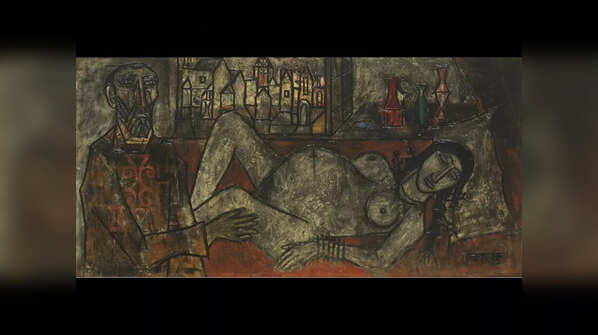
F. N. Souza's painting "Birth" is a significant work that exemplifies his unique style and exploration of human existence. Created in the mid-20th century, it reflects themes of creation and the primal forces of life, depicted through bold lines, vibrant colors, and expressive forms. The emotional intensity of the piece conveys deep truths about birth and the human experience, often pushing societal boundaries with its raw portrayal of figures. As a prominent member of the Progressive Artists' Group, Souza challenged conventional norms, and "Birth" stands as a testament to his status as a pioneer of modern Indian art, inviting viewers to confront the complexities of life and identity.
Crucifixion Painting (1951)
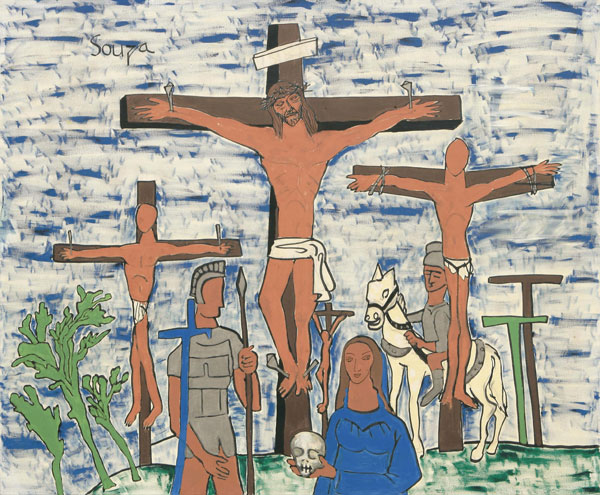
The Crucifixion painting by F N Souza is a striking work that showcases his bold style and provocative themes depicting the crucifixion of Christ in a uniquely raw and emotionally intense manner. Characterized by vibrant colors, expressive brushwork, and strong lines, the figures in the painting are often distorted, conveying a sense of urgency and deep emotion. The piece explores themes of suffering, sacrifice and redemption, using religious symbolism to comment on the human condition and reflect Souza's existential views on spirituality and mortality. This visceral portrayal compels viewers to confront profound themes of pain and faith, solidifying "Crucifixion" as a powerful testament to Souza's innovative spirit and enduring influence on modern Indian art.
The Last Supper Painting (1952)

The Last Supper by F N Souza is a significant reinterpretation of the iconic biblical scene marked by his distinctive modernist style. The work depicts the Last Supper of Jesus Christ with his disciples, characterized by emotional depth and urgency. Souza employs bold colors, expressive brushwork and strong lines, creating a dynamic composition where the figures are often distorted to reflect their emotional states and the tension of the moment. Rich in symbolism, the painting explores themes of betrayal, sacrifice, and communion, particularly highlighting the foreboding surrounding Judas. Overall, "Last Supper" evokes strong emotions, inviting viewers to contemplate the complexities of faith and human relationships, while showcasing Souza's innovative spirit and enduring influence on modern Indian art.
• The Birth of the Virgin (1953) - This painting by F.N Souza is a depiction of the Virgin Mary's birth and is a beautiful example of Souza's use of color and composition.
• The Virgin and Child (1954) - This painting Franciz Newton Souza is a portrait of the Virgin Mary and her child, Jesus and is a beautiful example of Souza's use of symbolism and color.
• The Crucified Christ (1955) - This painting is a powerful representation of Souza's Christian faith and features a crucified Christ surrounded by a halo of light.
• The Resurrection (1956) - This painting is a depiction of Christ's resurrection and is a beautiful example of Souza's use of color and composition.
• The Ascension (1957) - This painting is a depiction of Christ's ascension into heaven and is a beautiful example of Souza's use of symbolism and color.
• The Holy Family (1958) - This painting is a portrait of the Holy Family, featuring Jesus, Mary, and Joseph, and is a beautiful example of Souza's use of color and composition.
• The Last Judgment (1960) - This painting is a depiction of the Last Judgment, featuring Christ sitting in judgment over the souls of the dead, and is a powerful example of Souza's use of symbolism and color.
• The Apocalypse (1962) - This painting is a depiction of the Apocalypse, featuring a group of people gathered around a table to share a meal, and is a beautiful example of Souza's use of color and composition.
• Last Howl From The Cross (1963) - One of Souza's most famous works, this painting offers a modernist reinterpretation of the crucifixion. It is marked by bold colours and a dramatic composition that reflect Souza’s unique approach to religious subjects.
• Royal Couple (1985) - This artwork illustrates Souza's exploration of human relationships and sexuality through his distinctly expressive and abstract forms.
• Self-Portrait (1983) - Souza’s self-portraits are known for their raw honesty and psychological depth. This particular painting exemplifies his introspective approach and his complex view of himself.
• Portrait of Suruchi Chand - This piece is a striking example of his unique approach to portraiture, capturing the essence of his subject with emotional depth and complexity. The painting features Suruchi Chand, an individual from Souza’s circle, showcasing the artist's bold use of color, dynamic forms and expressive brushwork.
Controversial Artworks
Francis Newton Souza's controversial artworks include several provocative pieces that challenged conventional norms and elicited strong reactions. Notable among these are "Birth" painting (1955), which depicts childbirth in a raw and graphic manner; "Crucifixion" painting (1959), a distorted portrayal of Christ’s crucifixion; and his "Head" artwork series, featuring grotesquely exaggerated human heads. Other controversial works include "Nude with Mirror" (1962), which explores themes of sexuality and identity and "The Butcher" (1962), a grim depiction of violence and power.
Distortions In His Artworks
Souza utilizes distortion often to amplify emotional intensity to make sense of chaos, passion, or turmoil. This can create a visceral impact on the viewer and invite them to engage on a more instinctive level. His distorted works, including The Last Howl From The Cross and nude figures, also reflect psychological complexity. The distorted forms mirror the internal conflicts and fragmented identities of his subjects. Souza’s use of distortion can be seen as a critique of conventional aesthetics and societal norms. Through this style, Souza rejects realistic representation and challenges the traditional expectations of beauty standards and appropriateness, thus pushing the boundaries of artistic expression.
Depiction Of Heads
F. N. Souza’s depictions of heads are among the most distinctive elements of his oeuvre, showcasing his fascination with the human figure in all its raw, unidealized complexity. His portraits often feature exaggerated, distorted faces with bulging eyes, twisted mouths, and harsh lines, revealing the turbulent emotional landscape of his subjects. Souza’s heads are rarely traditional or flattering; instead, they evoke a visceral reaction, portraying an almost grotesque intensity that speaks to inner turmoil, alienation, and existential angst. His brushwork is aggressive, with thick black lines and rough textures that amplify the dissonance in his figures, making them unsettling yet captivating. Souza’s recurring themes of sexuality, religion, and morality are embodied in these heads, as he frequently combines sacred and profane elements—such as halo-like circles juxtaposed with grimacing, monstrous expressions. His heads can thus be seen as psychological portraits that confront viewers with uncomfortable truths about the human condition, society’s hypocrisies, and the darker recesses of the soul. Through these intense depictions, Souza’s heads transcend individuality, becoming archetypes of struggle, rebellion, and self-reflection.
Awards
Mentioned below are the names of some notable awards and honors he received:
- National Award: Francis Newton Souza was awarded the prestigious National Award in 1955 by the Lalit Kala Akademi, which is one of India's foremost institutions dedicated to promoting visual arts.
- J. D. Rockefeller Fellowship: In 1960, he received the J. D. Rockefeller Fellowship in the United States, which provided him with opportunities to further develop his artistic practice.
- President’s Gold Medal: He was awarded the President’s Gold Medal for his contribution to the arts, highlighting his impact on Indian art.
- Recognition by the Bombay Art Society: Souza was recognized multiple times by the Bombay Art Society, a significant organization that promotes the arts in India.
- Honorary Doctorate: In 1988, Souza received an honorary doctorate from the University of Bombay (now the University of Mumbai) in recognition of his contributions to Indian art.
- Participation in International Exhibitions: Souza's works have been featured in numerous international exhibitions, earning him recognition and acclaim worldwide.
- Posthumous Honors: After his passing in 2002, Souza's legacy has continued to be celebrated through various exhibitions and retrospectives, reinforcing his status as a key figure in Indian art.
Influence On Indian Art
Francis Newton Souza’s influence extends beyond his lifetime. His innovative style and thematic concerns have inspired countless artists in India and abroad. The artist's contributions to modern art, particularly through works like "The Lovers," have paved the way for future generations to experiment with new forms and techniques in diverse ways.
His art is a reflection of his complex relationship with Indian culture, colonialism, and his own personal experiences. Through his work, he captured the cultural transition and provided a valuable perspective on the socio-political landscape of his time. F N Souza’s impact on Indian modernism and his rich artistic history have paved the way for the next generation of artists.
F N Souza At The Progressive Artists’ Group
In 1947, the year of India's independence; Francis Newton Souza established the Progressive Artists’ Group. Other founding members included S H Raza, and K H Ara, later joined by M F Husain, Sadanand Bakre, and H A Gade. The first PAG exhibition was held at the Bombay Art Society Salon in 1949, followed by the second show in Calcutta in 1950. However, the group disbanded, and each artist went on to pursue their own interest in specific mediums and styles to seek exposure to new techniques.
F. N. Souza earned the title of the rebel artist of the Progressive Artists' Group (PAG) for his defiant rejection of artistic, societal and religious conventions. As a co-founder of the PAG in 1947, Souza sought to break away from both the colonial art traditions and the nationalist idealism of the Bengal School. However, he went further than many of his peers by embracing raw, provocative themes, often depicting distorted human figures, erotic imagery and anti-religious symbols. His works challenged both Western notions of beauty and the conservative morality of post-independence India, making him a polarizing figure in the art world. Frustrated with the lack of acceptance at home, Souza moved to London in 1949, where his rebellious style found greater recognition.
Souza’s radical individualism and outspoken personality set him apart, even within the avant-garde circles of PAG. Unlike other members who cautiously adopted Western modernism, Souza’s art was aggressive and explicit, unafraid to offend or shock viewers. Through his provocative paintings and essays like “Nirvana of a Maggot,” he criticized conformity, hypocrisy in religion and political corruption. His uncompromising nature and controversial work often put him at odds with the artistic establishment and even his peers, solidifying his reputation as the most defiant and non-conformist figure of the Progressive Artists' Group.
Conclusion
F N Souza's artworks continue to captivate art enthusiasts and collectors around the world with their bold themes and distinct style. Whether expressed through intricate canvas paintings or striking wall paintings, his mastery of oil painting stands as a testament to his genius. The auction scene has witnessed a surge in the demand for Souza’s beautiful paintings, with collectors vying for pieces that reflect both artistic brilliance and historical significance. Today, art by F N Souza is highly regarded and sought after by collectors and art enthusiasts around the world, with many of his works held in the collections of prominent museums and galleries. As a result, F N Souza paintings' price has grown exponentially, securing his legacy as one of the most influential figures in Indian modern art.
For a comprehensive showcase of F N Souza's original paintings, click here and explore his vibrant portfolio.