g r santosh’s tantric paintings: a fusion of mysticism & art
.jpg&w=3840&q=75)
Ghulam Rasool Santosh (born Ghulam Rasool Dar) widely known as G. R. Santosh was a pioneering Indian painter and poet whose work played a pivotal role in the neo-Tantra art movement. Born in Srinagar Kashmir, G R Santosh dedicated his life to creating a distinctive body of work that draws inspiration from Tantric philosophy, Indian mythology and the mystical dimensions of existence. His Tantric paintings are celebrated for their intricate patterns, vibrant colors and deep symbolic meanings.
Early Artistic Journey
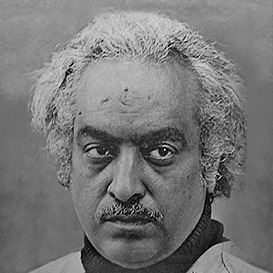 In his early years, G. R. Santosh took on various jobs, including working as a signboard painter, silk weaver, and whitewashing walls to support his family. His artistic journey began with watercolor landscapes under the guidance of Dina Nath Raina in Kashmir. He later pursued formal training at M.S. University, Baroda, studying under N. S. Bendre on the recommendation of S. H. Raza. Initially, his work reflected influences of Western artistic movements, particularly Cubism, marked by expressive brushstrokes and a vibrant color palette.
Spiritual Awakening & Neo-Tantric Art
A transformative moment in G. R. Santosh's career occurred in 1964 during a pilgrimage to the Amarnath caves in Kashmir. This profound experience ignited his deep exploration of Kashmir Shaivism and Tantric philosophy, drawing inspiration from the works of Abhinavagupta and Ajit Mookerjee’s Tantra Art: Its Philosophy and Physics. Influenced by these studies and a shift in consciousness, Santosh moved away from figurative representation, embracing abstract geometric forms imbued with rich symbolic meaning.
Artistic Style & Symbolism
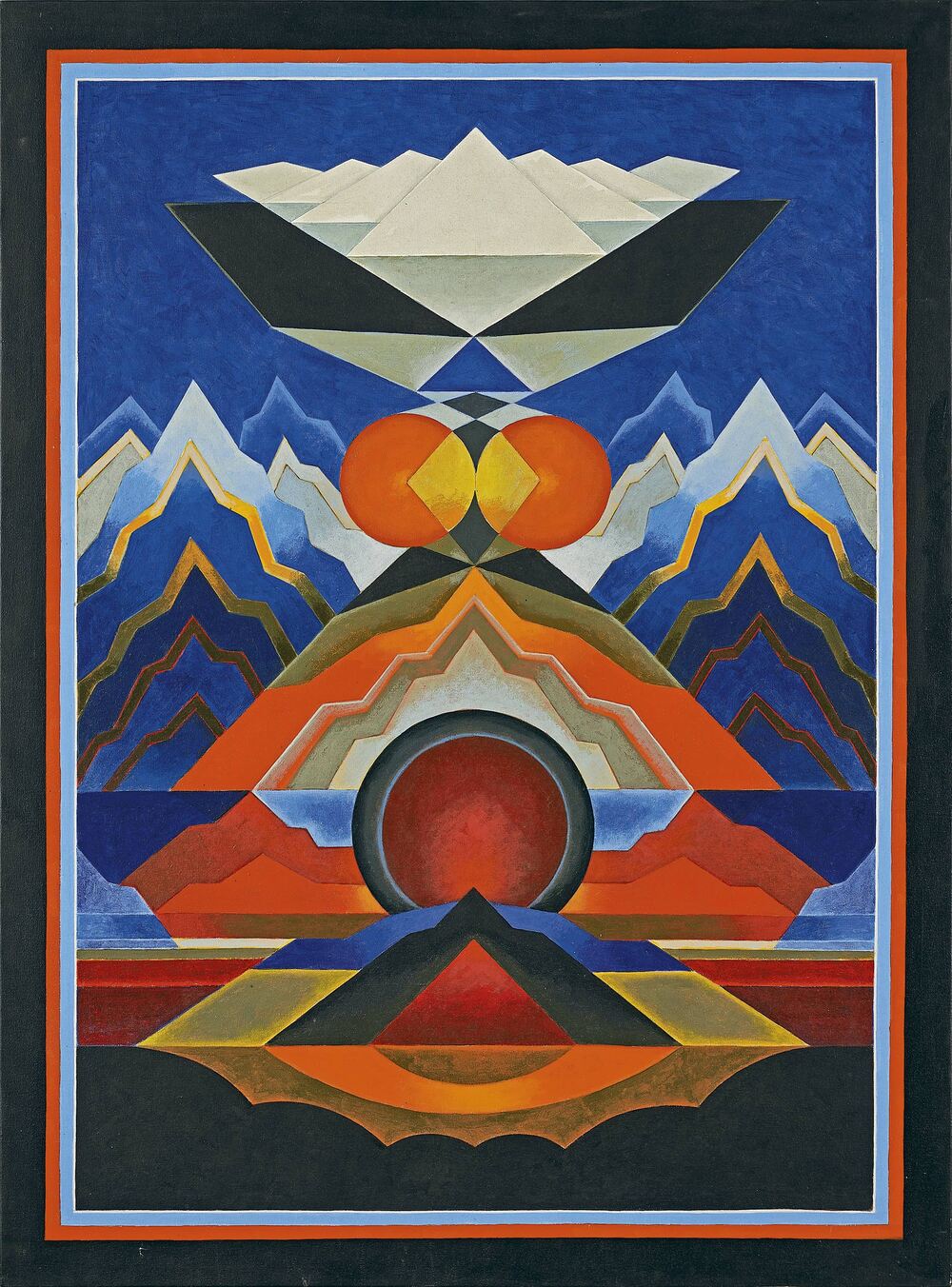
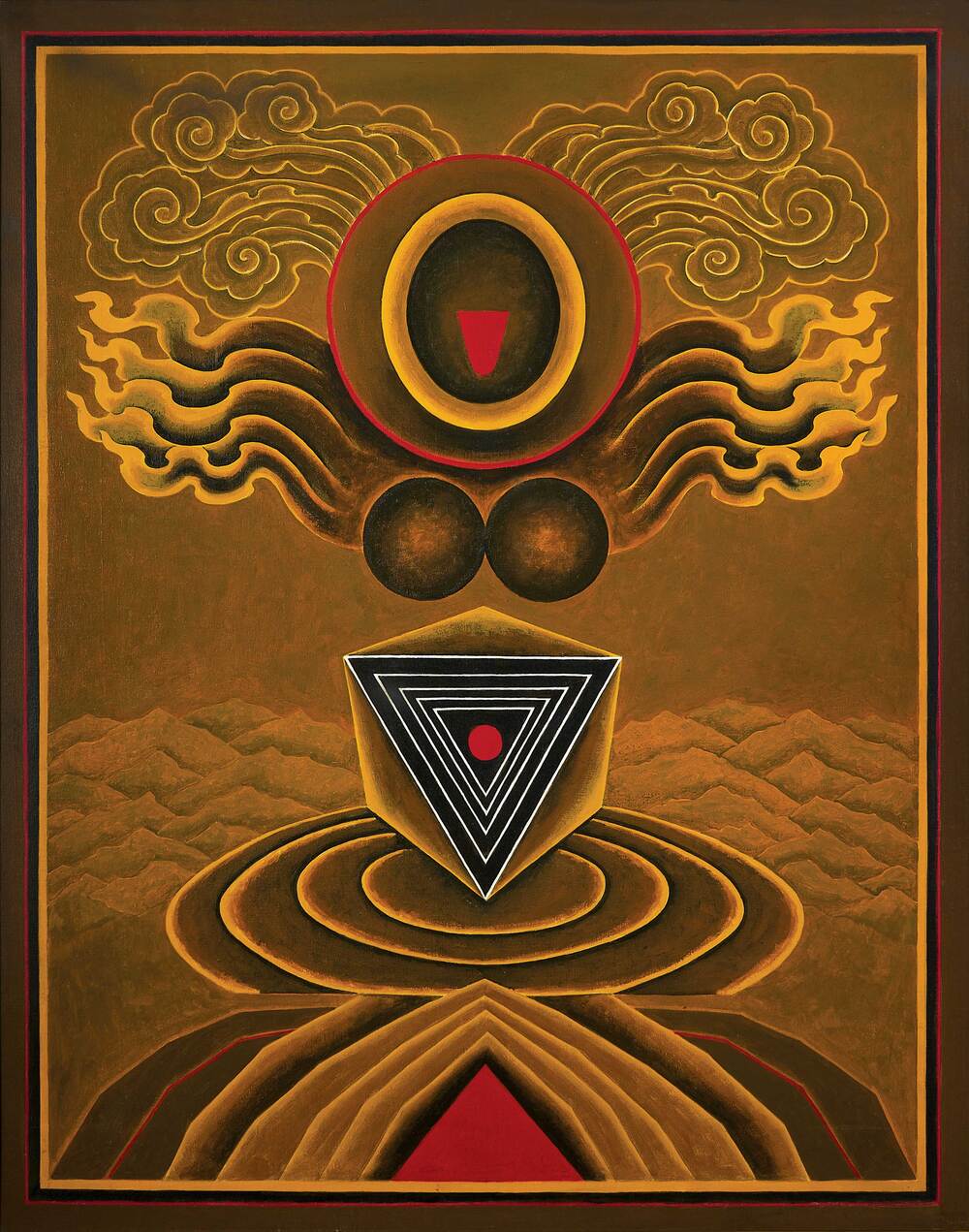
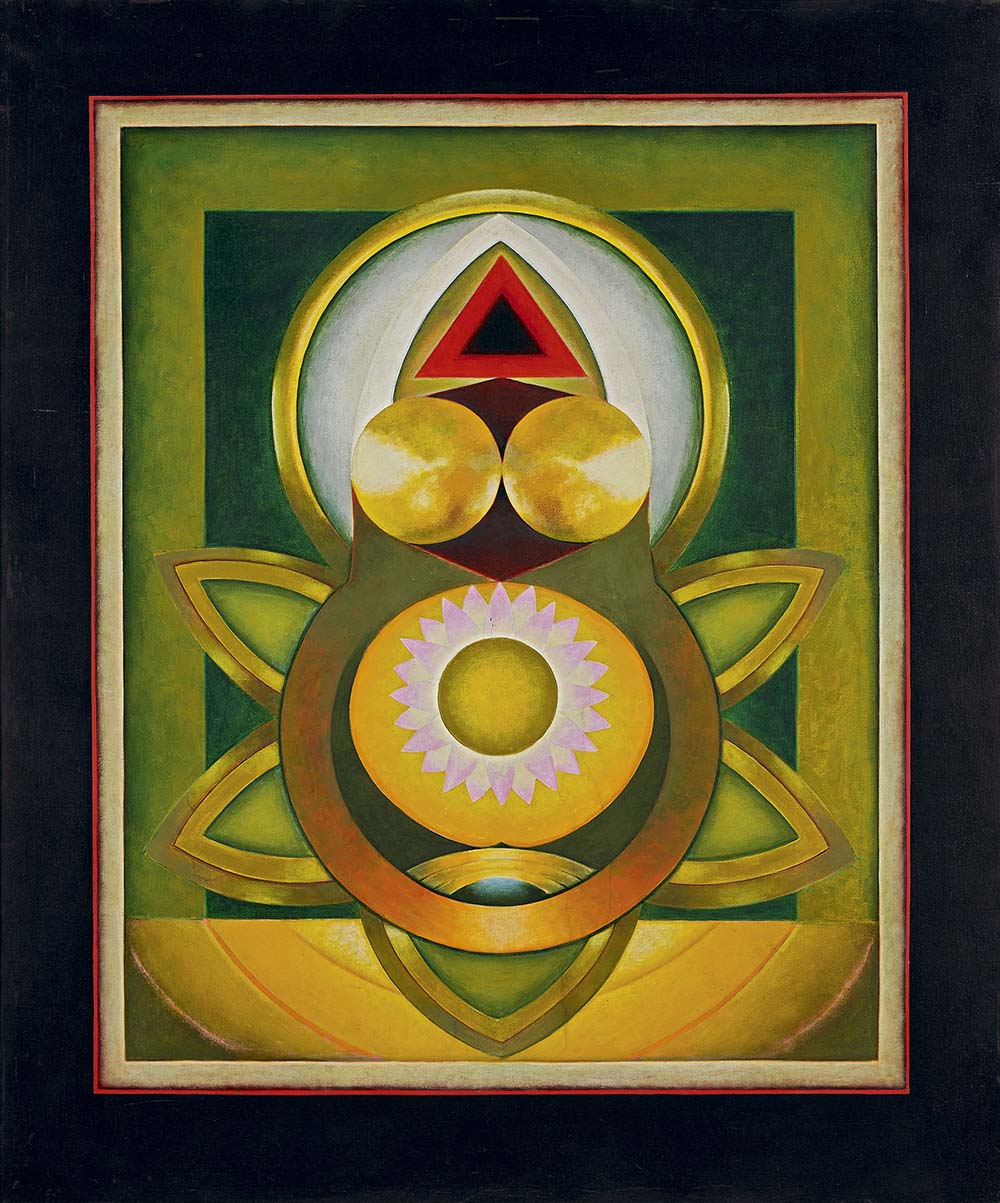
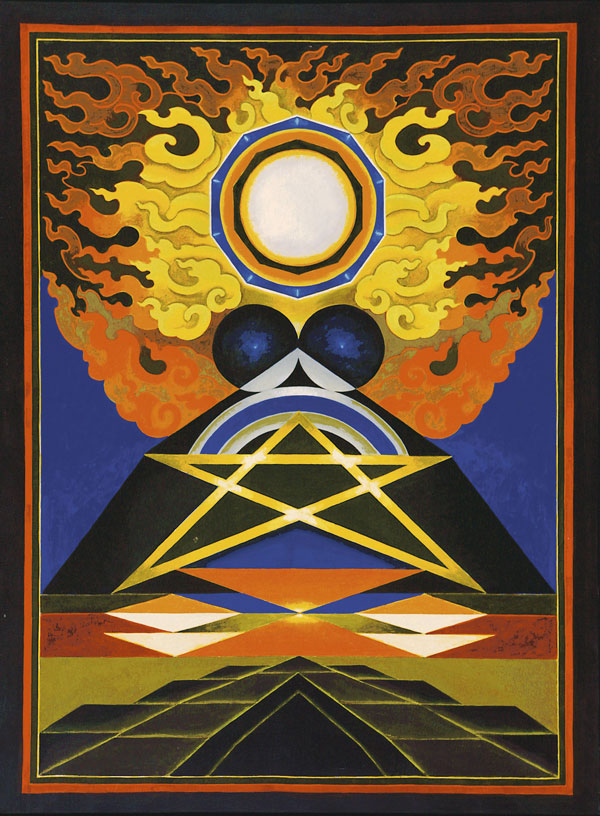
G R Santosh's Tantric paintings are notable for its vibrant colors and neat lines, which convey a sense of spiritual energy and sensuousness. The colors he used were symbolic: “Red” represented Shakti and sacred fire, “Green” symbolized life and happiness, “White” signified peace and purity & “Blue” denoted vastness and depth.
A defining characteristic of his Tantric paintings is the use of sacred geometry, deeply rooted in the philosophy of Advaita (non-duality), which emphasizes the interconnectedness of all existence. His Neo-Tantric works incorporate powerful forms such as Bindus (dots), Triangles, Circles (mandalas), Serpents and Hexagons to represent the union of Shiva and Shakti, the male (Purusha) and female (Prakriti) energies that are central to Tantric iconography.
Common symbols & forms in his work include the lotus, the triangle, the circle and the serpent, each carrying deep spiritual significance. The Lotus (purity and spiritual awakening), The Circle (eternal cycle of life and death), The Serpent (awakening of kundalini energy), The Triangle (balance of cosmic forces). These geometric symbols & forms symbolize the cosmic order and the interconnectedness of all existence. These elements are meticulously arranged to evoke a sense of spiritual awakening and cosmic consciousness.
Philosophical Underpinnings
At the core of G. R. Santosh's Tantric paintings is the philosophy of Kashmir Shaivism, which views reality as a manifestation of divine consciousness. This non-dualistic worldview perceives the universe as the interplay of Shiva (cosmic consciousness) and Shakti (creative energy). G R Santosh’s compositions often embody the integration of opposing forces—light and dark, male and female, static and dynamic—reflecting the Tantric pursuit of unity within duality. The geometric precision in his work mirrors the mathematical harmony of the cosmos, while his vibrant color palette captures the pulsating energy of existence.
The Essence of Tantra in Art
Tantra, an ancient spiritual tradition originating in India, is a profound and multifaceted philosophy that integrates rituals, meditation, and the pursuit of spiritual enlightenment. It emphasizes the union of the individual soul with universal consciousness, often employing symbolic imagery and geometric forms to depict this mystical journey. Tantric art, therefore, is not merely decorative; it serves as a powerful tool for meditation and spiritual awakening, guiding practitioners toward higher states of awareness.
Legacy
Beyond his visual art, G. R. Santosh was also a prolific writer and poet, deeply engaged with Tantric philosophy. His writings contributed significantly to the understanding and appreciation of this esoteric tradition. His Neo-Tantric paintings transcended geometric abstraction, transforming it from a formal exercise into a profound vehicle for spiritual expression. By bridging modern artistic practice with ancient wisdom traditions, he forged a path for Indian art that was both innovative and culturally authentic.
Poet-painter G R Santosh passed away in 1997, but his Tantric paintings continue to serve as vibrant portals into a reality where art, spirituality, and philosophy converge. Through their precise geometries and luminous colors, his work offers a glimpse into the artist’s profound realization—that while the ultimate nature of reality lies beyond form, it can paradoxically be approached through the careful arrangement of forms on a canvas.