


ganesh haloi - a maverick of modern indian art
.jpg&w=3840&q=75)
Fast Facts:
Date of Birth: 9 February 1936.
Place of Birth: Jamalpur, East Bengal (now Bangladesh).
Education: Government College of Art & Craft, Kolkata, in 1956.
Profession: Landscape Painter & Artist.
Painting Style: Abstract & Minimalist Art.
Biography
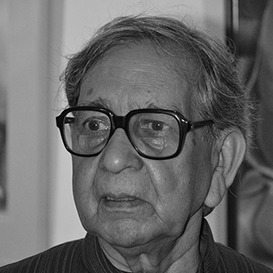 Artist Ganesh Haloi is a distinguished Indian landscape painter who was born in 1936 in East Bengal, now Bangladesh. During his childhood, he migrated to Kolkata during the partition. He graduated from the Government College of Art & Craft, Kolkata, in 1956 and subsequently joined the Archaeological Survey of India as a Senior Artist. From 1957 to 1963, he was assigned to work at Ajanta. Here, he created Ganesh Haloi drawings of Ajanta, fascinated with the murals he saw; the mandalas, apsaras, demons and lotus motifs painted on the walls of the heritage site lifted his artistic spirit.
In 1964, he began his tenure as a lecturer at the Government College of Art and Craft, Kolkata. As a teacher and mentor, Ganesh Haloi had a direct impact on the development of modern Indian painters and contributed significantly to the Kolkata art scene.
Today, Ganesh Haloi is regarded as one of India’s foremost contemporary artists. Ganesh Haloi’s paintings often evoke a sense of fluidity and movement, mirroring the way landscapes evolve, not only physically but in the minds and memories of those who experience them. Through abstraction, he captures the essence of time and place, often focusing on the rhythm of the earth, the sky and the subtle interplay of light and shadow. His works serve as visual meditations on life, memory and nature, inviting viewers to contemplate the silent forces shaping our world.
Early Life
Ganesh Haloi was born on February 9, 1936, in Jamalpur, Mymensingh (now in Bangladesh), on the banks of the Brahmaputra River. His early years were shaped by the lush landscapes of Bengal, which would later become a recurring theme in his art. The trauma of displacement following the Partition of India in 1950 forced Haloi and his family to migrate to Calcutta (now Kolkata), an upheaval that deeply influenced his emotional and artistic sensibilities.
Education
Ganesh Haloi graduated from the Government College of Art & Craft, Kolkata. His formal education was strongly rooted in academic realism and classical techniques. One of the most formative phases of his early career was working for the Archaeological Survey of India from 1957 to 1963, during which he copied murals at the Ajanta Caves. This exposure to Buddhist iconography, mural rhythms, and ancient Indian aesthetics had a lifelong influence on his style and spiritual approach to art.
Later Life
After settling in Kolkata, Haloi graduated from the Government College of Art and Craft in 1956. He joined the Archaeological Survey of India (ASI) as a senior artist, where from 1957 to 1963 he was tasked with documenting the Ajanta cave murals—a formative experience that left a lasting impact on his style and thematic choices. Returning to Kolkata, he began a long teaching career at his alma mater in 1964, shaping generations of artists until his retirement. Haloi remains an active member of The Society of Contemporary Artists, Kolkata, since 1971.
Artist Journey
Ganesh Haloi's artistic journey is a fascinating narrative of evolution and innovation in contemporary Indian art. He began his artistic journey under the tutelage of the famous Indian artist, Benode Behari Mukherjee. He went on to study at the Government College of Art and Craft in Kolkata, where he was deeply influenced by the works of European modernists such as Pablo Picasso and Henri Matisse.
Early in his career, he was influenced by realistic and figurative art, but over time, he moved toward abstraction as he sought to capture the inner essence of landscapes rather than simply their external forms. His rural upbringing, surrounded by the natural beauty of Bengal's rivers and fields, became a central theme in his work. Haloi’s distinctive style emerged in the 1960s and 1970s, when he began exploring abstract landscapes, blending bold, textured surfaces with subtle color gradients to evoke emotions and memories tied to specific places. His work reflects his belief in the interconnectedness of nature, time and memory, and he often sought to express the rhythms and silences of the land.
Over the decades, Haloi’s art has evolved, yet his focus on spiritual abstraction and his minimalistic approach to form have remained constant. Today, his work is recognized both in India and internationally and he is considered one of the leading figures in contemporary Indian painting.
Artistic Philosophy
Ganesh Haloi's artistic philosophy was a unique blend of traditional Indian art forms, modernist and abstract elements, and his own experiences as a painter, printmaker, and educator. He believed in synthesizing tradition and modernity, emphasizing the importance of line and form, and exploring the human condition through his art. His works often featured figures in contemplation, meditation, or introspection and were influenced by Indian philosophy and culture, including the Upanishads, the Bhagavad Gita, and Indian folk art & mythology. Haloi was also committed to education and community development, teaching at various art institutions in India and being involved in community-based art projects. Through his art, he sought to access the deeper, more profound aspects of human consciousness and provide a sense of connection to the divine, ultimately creating a new visual language that was both rooted in Indian culture and relevant to contemporary society.
Painting Style
Ganesh Haloi's painting style is characterized by its abstract, minimalist approach, deeply rooted in both personal experience and cultural heritage. His art style blends geometric forms, organic shapes, and a balanced use of line and color, with a limited palette to evoke calm and tranquility. Haloi’s distinctive technique involves meticulous layering, which he uses to create texture and depth, allowing the viewer to explore the subtle gradations and transitions within the painting.
His watercolor paintings are particularly noted for their fluidity and transparency, capturing fleeting moments and ephemeral qualities of light and shadow. Haloi’s work often conveys a spiritual dimension, drawing on eastern philosophies that emphasize balance, harmony, and the interconnectedness of all things. Ganesh Haloi's artwork moves beyond mere representation, inviting viewers to engage in a meditative experience that resonates with universal themes of nature, existence, and the metaphysical. Through this synthesis of abstraction and spiritual reflection, Haloi has developed a style that is both innovative and deeply resonant, making a significant contribution to the language of contemporary Indian art.
Famous Paintings
Ganesh Haloi's famous paintings include his Landscape Series & Abstract Compositions, which are characterized by a delicate balance of geometric forms, organic shapes & harmonious color palettes. His works, such as the "Kolkata Series" and the "Landscape Series," are particularly notable for their use of minimalistic forms, earthy tones, and intricate layering techniques, which capture the essence of both urban and natural landscapes.
In the "Kolkata Series" painting Ganesh Haloi explores the chaotic yet vibrant spirit of the city, employing a subtle interplay of light, shadow, and abstract shapes to convey its multi-layered cultural heritage. Meanwhile, his "Landscape Series" painting takes a contemplative approach, using geometric shapes and soft gradients to evoke a sense of tranquility and harmony with nature often reflecting his meditative process.
Landscape Series
Ganesh Haloi’s "Landscape Series" is celebrated for its abstract, contemplative approach to nature. These works use geometric shapes, soft gradients, and harmonious color palettes to evoke tranquility and a meditative connection with the land. The paintings often reflect his personal memories of the lush, moisture-laden landscapes of his native Jamalpur, as well as the experience of displacement after the Partition.
Kolkata Series
In the "Kolkata Series," Ganesh Haloi explores the vibrant, chaotic spirit of Kolkata. These paintings use minimalistic forms, earthy tones, and intricate layering to capture the city’s cultural complexity. The interplay of light, shadow, and abstract shapes in these works conveys both the dynamism and layered heritage of urban life.
Memoryscape (2002, gouache on paper)
A layering of earthy-toned patches and semi-geometric forms merges landscape with emotion. The work’s subtle interplay of abstract contours reflects Haloi’s attempt to visualize inner landscapes through external elements.
Manikarnika Ghat (1999, tempera on board)
Depicting the iconic cremation ghats of Varanasi, this mature-era painting condenses complex sacred geography into bold, symbolic blocks combining memory, ritual and abstraction. It has appeared at auction, reflecting its strong market recognition.
Rajasthan Series (2000, gouache on paper)
Inspired by Rajasthan’s architecture, this piece arranges forms in a bird’s-eye, quilt-like composition that abstracts built landscapes into planar color fields.
Scroll Works (2021–22, Chinese ink + gouache on Japanese paper)
Tall vertical scrolls explore flora, bamboo patterns, misty mountains, and a crane motif. Some evoke tapestry-like abstractions; others suggest distant landscapes through graded ink washes.
Gouache Works (2009–16, on paper/board)
Featured at Documenta?14 (2017), these works weave together fragmented natural forms—pond ripples, paddy fields, rocky terrain—using layered gouache to evoke both memory and place.
Spiritual Paintings
Ganesh Haloi’s art often embodies a deep sense of spirituality. His use of form, color and texture evokes transcendence or the sublime, aiming to connect viewers with a deeper, often ineffable experience. His artistic process itself is meditative. The meticulous layering and textural techniques are not just technical exercises but also spiritual practices; this is evident in his Untitled “gouache on paper work”. This series was influenced by Eastern spiritual philosophies, including ideas of balance, harmony, and the interconnectedness of all things. His abstract art frequently aims to capture the sublime—a sense of awe and wonder that transcends the ordinary through subtle, introspective elements. Through his work, Haloi invites viewers to contemplate the delicate balance between man and the environment, often emphasizing themes of harmony, dissonance and coexistence.
Key Spiritual Works
The Lord Buddha the Enlightened One: This is one of his most significant spiritual paintings, executed in oil on canvas 115 x 86cm (45 1/4 x 33 7/8in). The work demonstrates his deep connection to Buddhist philosophy and Eastern spiritual traditions. The painting reflects his understanding of enlightenment and spiritual awakening.
Characteristic Features of His Paintings
Abstract Inner Landscapes: Haloi's paintings transitioned from figurative to abstract, moving toward what critics call “innerscapes”; landscapes of memory and emotion rather than topography.
Medium Mastery: He is known for his control over gouache, tempera, and ink on paper, often working with delicate layers and a meditative palette.
Buddhist Philosophy: His work reflects quietude and balance, echoing the cyclicality and impermanence found in Buddhist thought.
Geometry and Nature: His later works fuse geometric grids, architectural outlines, and natural forms like ripples, leaves, and fields distilled into spiritual abstractions.
Scroll Format & Paper Sensibility: In recent decades, Haloi has created scroll paintings influenced by East Asian traditions, using handmade Japanese and Nepali paper.
Books
Ganesh Haloi is also an author. His autobiography, Amar Katha, received the Manojmohan Basu Smarak Samman award. He has contributed essays and reflections on art, further enriching the discourse on Indian modernism.
Awards
Here are some of the notable awards won by Ganesh Haloi :
1. National Award for Painting (1976): Haloi received this prestigious award from the Government of India for his outstanding contribution to the field of painting.
2. Kalidas Samman (1992): This award was conferred upon Haloi by the Government of Madhya Pradesh for his exceptional work in the field of art.
3. West Bengal State Academy Award (1995): Haloi received this award from the Government of West Bengal for his outstanding contribution to the field of painting.
4. Rabindra Bharati University Award (2002): This award was given to Haloi by Rabindra Bharati University for his outstanding work in the field of art.
5. Birla Academy of Art and Culture Award (2005): Haloi received this award from the Birla Academy of Art and Culture for his exceptional work in the field of painting.
Contribution To Indian Art
Ganesh Haloi has left a lasting impact on Indian art history. His innovative approach to abstraction and texture, combined with his exploration of natural themes, has cemented his status as a key figure among modern Indian painters. His work is also deeply connected to the Bengal School of Art, with elements reflecting the influence of the Bengal School. Haloi continues to work and live in Calcutta, India, remaining a significant and influential figure in the Indian art scene.
Enduring Legacy & Impact
Ganesh Haloi is regarded as a master of modern Indian abstraction, particularly in the Bengal modernist tradition. His subtle compositions have influenced younger artists interested in meditative art, abstraction, and the poetics of memory. His participation in Documenta 14 (Germany, 2017)—one of the most prestigious global art platforms—affirmed his global relevance. His works are in major collections, including the National Gallery of Modern Art (India), KNMA, and several international private collections.
Lesser-Known Facts
• He never works with assistants. Every line and wash is applied by his own hand.
• His love for Indian classical music and Tagore’s poetry often inspires the rhythmic flow in his visual compositions.
• He refers to painting as a “ritual of silence”, akin to spiritual practice.
• Despite global acclaim, he has rarely travelled outside India, preferring the introspective life of a studio artist.
• His long walks in Kolkata’s parks and old quarters are central to his artistic rhythm and visual memory.
Conclusion
In conclusion, Ganesh Haloi has made an indelible mark on the Indian art scene with his exceptional artworks that transcend the boundaries of traditional and contemporary styles. Known for his emotive landscapes and the harmonious use of color, his beautiful paintings often evoke a deep connection with nature, reflecting his personal experiences and spiritual reflections. His mastery of diverse mediums, from canvas paintings to oil paintings, has allowed him to experiment with texture and form, creating pieces that are both evocative and visually striking. Whether it’s a serene wall painting or a finely detailed oil painting, Ganesh Haloi’s works speak to the viewer’s soul, inviting them into a world of tranquility and reflection.
The wide-ranging appeal of Ganesh Haloi prints and his prominent presence at auctions further demonstrate the enduring popularity and significance of his work. Collectors and art enthusiasts alike continue to seek out his pieces, recognizing the artist's ability to infuse life and emotion into every brushstroke. As his legacy continues to grow, Ganesh Haloi remains a celebrated figure in Indian contemporary art, with his evocative canvas paintings standing as testament to his innovative spirit and profound artistic vision.
As we conclude our journey through the remarkable world of Ganesh Haloi, we invite you to explore his original paintings in greater depth. Click here to discover the stories behind the brushstrokes and the emotions that bring his art to life.




