jamini roy - three pujarins (1937) | overview
.jpg&w=3840&q=75)
Jamini Roy’s Three Pujarins, translated as “Three Priestesses” or “Three Women Worshippers” is a tempera on paper board painting measuring 36.5 x 70.5 cm. The artwork portrays three women engaged in ritual worship, symbolizing priestesses performing sacred rites. This article offers a comprehensive overview of Three Pujarins, examining its conceptual foundation, artistic techniques, and the broader thematic concerns it reflects within the context of Jamini Roy’s distinctive visual language and cultural engagement.
Overview
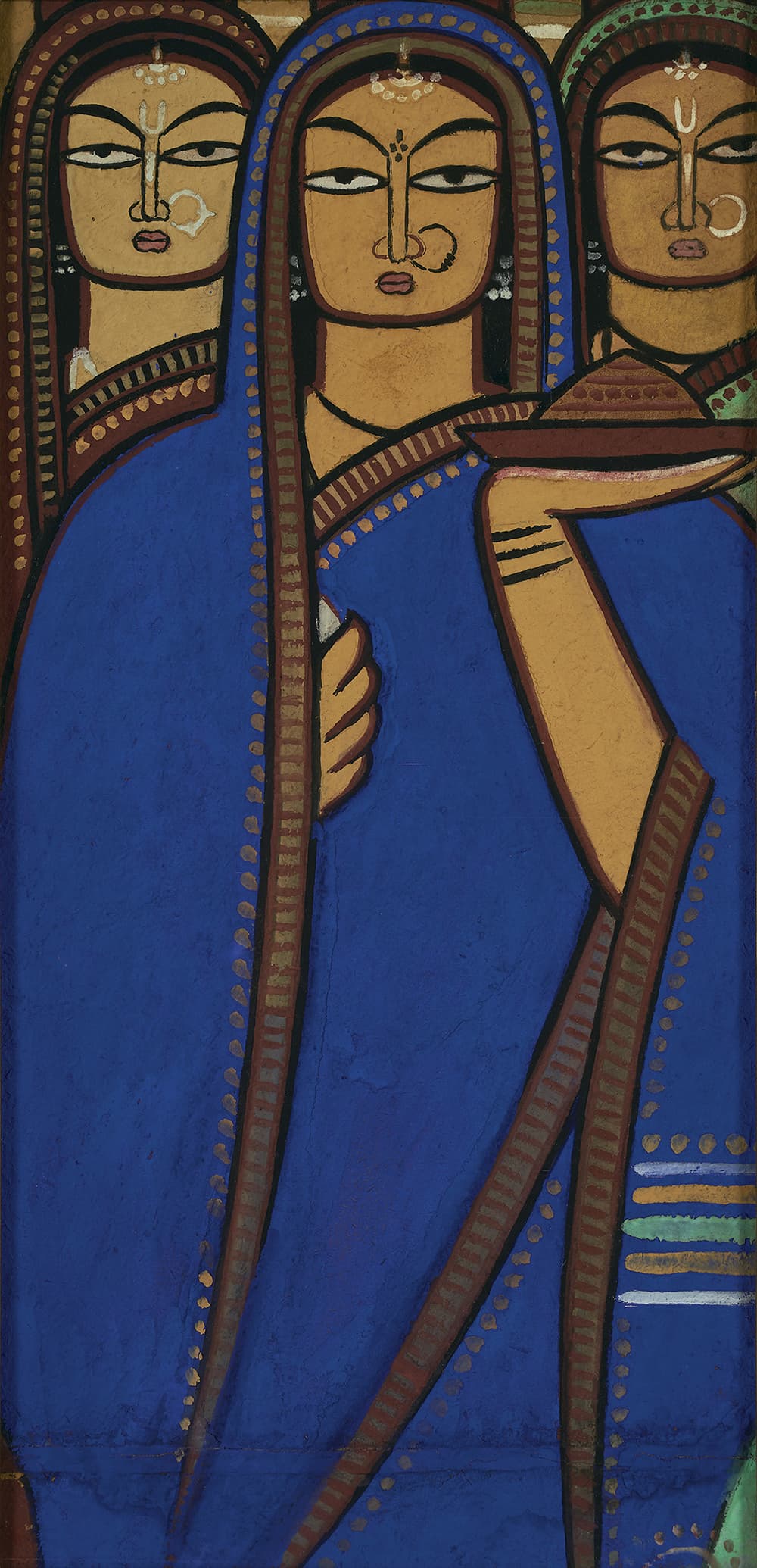
"Three Pujarins" depicts three women engaged in devotional practices. The painting is notable for its elongated figures, simplistic facial features, and the use of primary colors such as blue, yellow, and red. The women, adorned with traditional nose rings, exude a serene aura, embodying the sacredness of their ritualistic engagement.
Artistic Style and Technique
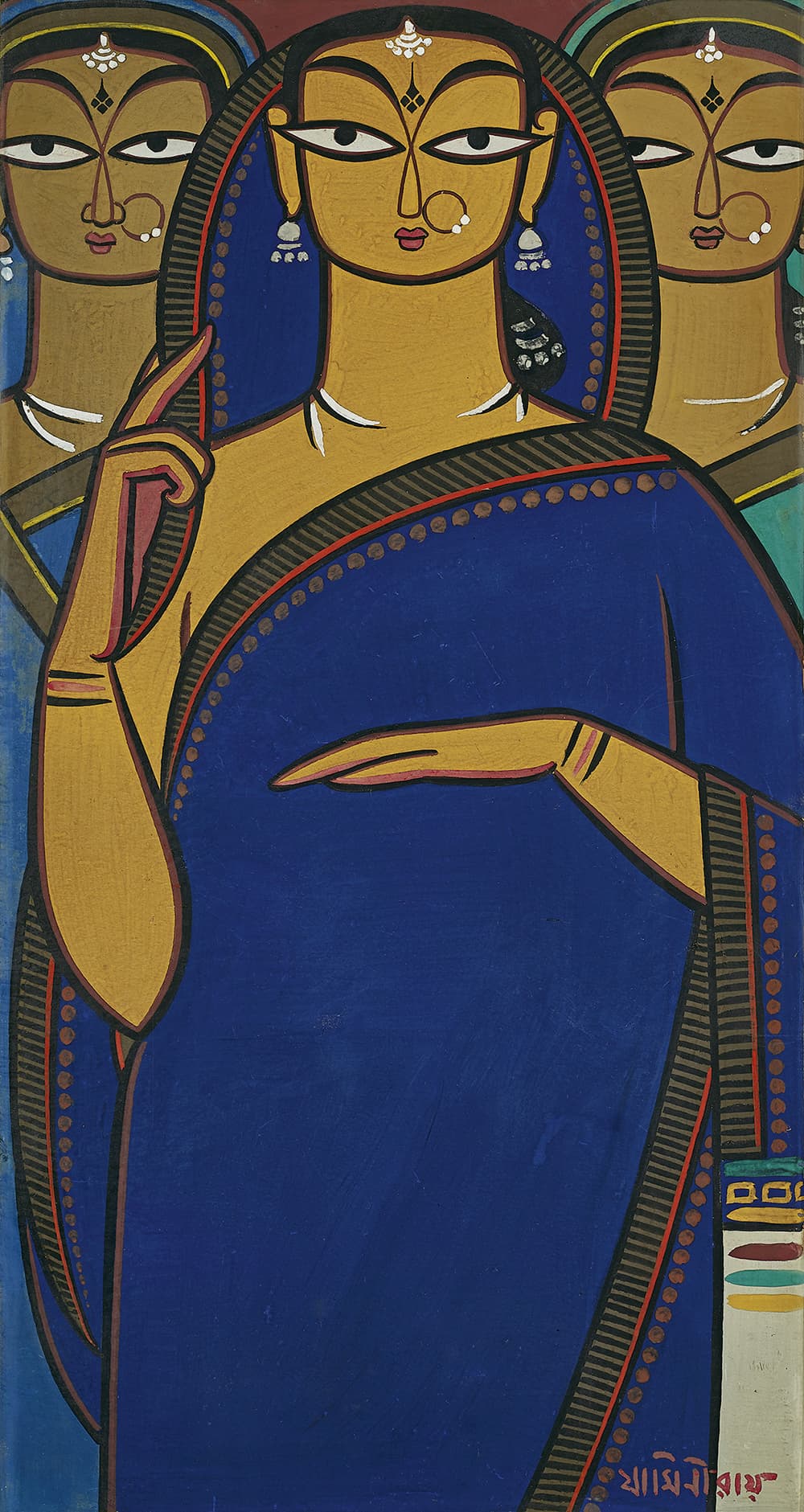 In Three Pujarins, Jamini Roy employs bold, sweeping lines and a flattened perspective—distinctive features of his mature style, shaped significantly by the Kalighat painting tradition. The composition presents three women immersed in worship, their figures delineated with thick black contours and rendered in flat, vibrant tones of blue, yellow, and red. The use of blue, in particular, evokes a sense of serenity and stability, underscoring Roy’s profound engagement with village iconography and rural sensibilities. The color palette is deliberately limited and earthy, featuring ochres, browns, and muted tones that reflect the natural pigments used in traditional Indian painting. This choice was both aesthetic and philosophical, representing Roy's rejection of industrial materials in favor of traditional, locally-sourced pigments that connected his work to centuries of Indian artistic practice. Executed in tempera on paper board, the work possesses a rich tactile quality, with the medium imparting a subtle texture that enhances the visual depth and material presence of the painting.
Cultural and Symbolic Significance
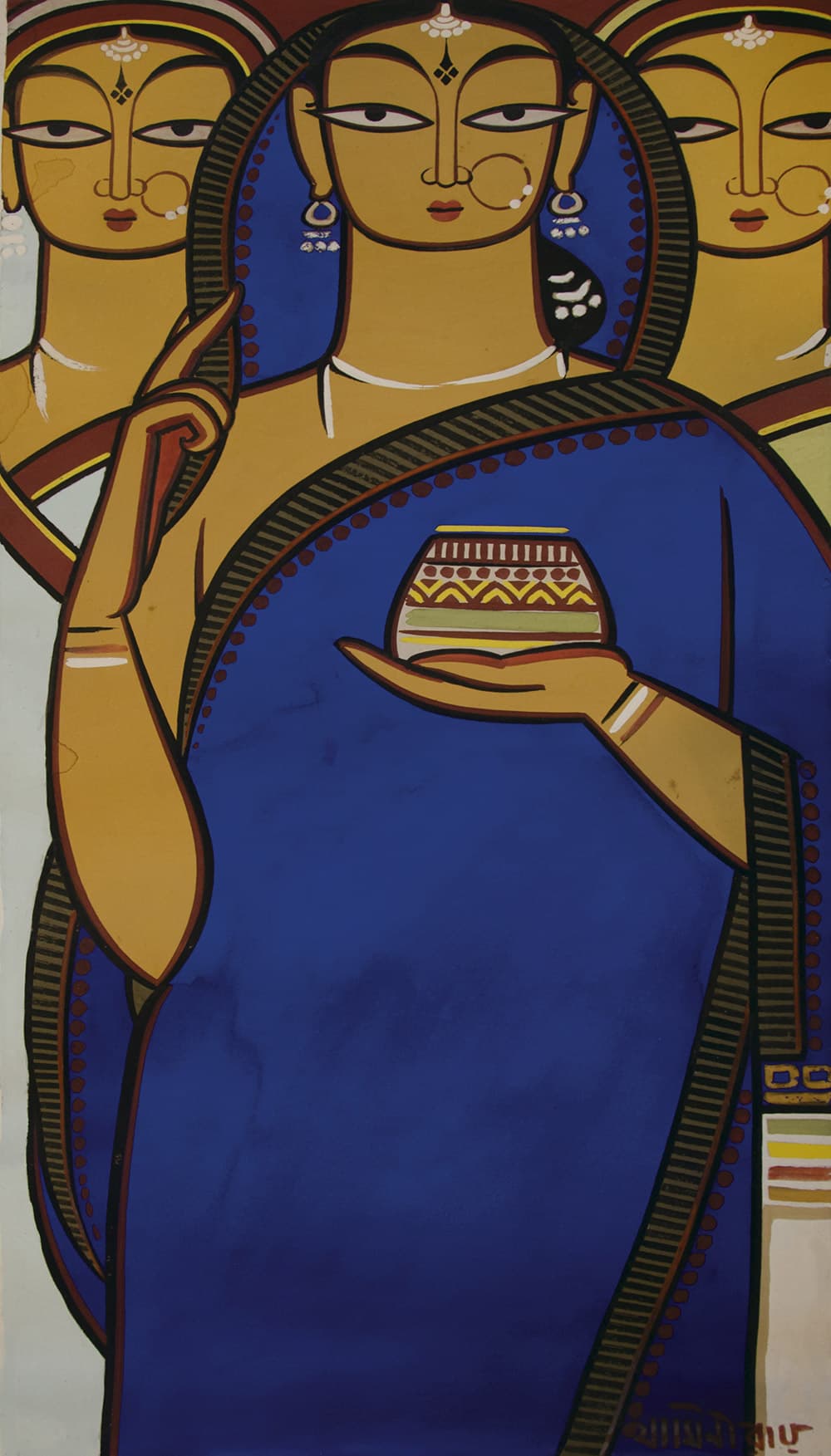 The painting reflects Roy's deep engagement with the cultural and spiritual life of rural Bengal. By portraying ordinary women as central figures in a religious context, he elevates their status and underscores the integral role of women in devotional practices. The serene expressions and direct gazes of the pujarins convey a sense of inner tranquility and spiritual focus, inviting viewers to contemplate the universal themes of faith and devotion.
Religious Significance
The subject matter of "Three Pujarins" reflects Roy's deep engagement with Bengali Hindu culture and religious practices. Pujarins, or female devotees engaged in worship, represent the essential role of women in maintaining spiritual traditions within Bengali society. By choosing this subject, Roy honored both the feminine divine principle that is central to Bengali Hinduism and the everyday spiritual practices of ordinary women.
The painting captures the meditative quality of religious devotion, with the three figures absorbed in their ritual activities. This representation goes beyond mere documentation; it elevates the everyday spiritual practice to the level of high art, suggesting that authentic Indian art should emerge from and speak to indigenous spiritual and cultural experiences.
Historical Context and Artistic Movement
 "Three Pujarins" was created during a pivotal period in Indian art history when artists were grappling with questions of cultural identity, colonial influence, and artistic authenticity. Jamini Roy's work emerged alongside the broader Swadeshi movement, which advocated for cultural and economic independence from British colonial rule.
The painting represents a crucial moment in the development of modern Indian art, when artists began to look inward to their own traditions rather than outward to European models for inspiration. Roy's approach influenced a generation of Indian artists who sought to create a distinctly Indian modernism that was neither a rejection of modernity nor an uncritical acceptance of Western artistic values.
Legacy and Influence
The impact of "Three Pujarins" and Roy's broader artistic philosophy extended far beyond the art world. His work demonstrated that Indian artists could create sophisticated, contemporary art while remaining rooted in their own cultural traditions. This approach provided a model for cultural authenticity that resonated with the broader independence movement and influenced subsequent generations of Indian artists.
Jamini Roy's technique of simplification and stylization, evident in "Three Pujarins," showed how traditional forms could be adapted to express modern sensibilities without losing their essential character. This balance between tradition and innovation became a defining characteristic of Indian modern art and influenced artists across South Asia and beyond.
Conclusion
Jamini Roy’s Three Pujarins is a masterpiece of cultural reclamation—a quiet yet powerful ode to rural spirituality and feminine resilience. Through the distilled simplicity of its devotional imagery, Jamini Roy crafted a composition that transcends temporal boundaries, affirming that the essence of enduring art lies in its authenticity. The painting occupies a significant place in the canon of Indian modern art, capturing the spirit of Bengal while resonating with the universal language of faith and reverence.