jamini roy - exploring the quintessence of india’s folk art
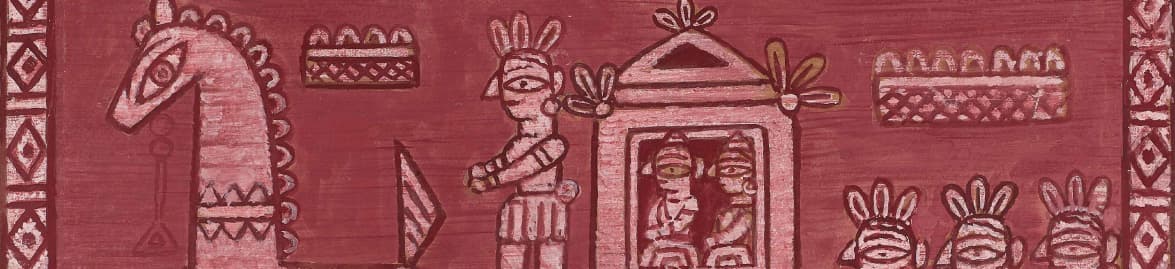
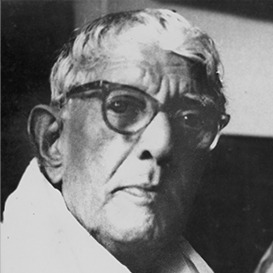 Jamini Roy (1887–1972), one of the most famous painters of the late 19th & mid-20th centuries, is celebrated as one of the prestigious 'Navaratnas' (nine gems) as declared by the Indian government. His art is considered a national treasure, making it illegal to sell his works outside the country. So, who is this artist & what is his life story? With this article we try to offer here a glimpse into the life and legacy of Jamini Roy, whose innovative style and deep connection to Indian folk art has played a pivotal role in redefining modern Indian art.
Early Life & Education
Jamini Ramataran Roy was born on April 11, 1887 in the village of Beliatore, located in the Bankura district of West Bengal, India into a Bengali Brahmin family. Beliatore was a culturally rich region known for its traditional art forms, including terracotta crafts and folk paintings. Roy's family had a rich cultural heritage, and his early years were marked by a deep connection to the land and the vibrant folk traditions of Bengal. The village of Beliatore was known for its terracotta temples and the Kalighat paintings, which would become significant influences on Jamini Roy's later work. During his early years, he spent time with clay modellers, learning and absorbing his first artistic lessons from them.
Jamini Roy received his early education in his native village of Beliatore, located in the Bankura district of West Bengal. His formal schooling began at the local village school, where he exhibited a natural aptitude for drawing. Recognizing his artistic talent, his teachers and family, particularly his father Ramataran Roy provided encouragement and support. Although a landowner by profession, Ramataran Roy valued artistic pursuits and nurtured his son's creative inclinations.
A pivotal phase of Jamini Roy’s education began in 1903 when, at the age of 16, he moved to Calcutta (now Kolkata) to enroll at the esteemed Government School of Art, now known as the Government College of Art & Craft. Established by the British in 1854, this institution was regarded as the premier center for art education in India at the time. During his five-year tenure (1903–1908) Roy received rigorous training in European academic traditions, which emphasized realism. Under the mentorship of distinguished faculty members including Abanindranath Tagore, the founder of the Bengal School of Art and then vice-principal of the institution. Jamini Roy mastered techniques such as classical figure drawing and oil painting on canvas, which were hallmarks of European artistic conventions. In 1908, he successfully completed his studies and was awarded a Diploma in Fine Arts.
Following his formal education, Jamini Roy pursued a career as a commissioned portrait painter, creating works for affluent Bengali clients and British patrons. This period allowed him to refine his technique further, reinforcing his academic training. However, by the early 1920s, he grew increasingly disenchanted with the Western artistic styles he had been taught. Seeking a more authentic and indigenous artistic expression, he turned to the traditional folk art of Bengal. Inspired by styles such as the Kalighat Pat tradition characterized by bold, sweeping brushstrokes and simplified forms, he deliberately moved away from European realism. This transition marked a defining moment in his career, as he sought to develop an art form deeply rooted in Indian cultural heritage and identity.
Family
 Jamini Roy was born into a moderately prosperous Kayastha family of landowners. His family lineage can be traced back nearly two centuries before his birth, when Kachu Roy settled in Beliatore. Kachu Roy had three sons i.e Atmaram Roy, Banchharam Roy and Panchanan Roy. Jamini Roy was the great-grandson of Panchanan Roy.
Jamini Roy's mother Gayatri Devi was a house-wife while his father Ramataran Roy worked in government service but later chose to leave his job to live among the potters in his village, an environment that profoundly influenced Jamini Roy’s artistic sensibilities. Notably, Basanta Ranjan Roy Bidvatballava, a distinguished scholar known for his association with Srikrishnakirtan, was Jamini Roy’s cousin. Jamini Roy’s sister, Sujankumari, also contributed significantly to the family's legacy. She established a primary school in the village, which initially served upper-caste students but later expanded to accommodate a larger number of Bauri students, reflecting her commitment to inclusive education.
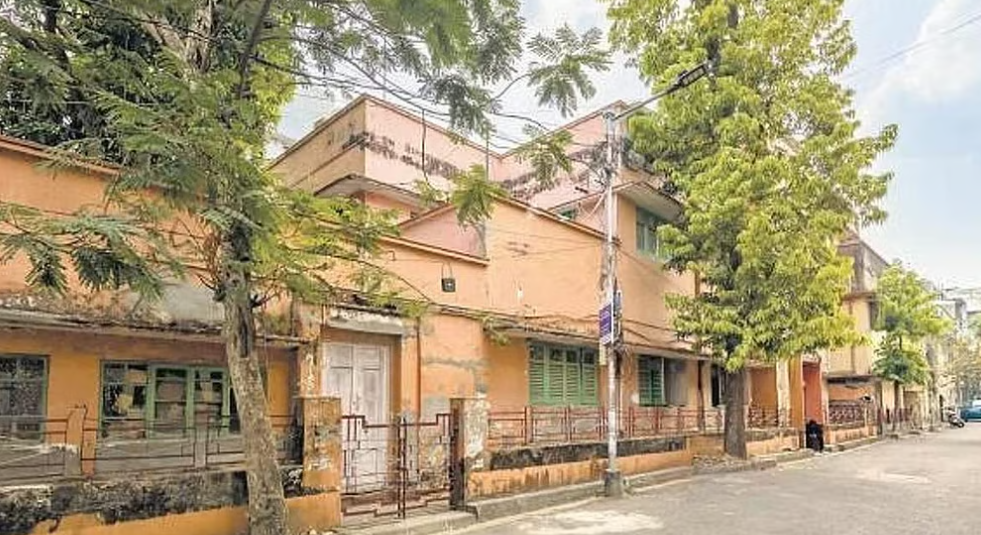
Jamini Roy’s house in Ballygunge Place, Kolkata.
In 1916, while still a student at the Government School of Art in Calcutta, Jamini Roy married Amiyasundari Devi. The couple had four sons and a daughter. In 1949, Jamini Roy relocated from his home in Baghbazar, North Kolkata, to the Ballygunge Place neighborhood, where he built a bungalow in multiple phases. At the time, Ballygunge Place was a serene area with open fields and bungalows owned by the city’s commercial and professional elite, unlike its present-day landscape filled with cafés, galleries, and schools. Jamini Roy designed the initial single-storeyed structure in collaboration with his fourth son Amiya Roy. As the family grew, additional floors and rooms were added to the home. Designed by Jamini Roy himself, the house features glass-paneled staircases, spacious rooms and open windows. It served as both his residence and studio, where he often painted under a mango tree in the garden. Over the years, this home was visited by eminent personalities such as Rabindranath Tagore, Sarojini Naidu, Indira Gandhi and Rajiv Gandhi. Jamini Roy resided in this house with his family until his passing in 1972. Following his passing, his descendants, including Jamini Roy's granddaughter Sanghamitra Roy (daughter of Amiya Roy) & great granddaughter Arkamitra Roy have transformed his house into India’s first private single-artist museum, ensuring the preservation of his artistic contributions for future generations.
Painting Style
Jamini Roy art style is typically referred to as "Neo-Bengali" art style and later evolved into a "Folk Art-Inspired Modernism" or "Traditional Revivalism". This style is also is sometimes referred to as "Indian Primitivism" characterized by its linear, decorative and colorful elements drawing heavily on local art forms such as the Rural Patachitra, Kalighat Pat, Clay Figurines & Terracotta Temple Sculptures of Vishnupur.
Initially trained in European academic techniques, Jamini Roy's early works featured portraits and landscapes influenced by Impressionism and Post-Impressionism. However, during the 1920s, he underwent a significant artistic transformation, shifting his focus toward indigenous themes and experimenting with folk-inspired forms and techniques.
By the mid-1920s, his style became more refined, characterized by controlled brushwork and on some series, monochromatic palettes. During this period, he abandoned conventional artistic practices and began creating works on self-prepared surfaces, including cloth, wood and lime-coated mats. He also transitioned to using natural pigments derived from earthen and vegetable sources, aligning his materials with the traditional techniques that inspired him. Jamini Roy drew inspiration from predecessors such as Abanindranath Tagore and Raja Ravi Varma, adopting rhythmic outlines, structured patterns, and vibrant colors. His distinctive artistic approach gained widespread recognition and by the 1940s, his works had become highly sought after, particularly in Bengal and Europe.
During World War II, Jamini Roy’s paintings gained further prominence when American officers and army personnel purchased them at premium prices. This surge in international interest helped elevate his reputation among art connoisseurs and the middle class alike. In keeping with the traditions of rural folk painters and potters of Bengal, Roy utilized inexpensive indigenous pigments, ensuring that his art remained accessible to both the affluent and the common people. His commitment to reviving and redefining Indian folk art played a crucial role in shaping the trajectory of modern Indian painting.
Painting Themes
Jamini Roy's oeuvre is distinguished by its thematic richness, reflecting his profound engagement with rural life, Hindu mythology, and Christian iconography. His work can be broadly categorized into three principal themes: the quotidian existence of Rural Bengal, Hindu Mythological Narratives & Christian Imagery.
Depictions of Rural Bengal - Jamini Roy's deep affinity for rural life is evident in his numerous portrayals of everyday activities. Drawing inspiration from folk dolls, children's art, and the traditional 'patas' of rural Bengal, he depicted scenes such as women engaged in household chores, farmers laboring in fields, and children at play. His particular interest in the Santhal tribal community led to vivid representations of their daily life—harvesting, dancing, and musical performances—capturing the joy and rhythm intrinsic to Santhal culture. These works, characterized by bold, simplified forms and flat compositions influenced by Kalighat paintings, are both accessible and visually striking.
Hindu Mythological Narratives - Jamini Roy extensively explored Hindu mythological subjects, creating iconic series like the "Ramayana" and "Krishna Leela." His "Ramayana," comprising 17 canvases, is considered a magnum opus, featuring simplified forms inspired by the Kalighat pata style. He portrayed epic narratives with bold lines, decorative motifs, and earthy colors, making them accessible to the general populace. His depictions of Radha-Krishna and other mythological figures often conveyed a sense of divine romance and pastoral beauty.
Christian Imagery - In the 1940s, Jamini Roy embarked on a compelling series centered on the life of Jesus Christ. These paintings adapted biblical stories into Indian visual traditions, portraying Christ with almond-shaped eyes and hieratic poses reminiscent of folk art figures. Works like "Crucifixion" and "Flight to Egypt" exemplify his ability to blend foreign themes with local aesthetics, imparting a uniquely Indian identity to these narratives.
Painting Techniques
Jamini Roy gained widespread recognition by developing a distinctive artistic language, which he referred to as the 'Flat Technique.' Moving away from commercially available tube colors, he meticulously prepared his own pigments using natural materials, drawing inspiration from the traditional methods of village patuas (folk artists). Like the patua painters of Bengal, he relied on indigenous materials such as lampblack, chalk powder, leaves, and creepers, employing a palette of seven fundamental colors: Indian red, yellow ochre, cadmium green, vermilion, grey, blue and white.
In alignment with his vision of creating authentic Indian art, Roy chose unconventional surfaces such as cloth, wood, and mats instead of canvas. His brushwork was fluid and calligraphic, often eliminating unnecessary background details to emphasize the essence of his subjects. His compositions typically adhered to rectangular formats, with figures arranged frontally or in profile. Rather than employing perspective or three-dimensional modeling, he achieved depth through the strategic placement of figures and compositional elements.
Jamini Roy frequently sketched his compositions beforehand, refining the design before applying color. He often created multiple iterations of the same subject, making subtle adjustments to composition and color balance in each version. Unlike traditional Western paintings, where signatures are placed in the corner, he integrated his signature in Bengali script as a seamless design element within the composition, further reinforcing his distinctive artistic identity.
Famous Paintings
Jamini Roy's works often drew inspiration from folk traditions, particularly Kalighat and Patachitra styles. Here are some famous paintings by him:
• The Santhal Paintings - In the 1920’s, Jamini Roy did a series of paintings featuring women from the Santhal community, an indigenous tribe found mostly in the Indian states of Bihar, West Bengal, Jharkhand, and Orissa. Painted sensuously, in angular lines, Roy’s paintings captured the women engaged in daily chores. They portrayed the romantic simplicity of their lives, and reflected upon the complexity of their relationship with their environment. His paintings from this time, are dotted with stories and cultural curiosities that reveal his connection with the community, and celebrate the integral dignity of their humble life. Roy’s fascination with the indigenous way of life is also reflected in the way he adopted the animal motifs from Indian folk-art drawing and depicted them in playful forms through his artwork.
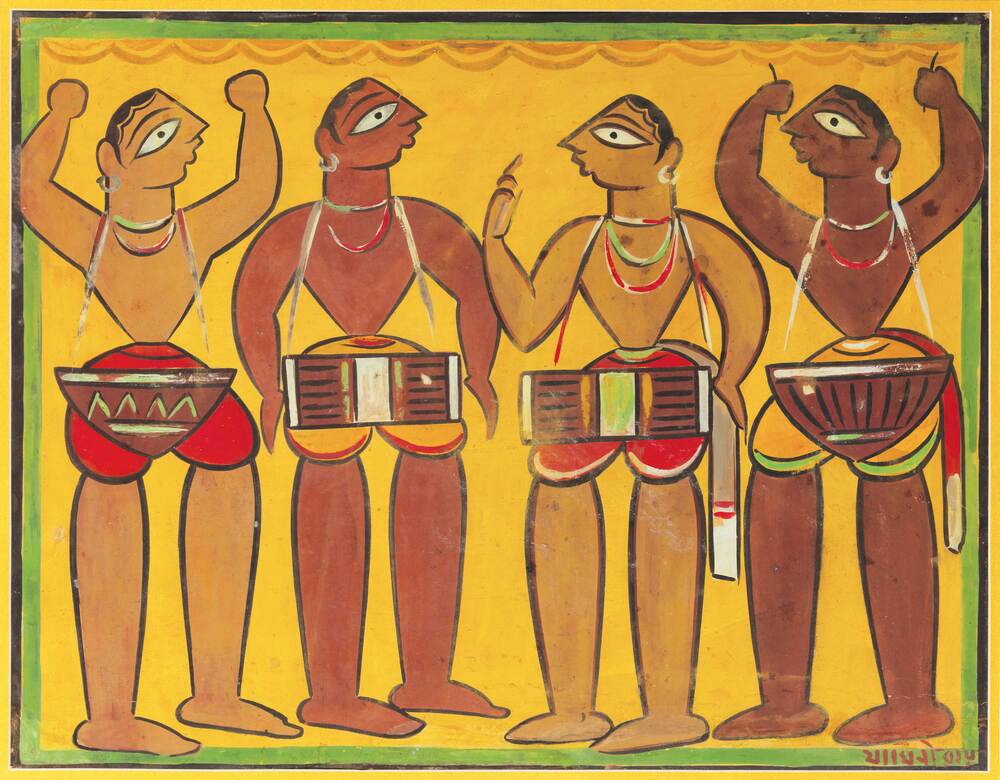 Santhal Painting by Jamini Roy, Tempera on cardboard, 16 x 20 in.
• Calligraphic Brush Drawings - Another remarkable series of works from the 1920’s are a set of monochromatic brush drawings that seem to be inspired by East Asian paintings styles like Kalighat Pats. Drawn from everyday life featuring women, children etc, these works are characterised by sweeping, calligraphic lines, that reveal Jamini Roy’s mastery and control over his brushwork and the proportion of his figures.
• Mother & Child Paintings - Jamini Roy’s Mother and Child paintings are iconic examples of his exploration of Indian folk art traditions and themes of universal human connection. These works typically depict a mother tenderly holding her child, rendered in bold lines, earthy colors and a style inspired by Kalighat patachitra and Bengali folk art. The simplicity of form and profound emotional depth in these paintings reflect Jamini Roy’s intention to celebrate the sanctity of motherhood and the primal bond between a mother and her child, a timeless and universal theme. By focusing on this subject, Roy sought to break away from western academic art traditions and embrace a distinctly Indian aesthetic that resonated with his cultural roots.
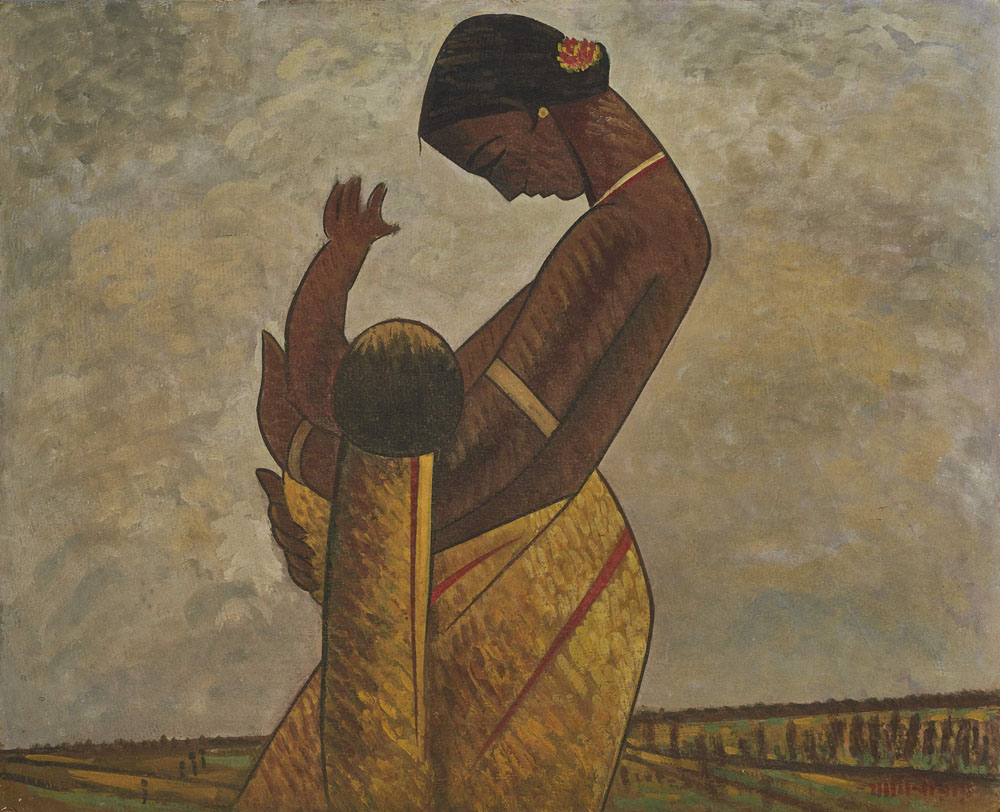 Mother & Child Painting by Jamini Roy, Tempera on cloth, 26 x 32 in.
• Religious Iconography - In the 1940’s Roy became preoccupied with the visual idea of portraying religious icons like Krishna, Jesus Christ and even the Buddha. He created a series of thought-provoking images around the life of Christ that adapted stories from an alien culture, rendering them in vibrant colours and bold lines. The aesthetic familiarity of these paintings made it seem like the depicted subjects were local people from an Indian village and became the distinguishing aspect of this work. His works about Krishna showcased idyllic landscapes with trees, birds and open pastures. By conjuring the rural utopia of people’s imagination, he was able to make his work relatable with the sensibility of the masses, thus making them more accessible.
• Gopis and Apsaras Paintings - Known for his fascination with Indian mythology, Jamini Roy often created imagery depicting the ‘gopis’ and ‘apsaras’ from epics like The Ramayana and The Mahabharata. He portrayed them in angel-like forms with almond eyes and extremely sharp features, making them look elegant but also ordinary at the same time. This helped him establish a common thread with the ordinary people and connect with them through his works.
 Apsara Painting by Jamini Roy, Tempera on cloth, 24 x 116 in.
• Krishna with Gopis Paintings - Jamini Roy’s Krishna with Gopis is a vibrant and stylized depiction of the divine love between Krishna and the Gopis, rooted in Indian mythology and devotional traditions. The painting showcases Krishna, the mischievous and charming god, surrounded by Gopis who are captivated by his divine presence. Rendered in bold, flat colors, and simplified forms inspired by folk art, the work draws heavily from Kalighat painting and traditional Bengali patachitra. Jamini Roy’s intent was to celebrate the spiritual and cultural richness of Indian narratives while moving away from Western artistic influences. The theme symbolizes the union of the human soul (Gopis) with the divine (Krishna), embodying devotion, love and spiritual longing. This painting reflects Roy’s desire to merge indigenous storytelling with modern artistic sensibilities, creating works that were deeply rooted in tradition yet universally evocative.
• Goddess Durga Paintings - These paintings by Jamini Roy depicts Hindu warrior Goddess Maa Durga in traditional bengali style, showing her as a powerful yet compassionate figure. His Durga paintings are heavily influenced by Kalighat art—flat, two-dimensional forms and bold outlines. Often, Durga is seen with her children (Lakshmi, Saraswati, Kartik & Ganesh) or slaying the buffalo demon Mahishasura.
• Radha Krishna Paintings - Jamini Roy’s Radha Krishna paintings are a sublime representation of divine love and spiritual union, drawn from the deeply rooted Indian tradition of Krishna and Radha’s eternal bond. Depicted in his signature folk-inspired style, these works use bold lines, flat vibrant colors and a minimalistic yet expressive approach to portray the tender intimacy between Radha and Krishna. The figures are often adorned with simplified ornaments and set against plain, unadorned backgrounds, emphasizing their connection rather than their surroundings. The painting symbolizes the transcendence of earthly love, representing the soul’s yearning for unity with the divine. Jamini Roy’s decision to paint Radha and Krishna reflects his intent to elevate indigenous myths and aesthetics, celebrating India’s cultural and spiritual heritage. By reimagining these iconic figures in a style rooted in Kalighat and Bengali folk art, Roy not only honored Indian traditions but also sought to make art more accessible and reflective of everyday Indian life.
• Ramayana Paintings - Jamini Roy’s Ramayana paintings are a vivid series that reimagine scenes from the ancient Indian epic with a distinctly folk-art aesthetic. Using bold outlines, earthy tones, and simplified forms influenced by Bengali patachitra and Kalighat painting, Roy brought to life iconic moments such as Sita’s abduction, Rama’s battles, and Hanuman’s devotion. These paintings capture the moral and spiritual essence of the epic, highlighting themes of duty, righteousness, and the triumph of good over evil. By depicting the Ramayana, Roy sought to connect deeply with India’s cultural heritage and create art that resonated with ordinary people. His stylistic choices reflect his rejection of Western techniques, focusing instead on indigenous traditions that were accessible and rooted in local storytelling. The Ramayana series not only preserves the timeless narrative of the epic but also celebrates its enduring relevance in Indian identity and values.
• Ganesh Paintings - Jamini Roy’s Ganesha paintings celebrate the beloved Hindu deity known as the remover of obstacles and the patron of arts and wisdom. In these works, Ganesha is depicted in Roy’s characteristic folk-art style, influenced by Bengali patachitra and Kalighat paintings. Using bold lines, earthy tones, and simplified yet expressive forms, Roy captures the divine essence of Ganesha while making it accessible and relatable. The painting often emphasizes Ganesha’s iconic features, such as his elephant head and potbelly, symbolizing wisdom, prosperity, and abundance. Roy’s choice to depict Ganesha reflects his deep engagement with Indian cultural and spiritual motifs, as well as his mission to bring traditional art forms into modern contexts. By integrating local artistic traditions with universally resonant themes, Roy’s Ganesha paintings embody a harmonious blend of devotion, artistry, and cultural pride, reinforcing his commitment to creating an Indian modern art identity rooted in heritage.
• Three Pujarins (Priestesses) Paintings - Jamini Roy’s Three Pujarins is a striking portrayal of three priestesses engaged in a moment of devotion, rendered in his iconic folk-inspired style. The painting features three women depicted with bold, geometric forms, minimalistic details, and vibrant yet earthy colors, reflecting the influence of Bengali patachitra and Kalighat painting. The serene expressions and symmetrical arrangement emphasize a sense of spiritual calm and collective reverence. The artwork symbolizes the sacredness of ritual and the role of women in maintaining cultural and spiritual traditions. By choosing this subject, Jamini Roy highlighted everyday spirituality and the quiet strength of women in Indian society. His focus on indigenous themes and stylization was part of his broader aim to reconnect Indian art with its folk roots, making it accessible while honoring its rich heritage. Three Pujarins thus becomes a celebration of devotion and cultural identity, captured in a timeless, evocative form.
• Kalighat Paintings - Jamini Roy’s Kalighat paintings reflect his deep inspiration from the traditional Kalighat patachitra style, which originated near the Kalighat temple in Kolkata. These works are characterized by bold, sweeping lines, flat, vibrant colors, and a focus on simplified yet expressive forms. Roy embraced this folk-art tradition to portray both religious and secular themes, including deities like Durga, Krishna, and Ganesha, as well as scenes from rural and urban life. By adopting the Kalighat style, he rejected Western artistic norms and instead celebrated the indigenous aesthetics of Bengal. His reinterpretation of Kalighat art emphasized the beauty of ordinary lives and spiritual devotion, making it accessible to a wider audience while preserving its cultural authenticity. Jamini Roy’s Kalighat paintings were a revolutionary statement in modern Indian art, blending traditional techniques with his vision for a national art identity rooted in heritage.
• Patachitra Paintings - Jamini Roy’s Pattachitra-inspired paintings are a testament to his admiration for traditional Indian folk art and his efforts to create a uniquely Indian modern art style. Drawing heavily from the centuries-old Bengal pattachitra tradition, his works feature bold outlines, flat, vivid colors, and simplified forms to depict themes from Indian mythology, rural life, and spiritual devotion. These paintings often incorporate narratives from epics like the Ramayana and Mahabharata, or iconic figures such as Radha, Krishna, and Durga, rendered with an earthy charm that reflects the essence of folk storytelling. By adopting and reimagining the pattachitra style, Jamini Roy sought to break away from Western artistic influences, creating art that resonated deeply with Indian cultural identity. His Pattachitra-inspired artworks not only celebrate the beauty of indigenous art forms but also elevate them to a national and global platform, ensuring their enduring legacy.
• Cat And The Lobster / Dual Cats With One Crayfish - Jamini Roy's Cat & Lobster paintings are a playful yet symbolic depiction of the natural world, rendered in his distinctive folk-art style. In these works, a cat is shown eyeing a lobster, capturing a moment of tension and curiosity. The simple, bold lines and flat, vivid colors typical of Roy’s style transform this everyday interaction into a vibrant, almost whimsical tableau. The cat, often associated with independence and curiosity, contrasts with the lobster, symbolizing a certain level of mystery and danger. This juxtaposition may reflect the dynamics of nature, where instinct and survival intertwine with beauty and intrigue. By choosing this subject, Roy aimed to explore the humor and complexities of life through a modern interpretation of folk art. His Cat and the Lobster paintings are a departure from more traditional mythological themes, showcasing Roy’s ability to blend the innocence of childhood curiosity with deeper reflections on the natural world, all while staying true to his vision of a distinctly Indian, accessible art form.
• Saree (Women in Traditional Attire) Paintings - Jamini Roy’s Women in Traditional Attire paintings are a celebration of Indian cultural heritage, capturing the grace and dignity of women dressed in traditional clothing. In these works, Roy portrays women in simple yet elegant forms, often wearing sarees or other regional garments, with their expressions and postures conveying a sense of quiet strength and poise. Using bold lines, vibrant colors, and minimal details, Roy’s style emphasizes the beauty of the subject rather than intricate realism. The depiction of women in traditional attire speaks to Roy’s desire to honor the everyday lives of Indian women, who, though often relegated to domestic roles, are portrayed with a sense of reverence and importance. By focusing on these figures, Roy sought to elevate the role of women in society while also celebrating the timeless beauty and cultural significance of traditional dress. These paintings reflect his broader commitment to modernizing Indian art by grounding it in indigenous, accessible themes that connect deeply with the nation’s identity and values.
• Black Horse Paintings - Jamini Roy’s Black Horse paintings are a striking representation of strength, elegance, and vitality, depicted in his iconic folk-inspired style. The black horse, often portrayed in motion with flowing mane and a dynamic posture, symbolizes power and unyielding spirit. Using bold, sweeping lines, earthy tones, and minimalistic details, Roy captures the essence of the animal with a sense of movement and energy that transcends the static medium. This subject reflects Roy’s admiration for the simplicity and vigor found in rural life, as horses were integral to both labor and cultural symbolism in traditional Indian society. By choosing such a theme, Roy not only celebrated India’s pastoral heritage but also demonstrated his commitment to creating art that resonated with the everyday lives of his audience. The Black Horse paintings epitomize Roy’s fusion of folk aesthetics with modern sensibilities, embodying both artistic beauty and cultural significance.
• Horse & Rider Paintings - Jamini Roy’s Horse and Rider paintings depict a powerful and dynamic relationship between the rider and the horse, rendered in his distinctive folk-art style. These works are characterized by bold lines, vibrant colors, and a minimalist approach, often using flat, earthy tones to portray the figures. The horse, symbolizing strength and vitality, and the rider, representing control and direction, together convey themes of harmony, power, and determination. Through this motif, Roy captures the essence of movement and the bond between man and nature, celebrating the rural and agrarian life where horses were integral to both work and culture. By choosing this subject, Roy sought to highlight the spirit of independence and resilience in Indian life, while also emphasizing the importance of human connection to the natural world. His Horse and Rider paintings reflect a departure from Western traditions, aligning instead with indigenous artistic expressions and creating a distinctly Indian modern art identity.
• Lady With A Flute Paintings - Jamini Roy's Lady with a Flute paintings showcase a graceful and simplified portrayal of a woman playing a flute, rendered in his signature folk-art style. Using bold, fluid lines, flat colors, and minimal detail, Roy captures the essence of the female form and the serene, almost meditative act of music-making. The image of the lady with a flute evokes themes of beauty, music, and the artistic expression of inner emotions. The painting may also reflect the idealized figure of the woman in traditional Indian culture, where femininity is often associated with creativity, nurturing, and spiritual connection. By choosing this subject, Roy not only celebrated the artistic and cultural significance of music in Indian life but also sought to reimagine the portrayal of women through a modern, indigenous lens. His focus on this serene, musical motif aligns with his broader vision to create accessible, culturally resonant art that moved away from Western influences and embraced Indian folk traditions.
• Woman With A Pot Paintings - Jamini Roy’s Woman with a Pot paintings are powerful representations of rural life and the role of women in traditional Indian society. In these works, Roy depicts women carrying large clay pots, a symbol of sustenance, domesticity, and connection to the earth. The women are shown with simplified, geometric forms, bold outlines, and vibrant, earthy colors, characteristic of Roy’s adaptation of folk-art styles like Kalighat and patachitra. The pot itself represents fertility, nourishment, and the cycle of life, while the act of carrying it signifies both strength and responsibility. Through this subject, Roy sought to highlight the dignity of everyday labor and the central role of women in sustaining both family and community life. His focus on rural and indigenous themes, such as the Woman with a Pot, reflected his desire to create art that resonated with Indian traditions, rejected Western artistic norms, and celebrated the everyday beauty of Indian life.
• Man With A Bull Paintings - Jamini Roy’s Man with a Bull paintings capture the profound connection between humans and animals, particularly in rural Indian life. Depicting a man standing alongside a bull, these works reflect the importance of the bull in agrarian societies as both a symbol of strength and a vital part of farming and daily labor. Using his signature folk style with bold outlines, simplified forms, and earthy tones, Roy highlights the harmonious bond between the man and the animal, emphasizing themes of cooperation, resilience, and the symbiosis of nature and humanity. The bull, representing power and endurance, contrasts with the human figure, symbolizing the partnership required for agricultural success. By choosing this subject, Roy not only celebrated rural life and its deep-rooted connection with nature but also sought to elevate the everyday, bringing attention to the dignity of labor and the importance of animals in sustaining traditional livelihoods. His Man with a Bull paintings reflect his broader goal of fostering a uniquely Indian art that was both rooted in indigenous themes and accessible to the masses.
• Peacock Paintings - Jamini Roy’s Peacock paintings are a vibrant celebration of one of India’s most beloved symbols of beauty, grace, and spiritual significance. The peacock, often associated with divine energy and abundance in Indian mythology, is depicted in Roy’s signature style, using bold lines, flat colors, and simplified forms. The elegant yet dynamic postures of the peacock in these works highlight its regal and enchanting nature. For Roy, the peacock was not just a decorative motif but a symbol of the rich cultural heritage of India, representing both the beauty of nature and the divine in everyday life. By choosing this subject, Roy sought to express the vibrant colors and textures of Indian folk art, drawing from traditions like Kalighat painting, while also making it relevant to modern audiences. His Peacock paintings reflect his vision of art that celebrates the natural world, cultural symbols, and the emotional depth inherent in traditional Indian themes.
Patua Paintings
Jamini Roy’s paintings are often termed as Patua, derived from the Bengali folk tradition of Patachitra, which involves intricate scroll paintings created by rural artisans or "Patuas." Deeply inspired by this indigenous art form, Roy adapted its stylistic features to create a unique modern aesthetic that resonated with India’s cultural roots. His works were characterized by bold, sweeping lines, flat and vivid colors, and minimalistic details, echoing the essence of Patachitra while infusing it with his own creative vision. By adopting the techniques and themes of the Patua tradition, Roy sought to revive and celebrate India’s rural artistic heritage.
Roy’s subject matter often mirrored the themes found in traditional Patachitra, such as mythological stories, folk narratives, and depictions of rural life. However, he reinterpreted these motifs with a modern sensibility. His paintings of characters like Krishna, Radha, and scenes from the Ramayana were stylized to reflect both the simplicity and elegance of folk art. Additionally, he introduced dynamic, flattened perspectives, a departure from the depth and realism of Western academic styles, which aligned his work with the iconic folk aesthetic. By calling his works Patua-inspired, Jamini Roy not only paid homage to the tradition but also elevated it to a respected position in modern Indian art.
Through his Patua-style paintings, Jamini Roy made a profound cultural statement, rejecting colonial art influences and advocating for an art form deeply rooted in the Indian ethos. His work symbolized a revival of indigenous traditions and demonstrated how folk art could resonate with contemporary audiences. Today, his art is celebrated as a bridge between rural craftsmanship and modern expression, underscoring the timeless appeal of Patua’s visual storytelling.
Awards & Recognition
Jamini Roy received several prestigious awards and recognitions throughout his illustrious career:
• 1934 - Awarded the Viceroy's Gold Medal in an All-India exhibition for one of his works.
• 1954 - Conferred the Padma Bhushan by the Government of India, the nation's third-highest civilian honor, acknowledging his significant contributions to Indian art.
• 1955 - Jamini Roy was awarded an honorary D.Litt. (Doctor of Letters) by Visva-Bharati University, a prestigious institution founded by the famous poet Rabindranath Tagore.
• 1976 - Posthumously, the Archaeological Survey of India declared Roy's works among the "Nine Masters" whose art was considered "national treasures" and prohibited from export outside India under the Antiquities and Art Treasures Act.
• 1978 - The Government of India issued a commemorative stamp featuring Roy's artwork, six years after his death, to honor Roy's contributions to Indian art.
Legacy & Influence
Jamini Roy’s legacy and influence on Indian art are profound and enduring, marking him as a pivotal figure in the history of modern Indian art. His impact can be observed across multiple dimensions:
• Revival of Traditional Art Forms: One of Jamini Roy's most significant contributions was his role in reviving and modernizing traditional Indian art forms, particularly Bengali folk art. By incorporating elements from the Kalighat style and other local traditions, he demonstrated the richness of Indian heritage and inspired artists to explore their cultural roots.
• Indigenous Modernism: Jamini Roy pioneered a path for Indian artists to create modernist work without relying on Western idioms. His successful integration of folk traditions with modern sensibilities demonstrated that authentic Indian expression could be both contemporary and rooted in cultural heritage. This approach inspired the Bengal School movement and later artists like K.G. Subramanyan and A. Ramachandran.
• Nationalist Art Movement: During India's struggle for independence, Jamini Roy's deliberate turn toward indigenous aesthetics represented cultural resistance against colonial influences. His work bolstered the swadeshi (self-reliance) movement in art, encouraging Indian artists to develop visual languages reflective of their own traditions rather than imported European styles.
• Democratization of Art: Roy's commitment to making art accessible to ordinary people—through simplified styles, affordable pricing, and subjects relevant to everyday Indian life—challenged the elitism of fine art. This democratizing impulse influenced later Indian artists' engagement with popular culture and traditional craft communities.
• Formal Innovation: Roy's bold simplification of form, restricted color palette, and rhythmic line work provided technical strategies that many Indian artists have adapted. His exploration of seriality—creating multiple versions of the same subject—prefigured contemporary approaches to artistic production.
• Educational and Institutional Impact: Jamini Roy's legacy extends beyond his artistic contributions to his impact on art education and institutions. His work has been featured in major exhibitions and museums worldwide, introducing his unique style to a global audience. The establishment of the Jamini Roy Museum in Kolkata, the first private single-artist museum in India, serves as a testament to his enduring influence and the importance of preserving his legacy for future generations.
Death
Jamini Roy passed away on April 24, 1972 at the age of eighty five, just a few days after celebrating his 85th birthday. In the final stages of his life, he struggled with uraemia and fell into a coma a day prior to his passing. He breathed his last at his residence in South Calcutta, marking the end of an illustrious career that left an indelible mark on Indian art.
Lesser-Known Facts About Jamini Roy
• Artistic Prolificacy - Jamini Roy is often described as an "art machine" because he produced around 20,000 paintings in his lifetime, which averages to about 10 paintings daily.
• Artistic Integrity and Middle-Class Focus - Jamini Roy always targeted the ordinary middle class as the upholder of art, believing that ordinary people were more important than governments because they were the voice of his art. He would even buy back his works if he found out that his paintings were not being well-maintained by the buyers
• Self-Identification as a Patua - Jamini Roy preferred to be called a "patua" reflecting his deep connection with traditional folk art forms and his role as a storyteller through his paintings.
• Self-imposed artistic restrictions - Jamini Roy deliberately limited his color palette to just seven colors (including white), all made from natural materials like mud, chalk, and vegetable dyes.
• Personal Struggles - Jamini Roy faced financial difficulties for much of his life, as his art was not always commercially successful during his lifetime. However, he remained committed to his artistic vision, prioritizing cultural authenticity over financial gain.
• Role in Indian Independence Movement - Jamini Roy was not just an artist; he was also influenced by the socio-political climate of his time. His embrace of indigenous art forms coincided with the Indian independence movement, reflecting a broader cultural awakening among artists to reclaim their heritage.
• Family Involvement - Jamini Roy involved his family in his artistic process, often turning them into a production unit. This approach allowed him to emulate a craft-guild mode of artistic production.
• Rarely Signed His Paintings - Jamini Roy rarely signed his works, as he believed that art should be identified by its style rather than a signature.
• Recognition as a National Treasure - In 1949, the Government of India declared Jamini Roy's works as national art treasures, prohibiting them from being sold or exported.
• His House is Now a Heritage Site - The house he built in Ballygunge Place, Kolkata, where he lived until his death in 1972, has been declared a heritage site and continues to be an important landmark for art lovers.
• Google Doodle - On his 130th birthday in 2017, Google celebrated Jamini Roy's birthday a special doodle.
Conclusion
Jamini Roy’s legacy as a master artist continues to captivate art lovers and collectors around the world. His original paintings, celebrated for their bold lines and vibrant colors, remain a testament to the timeless appeal of India’s folk traditions. From his exquisite oil paintings to his innovative canvas works, each piece showcases a harmonious blend of simplicity and cultural depth. The beauty of his art has transcended decades, with prints and reproductions ensuring that his influence reaches a broader audience. Today, his beautiful paintings are highly sought after in auctions, often fetching impressive painting prices that reflect their historical and artistic value. Jamini Roy’s art not only enriched the canvas of Indian modernism but also set a benchmark for the celebration of indigenous traditions in contemporary art.
Through his rejection of colonial influence and his embrace of indigenous artistic traditions, Jamini Roy has inspired generations of Indian artists to explore their roots and create art that is both deeply personal and culturally significant. Today, his legacy continues to resonate, as his work not only stands as a testament to his skill as a painter but also as a symbol of the power of art to inspire, challenge, and redefine cultural identity.
The journey on Jamini Roy doesn’t stop here! Click here to explore a related article on him here - 20 Famous Paintings Of Artist Jamini Roy