jogen chowdhury’s paintings - how ink, watercolor & pastel define his unique style
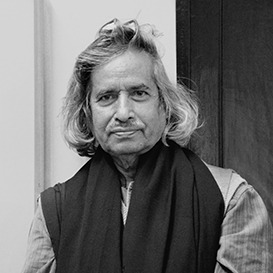 Bengal artist Jogen Chowdhury (born 19 February 1939) is a star in the contemporary Indian art world who created his own niche in a very short time with his imagery and style. His exceptional mastery over ink, watercolour and pastel has given him a peculiar visual language, which stands out as both old-worldly Indian tradition and very modern at the same time. This blog here delves into the life, artistic journey and unique style of Jogen Chowdhury. It explores how his choice of medium and technique has shaped his oeuvre and contributed immensely to his impact on the world of art.
Family Background
Jogen Chowdhury was born into a culturally rooted family in Faridpur (now in Bangladesh). His father, Pramatha Nath Chowdhury, was a teacher, and his mother, Monica Devi, nurtured their household with traditional values. After the partition of India in 1947, the family relocated to Kolkata, enduring financial hardships but remaining supportive of Jogen’s artistic ambitions. He later married Chandra Chowdhury and the couple has two children—a son named Manas Chowdhury and a daughter named Madhuchhanda Chowdhury. Despite the challenges of migration and rebuilding their lives, the close-knit family played a pivotal role in fostering Jogen’s creative journey.
Early Life
Jogen Chowdhury was born in 1939 in a small village called Faridpur in present-day Bangladesh (then part of British India). His early life was marked by the Partition of India (1947), which forced his family to relocate to Kolkata (then Calcutta) in the newly formed India. The displacement caused a significant shift in his personal life and had a lasting influence on his art. He grew up in a creative environment, surrounded by an appreciation for literature, art, and culture. His father, Pramatha Chowdhury, was a government official but also nurtured an interest in traditional arts, which influenced Jogen’s artistic inclinations from an early age.
Education
Government College of Art & Craft, Kolkata (1955-1960):
Chowdhury completed his Diploma in Fine Arts from this prestigious institution, one of the oldest art schools in India. During this time, he explored various techniques and styles, from Western academic art to Indian classical painting traditions. This dual exposure shaped the hybrid visual language he later developed. He was particularly inspired by Indian folk and miniature traditions, which became hallmarks of his artistic vocabulary.
École Nationale Supérieure des Beaux-Arts, Paris (1965-1967):
Chowdhury received a French Government scholarship to pursue higher studies in Paris. At this institution, he was exposed to European modernism and post-Impressionist movements like Surrealism, which significantly broadened his artistic outlook. His stay in Paris helped him understand the importance of merging global and local influences, leading to the development of his signature style—a blend of modern art with Indian cultural and folk elements. After returning from Paris, he worked as an art teacher and also engaged in various exhibitions. His early experiences of displacement, cultural transition, and artistic exploration laid the foundation for his later work, which often reflects themes of nostalgia, melancholy, and the human condition.
Career Highpoints
A treasure of achievements and memories surrounds Chowdhury's career path. Just upon returning to India from Paris, he joined the Handloom Board at Madras (now Chennai) as a textile designer. His experience with patterns and texture was very influential in making his art style different. In 1972, he became a lecturer at Kala Bhavana, Visva Bharati University in Santiniketan, a place he later became professor and head of the painting department.
This was soon followed by his first solo exhibition at the Academy of Fine Arts, Kolkata, in 1966. More than five decades have passed since Chowdhury's subsequent career, wherein he has exhibited work in galleries and museums of all the world's principal cities, including Paris's Centre Georges Pompidou and London's Victoria and Albert Museum.
This is what Chowdhury's artwork depicts: a journey from evolving style and continuous exploration of form and medium. The early artwork was actually quite realistic because it had come under the influence of academic training. However, when Chowdhury discovered his unique voice, his art became more stylised and abstract, but humanity was always rooted in human figures and experiences.
The Parisian period was replete with new explorations for the modern art movements, mainly propagated through the painters Paul Klee and Henri Matisse, and finally found a distinctly unique style marked by sinuous, sensuous lines and master cross-hatching.
Important Themes In The Artist's Work
Chowdhury's writing is very reflexive, many times questioning what it means to be human. His work includes themes that cover societal ills, the nature of relationships, and a more subtle texture of life in cities. His vision has been shaped by the experiences he lived through—growing up through the partitioning of India—and his observations about society in India.
One of the most common themes recurrent in Chowdhury's work is women. His visions about women are not sexual alone but rather mark the critique of society and their acts as well as gender-related issues. Other key themes include isolation of urban life, conflict between power and vulnerability, and complexity in human relationships.
Painting Style & Technique
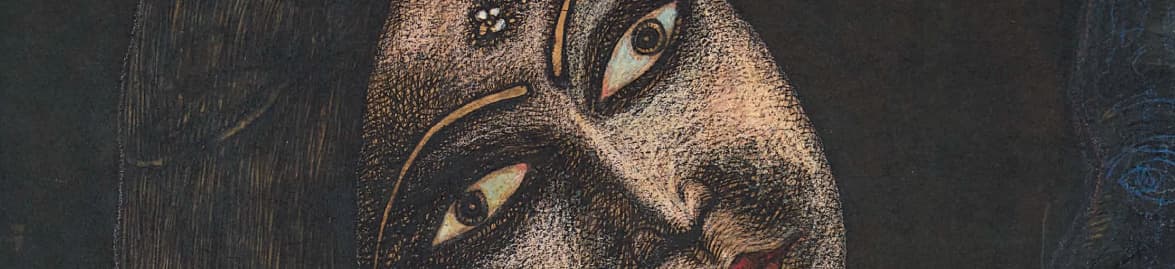
Jogen Chowdhury is known for his distinctive figurative expressionism, where human figures are distorted to convey psychological tension, vulnerability, and irony. His work reflects influences from Bengali folk traditions, particularly the Kalighat Pata style, along with personal experiences and social observations. His characters—often exaggerated and grotesque—express discomfort and unease, exploring themes like alienation, desire, and inner conflict. Chowdhury’s art bridges traditional Indian aesthetics with modern sensibilities, capturing the complexities of human nature through minimal yet impactful imagery. His figures, marked by twisted forms and exaggerated hands or feet, convey a dream-like quality, often floating in sparse backgrounds that heighten their emotional intensity.
Chowdhury’s technique is rooted in his intricate linework and textured surfaces, which he achieves through mediums like ink, watercolor, pastels, and oil on canvas. A hallmark of his style is his use of fine cross-hatching and dry brush techniques, creating subtle tonal variations and tactile textures. His colors are typically muted—favoring earthy tones like ochre, brown, and green—enhancing the raw, organic feel of his work. Even in his oil paintings, he uses a dry-brush method, minimizing gloss and adding to the gritty, decaying appearance of his figures. By letting the surface texture interact with the paint, Chowdhury imbues his art with a spontaneous, lyrical quality that emphasizes emotion over realism, making his work both evocative and thought-provoking.
Personal Philosophy & Beliefs
The philosophy of Jogen Chowdhury as an artist is very closely embedded in his personal philosophies. He has a strong sense of social responsibility and belief in using his art as a form of social commentary. Jogen Chowdhury's art works, time and again, tend to project the world around him—struggles, the injustices of the marginalised, and the oppressed.
His human infatuation would also influence his personal philosophy as an artist. He is in love with the depth of human relationships and the intricacies of love, loss, and longing. Jogen Chowdhury's works not only reflect the world he lives in but also delve deeply into the experience of the human heart.
Famous Paintings
Jogen Chowdhury has created several notable works that reflect his signature style of figurative expressionism and emotional depth. Below are some of his most famous paintings:
1. ‘Night of the Honeymoon’ (1975)
This painting depicts a couple lying together, yet their twisted postures and expressions suggest discomfort and alienation rather than intimacy. The tension in their body language reflects the psychological complexity of relationships. The use of dry brush technique and cross-hatching enhances the texture and emotional undertone of the work.
2. ‘Day Dreaming’ (1996)
This piece portrays a figure in a contemplative, melancholic state, surrounded by minimal background details. The expressive lines and muted earthy colors capture a sense of loneliness and longing, showcasing Chowdhury’s ability to convey deep emotions through simple yet distorted forms.
3. ‘Mother and Child’ (1980s)
In this painting, Chowdhury explores the universal theme of maternal love. However, the distorted bodies and exaggerated gestures introduce a sense of unease, hinting at the complexities of motherhood. The use of muted tones and textured brushwork further adds to the depth of the piece.
4. ‘Tiger in Moonlit Night’ (1998)
This artwork reflects the artist’s connection with nature and Bengal’s folk traditions. The tiger appears both majestic and eerie, with its form blending into the moonlit night. Chowdhury uses flowing lines and textured strokes, emphasizing the balance between beauty and menace in the animal’s presence.
5. ‘The Couple’ (2011)
This painting features two figures intertwined, though their body language suggests tension and separation. The exaggerated hands and feet, combined with Chowdhury’s signature cross-hatching technique, reflect both closeness and emotional distance, a recurring theme in his work.
6. 'Ganapati the Warrior'
This piece by Jogen Chowdhury is a striking serigraph that reflects his signature artistic style—marked by flowing, contour-based lines and textural patterns. This artwork, like many others by Chowdhury, emphasizes both form and expression with a focus on intricate detailing.
7. 'Ganesh Series'
This series is a unique exploration of the elephant-headed deity through his distinctive artistic language. In the painting Chowdhury departs from traditional depictions, portraying Ganesha not with the typical divine grace but with sagging skin, contorted limbs and wrinkled features.
8. 'Young Lady With A Mirror (Woman With Mirror)'
This piece is a notable work reflecting his signature blend of figurative expressionism and emotional introspection. This painting, like many others in his repertoire, captures the complex psychology of individuals, with the mirror serving as a symbol of self-reflection or inner turmoil.
These works exemplify Jogen Chowdhury’s ability to blend personal experiences with social commentary, using his unique figurative style to explore the complexities of human relationships, emotions, and inner conflicts.
Impact on Society
Jogen Chowdhury is one of the Indian artists who gave a distinct Indian touch to art in India. His style and strong imagery inspired generations of artists, whereas his social commitment reflected his stand on burning issues such as gender inequality and social injustice.
The social and cultural worlds had him as a revolutionary. His influence has entered the world beyond art. His work was something powerful for social change. Chowdhury's works possessed vital social issues and helped in spreading awareness, and his work toward using his platform as a force for good has inspired countless others to take up the same route.
Awards & Recognition
Artist Jogen Chowdhury has received numerous prestigious awards and accolades throughout his career, recognizing his significant contributions to contemporary Indian art. Below are some of the most notable ones:
1. National Award, Lalit Kala Akademi (1967)
This was one of his early recognitions, awarded by India’s premier arts organization, acknowledging his unique artistic voice and contribution to modern Indian painting.
2. Prix le France de la Jeune Peinture, Paris (1966)
This international award recognized his talent during his stay in Paris, where he honed his skills and explored various artistic techniques, including dry brush methods and figurative expressionism.
3. Rabindra Bharati University Award (1980)
Honoring his achievements in the arts, this award linked his contribution to the cultural heritage of Bengal, emphasizing his influence within the region.
4. Kalidas Samman, Government of Madhya Pradesh (2001)
One of India’s most prestigious awards in the arts, the Kalidas Samman recognized Chowdhury's lifetime achievements and his impact on the country’s cultural and artistic landscape.
5. Banga Bibhushan Award, Government of West Bengal (2012)
This civilian honor acknowledged his significant contributions to the cultural identity of Bengal, reinforcing his legacy as one of the foremost contemporary artists from the region.
6. Padma Bhushan Nomination (2022)
Chowdhury was nominated for the Padma Bhushan, one of India’s highest civilian honors, recognizing his lifelong dedication to art and his influence on generations of artists.
These awards highlight the broad recognition Jogen Chowdhury has received both domestically and internationally for his artistic innovations, contributions to Indian contemporary art, and promotion of Bengal's cultural ethos.
Mediums Of Expression: Ink, Watercolor & Pastel
Jogen Chowdhury's unique artistic style is vividly defined by his masterful use of ink, watercolor, and pastel, which together create a rich tapestry of emotion and depth. The fluidity of ink allows him to capture intricate details and dynamic lines, while watercolor infuses his work with a sense of ethereality and movement. Pastel adds a soft texture and vibrant hues, enhancing the overall visual impact. This combination not only underscores his thematic explorations of identity and culture but also reflects a harmonious balance between boldness and delicacy. Chowdhury’s ability to blend these mediums results in artworks that resonate with viewers, inviting them into a world where tradition meets contemporary expression.
Conclusion
Jogen Chowdhury is an artist whose paintings reflect the style and imagery he bestows. His mastery with ink, watercolour, and pastel has taken on a visual language, deep in Indian traditions yet really modern. Through his art, Chowdhury has not only explored the human condition but also loudly presented his social activism. Jogen Chowdhury's artistic journey is a testament to the profound impact of art in shaping societal perspectives. His ability to intertwine personal experiences with broader social issues not only enriches his work but also inspires others to engage with the world around them. Chowdhury's legacy continues to encourage artists and audiences alike to explore the deeper meanings of humanity and social justice through the lens of art.
We hope you enjoyed this article. For a comprehensive showcase of Jogen Chowdhury's original paintings, click here and explore his vibrant portfolio.