


jogen chowdhury - ganesha | overview
.jpg&w=3840&q=75)
Jogen Chowdhury’s Ganesha series, created between the 1970s and 1990s, offers a distinctive reinterpretation of the revered Hindu deity through a modern, often satirical perspective. Departing from traditional devotional depictions, Chowdhury employs the familiar form of Ganesha to reflect on contemporary social and political realities. His approach transforms the deity into a vehicle for commentary, blending reverence with caricature and nuanced critique.
In one particularly notable work from 1996, Ganesha is portrayed seated at the center of the composition, his figure exaggerated to the point of nearly spilling out of the frame. Holding a delicate flower in one hand, with a prominent belly, cross-legged posture, and a single tusk, the image simultaneously honors and playfully distorts classical iconography. This article delves into the artistic significance of Jogen Chowdhury's Ganesha series, examining its visual techniques and the layered themes it articulates.
The Iconic Ganesha
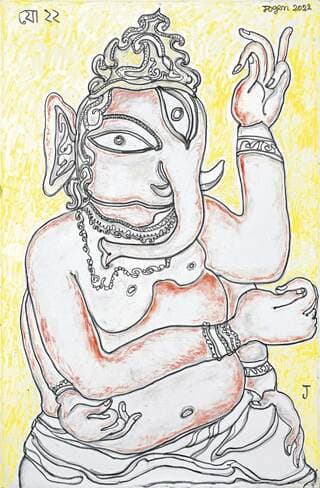 Jogen Chowdhury's portrayal of Ganesha is distinctive and thought-provoking. Unlike traditional representations, Jogen Chowdhury's Ganesha is often depicted with a wrinkled and flaccid appearance, symbolizing the complexities and contradictions of contemporary society. This unique interpretation challenges conventional norms and invites viewers to reflect on deeper narratives.
Context and Background
Jogen Chowdhury's fascination with Ganesha, the elephant-headed god known as the remover of obstacles and patron of arts and intellect, is evident in several of his works. His representations of Ganesha are not mere religious iconography but are imbued with contemporary relevance and personal symbolism. For instance, in his 1977 work titled Ganapati the Warrior, Jogen Chowdhury portrays Ganesha in a warrior-like stance, possibly reflecting the resilience and strength required to navigate modern life's challenges. This piece, created using pastel, ink, and lacquer on paper, measures approximately 75.6 x 55.2 cm and is part of the Peabody Essex Museum's collection.
Artistic Technique and Composition
Jogen Chowdhury is known for his unique style, often referred to as the "Master of Unbroken Lines”. He often employs a meticulous cross-hatching technique, using mediums like pastel, ink, and charcoal to create texture and depth. In his Ganesha series, Jogen Chowdhury deviates from traditional depictions by presenting the deity with exaggerated features—wrinkled skin, angular trunk, and contorted limbs; imparting a caricature-like quality that challenges conventional aesthetics. This approach is evident in works like his 2008 Untitled (Ganesha), executed in pastel and charcoal on paper, measuring 68.5 x 49.5 cm.
Themes
Jogen Chowdhury's Ganesha artworks delve into themes of transformation, adaptability, and the intersection of tradition and modernity. By distorting the deity's form, he invites viewers to reconsider preconceived notions of divinity and perfection. His portrayal of Ganesha reflects the complexities of contemporary life, where ancient beliefs coexist with modern challenges. Furthermore, Jogen Chowdhury's Ganesha series may also comment on the commercialization of religious symbols, as he once noted that his representation of Ganesha was meant to reflect unfairness of businessmen who worship the deity for personal gain.
Cultural Significance
Jogen Chowdhury's reinterpretation of Ganesha holds significant cultural value, as it bridges the gap between traditional religious imagery and contemporary artistic expression. His works encourage a dialogue about the evolving role of mythology in modern society and the ways in which cultural symbols can be reimagined to reflect current realities. By presenting Ganesha in unconventional forms, Jogen Chowdhury challenges viewers to engage with the deity beyond ritualistic confines, fostering a deeper, more personal connection.
Legacy and Impact
This work exemplifies Chowdhury’s ability to infuse traditional subjects with contemporary relevance. His Ganesha has influenced younger artists to explore mythology beyond literal representation, emphasizing emotional and psychological depth. Exhibitions of his works, including this series, continue to draw critical acclaim for their innovative fusion of the sacred and the surreal.
Conclusion
Jogen Chowdhury's Ganesha series exemplifies his ability to infuse traditional subjects with modern sensibilities, creating artworks that are both thought-provoking and visually compelling. Through his distinctive style and thematic exploration, Jogen Chowdhury invites viewers to reflect on the fluidity of cultural symbols and the enduring relevance of mythology in contemporary life.




