mrinalini mukherjee - visionary who transformed fiber into art
.jpg&w=3840&q=75)
In the pantheon of Indian contemporary art, few names command as much respect as Mrinalini Mukherjee (1949-2015), the groundbreaking artist who elevated fiber art from craft to fine art through her extraordinary organic sculptures. Working primarily with hemp, jute and other natural fibers, artist Mrinalini Mukherjee created monumental works that challenged conventional boundaries between sculpture, craft, and contemporary art.
From Baroda to International Acclaim
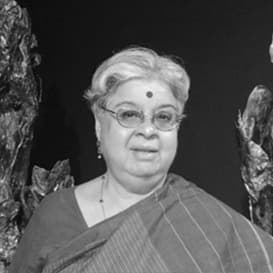 Born in Calcutta and educated at the prestigious Maharaja Sayajirao University in Baroda, Mrinalini Mukherjee emerged from India's vibrant art scene of the 1970s with a unique vision. While her contemporaries explored painting and traditional sculpture, she gravitated toward an entirely different medium, the humble rope and fiber that would become her artistic signature.
"Mrinalini saw possibilities where others saw limitations" recalls art critic Geeta Kapur. "She transformed what was considered women's work, weaving and knotting into powerful sculptural statements that commanded museum walls worldwide."
Revolutionary Technique Meets Ancient Wisdom
Mrinalini Mukherjee's breakthrough came through her mastery of macramé, an ancient knotting technique that she elevated to unprecedented artistic heights. Her process was both meditative and physically demanding, requiring months of patient work to create single pieces. Using natural fibers like hemp and jute, she would knot, twist, and manipulate materials into forms that seemed to breathe with organic life.
Mrinalini Mukherjee Sculptures bore titles that reflected her deep connection to nature: "Seed Pod," "Forest Growth," and "Organic Form." These works didn't merely represent natural forms, they embodied the very essence of growth, transformation, and organic evolution.
Breaking Gender Barriers in Art
In an art world dominated by male painters and sculptors working in traditional media, Mrinalini Mukherjee's choice of fiber was both radical and subversive. She reclaimed textile work from its marginalized status as "women's craft" and positioned it firmly within the contemporary art discourse.
"She was fighting multiple battles," explains curator Nancy Adajania. "Not only was she working in an unconventional medium, but she was also asserting the artistic value of techniques historically associated with domestic work."
International Recognition and Museum Collections
Mrinalini Mukherjee's work gained international recognition throughout the 1980s and 1990s. Her sculptures were acquired by major institutions including the National Gallery of Modern Art in New Delhi, the Museum of Fine Arts in Boston, and the Victoria and Albert Museum in London. Solo exhibitions in New York, London, and across India established her as one of the most important contemporary artists of her generation.
The art market has increasingly recognized her significance. In recent years, her works have commanded substantial prices at international auctions, with pieces selling for hundreds of thousands of dollars; a testament to the growing appreciation for her pioneering vision.
Legacy of Innovation
What set Mrinalini Mukherjee apart was her ability to infuse traditional craft techniques with contemporary artistic sensibility. Her sculptures possessed a monumental quality that transcended their material origins. Standing before works like "Forest Growth" or "Seed Pod," viewers experienced a sense of encountering living, breathing entities rather than static objects.
Her influence extends far beyond her own practice. A generation of contemporary artists working with textiles, fibers, and unconventional materials acknowledge her pioneering role in legitimizing these approaches within fine art contexts.
Teaching and Mentorship
Beyond her artistic practice, Mrinalini Mukherjee was a dedicated educator who taught at various institutions across India. Her students remember her emphasis on understanding materials intimately not just their physical properties, but their cultural and emotional resonances.
"She taught us that every material has its own language," recalls former student Vibha Galhotra. "The key was learning to listen and respond rather than impose arbitrary concepts."
The Philosophical Dimension
Mrinalini Mukherjee's artwork was deeply informed by her understanding of Indian philosophy and aesthetics. Her sculptures embodied concepts of growth, decay, and regeneration that are central to Hindu and Buddhist thought. Yet they spoke a universal language that transcended cultural boundaries.
Art historian R. Siva Kumar notes: "Her work bridged the gap between traditional Indian craft knowledge and contemporary global art discourse. She proved that authenticity didn't require rejecting modernity, but rather finding innovative ways to express timeless truths."
Continuing Influence
Today, more than eight years after her death, Mrinalini Mukherjee's influence continues to grow. Major retrospectives have introduced her work to new audiences, while a generation of fiber artists worldwide acknowledges her pioneering role in elevating textile-based art.
A Medium Transformed
Perhaps Mrinalini Mukherjee's greatest achievement was demonstrating that artistic significance lies not in the material chosen, but in the vision and skill brought to its manipulation. Through her patient, meditative practice, she transformed humble fibers into objects of profound beauty and meaning.
As the art world continues to expand its understanding of what constitutes legitimate artistic practice, Mrinalini Mukherjee pioneering work with organic fibers stands as a testament to the power of creative vision to transcend conventional boundaries. Her legacy reminds us that the most profound artistic statements often emerge from the most unexpected places.