niren sengupta - profile, history, paintings & art style
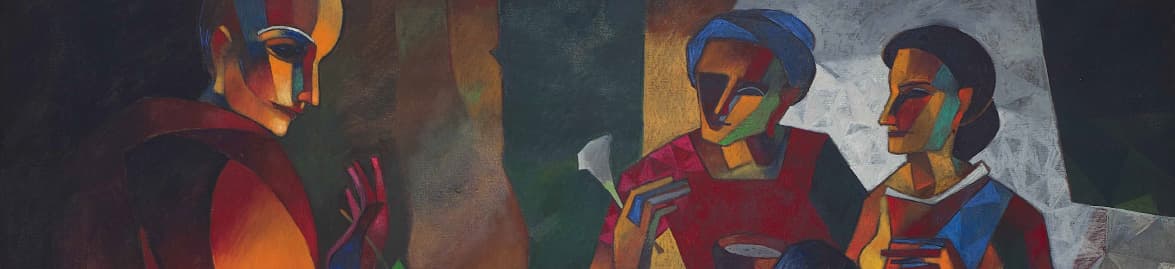
Niren Sengupta, born in January 1940, is a prominent Indian contemporary artist and academic known for his cubist-inspired art that often reflects spiritual themes. His works draw heavily from Buddhist legends and the philosophy of the Ramakrishna Mission, which deeply influenced his artistic and personal life. Sengupta’s art is celebrated for its vibrant colours, emotional depth, and spiritual undertones, making him a distinguished figure in modern Indian art.
Born into a business family engaged in jute trading, Sengupta’s early life was marked by a blend of traditional expectations and creative inclinations. Despite the familial emphasis on pursuing conventional careers like medicine or engineering, Sengupta’s artistic talents shone early on. This dichotomy between tradition and innovation would later become a hallmark of his artistic journey.
Early Life & Education
Niren Sengupta’s journey into the world of art began with informal training at home. His mother, who was skilled in traditional crafts and decorations during festivals, inspired him to explore art as a medium of self-expression. This familial encouragement laid the foundation for his formal education in art.
Sengupta completed his science degree at the University of Calcutta, a decision influenced by his family’s wishes. However, his passion for art led him to enroll at the Government College of Art & Craft in Kolkata, where he formally trained as an artist. This transition marked a significant turning point in his life, as he began to explore the technical and creative aspects of art under the guidance of renowned artists.
During his time at the Government College of Art & Craft, Sengupta was exposed to a variety of artistic styles and techniques. He was particularly drawn to cubism, which would later become a defining feature of his work. The cubist movement, with its emphasis on geometric forms and fragmented images, resonated with Sengupta’s desire to break away from traditional representations and explore new dimensions in art.
Career & Academic Contributions
Niren Sengupta dedicated over three decades to teaching art at graduate and postgraduate levels. His academic career culminated in his tenure as the Principal of the Delhi College of Art from 1992 to 1998. During this period, he significantly contributed to curriculum development and mentored numerous budding artists. His approach to education emphasized not only technical skill but also the importance of understanding art as a form of self-expression and communication.
He also co-founded 'Gallery 26' in Kolkata and served as an executive member of the Academy of Visual Media in New Delhi. His involvement with these institutions underscores his commitment to nurturing India’s art community and providing platforms for emerging artists to showcase their work.
Sengupta’s academic contributions extend beyond his administrative roles. He has been a vocal advocate for the integration of art into mainstream education, believing that it fosters creativity, critical thinking, and emotional intelligence. His efforts have inspired a generation of artists and educators to view art as an essential part of a well-rounded education.
Artistic Style & Themes
Niren Sengupta's paintings are primarily cubist in style but transcend traditional boundaries by incorporating spiritual and emotional dimensions. His works often feature motifs from nature, animals, birds, and human life, blending them with abstract forms to create harmony between warm and cool tones. Key characteristics of his art include:
• Spirituality: Influenced by his association with the Ramakrishna Mission, Sengupta’s works reflect themes of serenity, sacrifice, and service. His art often explores the relationship between the individual and the universe, seeking to convey a sense of unity and interconnectedness.
• Use of Colour: Initially working in monochrome, he later embraced vibrant colours inspired by visits to tribal areas. The use of colour in Niren Sengupta's paintings is not merely aesthetic but also symbolic, often representing different states of mind or spiritual conditions.
• Cubist Influence: His compositions balance geometric precision with emotional depth. Sengupta’s cubist style allows him to fragment forms and reassemble them in ways that reflect the complexity and multiplicity of human experience.
• Connection with Nature: While not strictly landscapes, his works evoke a sense of unity with natural elements. This connection to nature is both physical and metaphysical, reflecting his belief in the interconnectedness of all living beings.
Notable Achievements
Niren Sengupta has received several prestigious awards for his contributions to art:
AIFACS Award: Presented by the All India Fine Arts and Crafts Society, this award recognizes his contributions to the development of Indian art.
• Mahakoshal Award: This award acknowledges his impact on the cultural landscape of India, particularly in the realm of visual arts.
• NBT Award: The National Book Trust award highlights his role in promoting art education and awareness.
• Award for Humanity by Udayan Care: This award reflects his commitment to using art as a tool for social change and human welfare.
His paintings are housed in esteemed collections such as the National Gallery of Modern Art (New Delhi) and Lalit Kala Akademi. Additionally, his works have been showcased in numerous solo and group exhibitions across India and abroad, further cementing his reputation as a leading figure in Indian contemporary art.
Legacy & Philosophy
For Sengupta, art is an expression of inner reflections—a communion between beauty and spirituality. He believes that true creativity lies in exploring one’s inner self while remaining open to external inspirations. His humility is evident in his self-critical approach to art; he often refrains from labelling any piece as “complete” or “perfect”, instead viewing each work as part of an ongoing journey of discovery. Sengupta’s influence extends beyond his own work through the artists he mentored during his tenure as an educator. He holds deep admiration for both contemporaries like Shobha Broota and students such as Neeraj Goswami. His legacy is not just in the art he creates but also in the artistic community he has nurtured over the years.
Impact On Indian Art Scene
Niren Sengupta’s contributions to the Indian art scene are multifaceted. He has played a pivotal role in shaping the country’s art education system, emphasizing the importance of creativity and innovation in academic curricula. His involvement in founding and managing art galleries has provided platforms for emerging artists to showcase their work, fostering a vibrant and diverse art community.
Moreover, Sengupta’s art has inspired a new generation of artists to explore themes of spirituality and social responsibility. His use of cubism as a medium to convey complex emotions and ideas has influenced many young artists to experiment with non-traditional forms and techniques.
Conclusion
Niren Sengupta stands as a beacon of modern Indian art, blending cubism with spiritual depth to create timeless masterpieces. His contributions as an artist, teacher, and mentor have left an indelible mark on India’s cultural landscape. Through his vibrant canvases and thoughtful pedagogy, Sengupta continues to inspire generations of artists and art enthusiasts alike. As a testament to his enduring legacy, Sengupta’s art remains a powerful expression of the human condition—reflecting our hopes, fears, and aspirations. His journey from a traditional Bengali family to becoming a leading figure in Indian contemporary art is a story of passion, dedication, and the transformative power of creativity.