paramjit singh - profile, history, paintings & art style
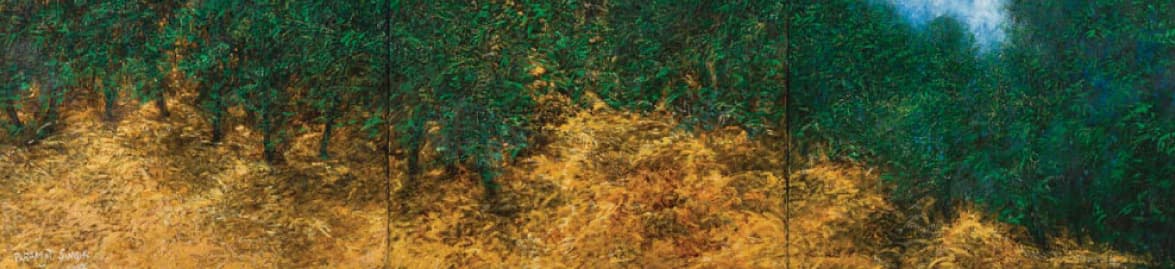
Paramjit Singh (b. 1935) is an acclaimed Indian contemporary artist whose works are celebrated for their evocative depictions of nature, particularly landscapes. Known for his ability to create imagined yet lifelike environments, Paramjit Singh’s paintings transcend traditional representations of nature by blending realism with abstraction and a sense of mystery. His works are characterized by vibrant colours, dynamic brushstrokes, and an ethereal quality that invites viewers to experience the transcendence of nature.
A pioneer in Indian modern art, Paramjit Singh is a founding member of The Unknown, a Delhi-based group of artists and sculptors established in 1960. Over a career spanning six decades, he has exhibited widely across India and internationally, earning recognition for his unique artistic vision. Singh has also contributed significantly to art education as a professor and head of the Fine Arts Department at Jamia Millia Islamia University in New Delhi. Today, he lives and works in New Delhi, continuing to inspire generations through his art.
Early Life and Education
Paramjit Singh was born in 1935 in Amritsar, Punjab. Growing up amidst the cultural richness of Punjab, he developed an early appreciation for art and nature. After completing his initial education at Khalsa College in Amritsar, Singh pursued formal training in art at the Delhi Polytechnic School of Art (now known as the College of Art), where he earned his Bachelor’s degree in Fine Arts in 1958.
Singh’s formative years were marked by his exposure to both Indian artistic traditions and modernist movements. This dual influence shaped his unique approach to painting, which combines Indian aesthetic sensibilities with modern techniques. In 1960, he co-founded The Unknown, a collective of young artists who sought to challenge conventional norms and explore innovative artistic expressions.
Career Milestones
Paramjit Singh held his first solo exhibition at Triveni Gallery, New Delhi, in 1967. Since then, he has participated in numerous solo and group exhibitions across India and abroad. His works have been displayed at prestigious venues such as:
Vadehra Art Gallery (New Delhi)
Talwar Gallery (New York)
City Art Center (Hong Kong)
Lalit Kala Akademi (Chandigarh)
Centre for International Modern Art (CIMA), Kolkata
Grosvenor Vadehra (London)
Singh’s international exhibitions have taken him to Germany, Norway, Belgium, Singapore, and other countries. His works are part of significant collections at institutions like the National Gallery of Modern Art (NGMA), New Delhi; Chandigarh Museum of Art; and Kiran Nadar Museum of Art (KNMA), New Delhi.
In addition to his artistic achievements, Singh served as a professor and later head of the Fine Arts Department at Jamia Millia Islamia University for nearly three decades. He has also been recognized with several awards, including the National Award from the Lalit Kala Akademi in 1970.
Artistic Style and Themes
Paramjit Singh’s art is deeply rooted in his love for nature. His paintings often depict serene landscapes filled with clustering trees, flowing water bodies, sprawling grasslands, and dense foliage. However, these are not literal depictions but rather imagined landscapes that evoke memory and transcendence. Key elements of his style include:
1. Imagined Landscapes - Singh’s landscapes are neither real nor entirely abstract; they occupy a space between reality and imagination. His works often lack pictorial depth but create a sense of boundlessness that invites viewers into a meditative experience.
2. Dynamic Brushstrokes - His use of expressive brushstrokes brings movement and spontaneity to his compositions. The textures created by these strokes add a tactile quality to his paintings.
3. Play of Light and Shadow - Singh masterfully uses light and shadow to create mood and atmosphere in his works. His smaller charcoal drawings often explore this interplay more subtly than his vibrant oil paintings.
4. Colour Palette - Rich hues like greens, blues, lilacs, and earth tones dominate Singh’s canvases. These colours imbue his works with vibrancy while maintaining a sense of tranquility.
5. Absence of Human Figures - While Singh’s landscapes are devoid of human figures, they do not feel empty or lifeless. Instead, they exude an invisible human presence through their emotional resonance.
6. Symbolism - His works often incorporate symbolic elements like stones or vases that suggest deeper philosophical meanings about time, memory, and existence.
Famous Works
Some of Paramjit Singh’s most celebrated works include:
The Seventh Walk: A series inspired by imagined walks through forests; these paintings explore themes of solitude and introspection.
Charcoal Drawings: Smaller works that use light and shadow to create intimate portrayals of nature.
Collaborative Work with Arpita Singh: A notable piece where Paramjit painted a landscape while Arpita added figures and an aeroplane—symbolizing the journey of life.
His work has also been immortalized in The Seventh Walk (2013), an experimental documentary film by Amit Dutta that explores Singh’s creative process through his charcoal drawings.
Exhibitions
Paramjit Singh has participated in numerous exhibitions over the years:
Solo Exhibitions:
Touched by the Sun (2021) – Shridharani Gallery, Triveni Kala Sangam
Drawings and Paintings (2017) – Vadehra Art Gallery
Shifting Terrains (2014) – Talwar Gallery, New York
Group Exhibitions:
India Art Fair (2023)
Rajendra Dhawan & Paramjit Singh: Inner/Outer (2002) – Talwar Gallery
Shall Return Again (2009) – CIMA Gallery
Awards and Recognition
Paramjit Singh has received several accolades throughout his career:
National Award from Lalit Kala Akademi (1970).
Recognition as Professor Emeritus at Jamia Millia Islamia University.
International acclaim through exhibitions at MoMA New York Film Festivals for The Seventh Walk documentary.
Legacy
Paramjit Singh is widely regarded as one of India’s foremost landscape painters whose works have redefined how nature is represented in contemporary art. His ability to merge realism with abstraction has inspired countless artists while offering viewers a transcendent experience through his imagined landscapes.
Beyond his artistic contributions, Singh’s role as an educator has left a lasting impact on Indian art education. His emphasis on innovation and introspection continues to influence young artists today.
Singh’s marriage to fellow artist Arpita Singh further underscores their shared dedication to art; together they have enriched India’s cultural landscape profoundly.
Conclusion
Paramjit Singh’s journey from Amritsar to becoming one of India’s most celebrated painters is a testament to his dedication to exploring the beauty and mystery of nature through art. His imagined landscapes transport viewers into realms where reality meets memory—offering moments of introspection and serenity.
As both an artist and educator, Paramjit Singh has left an indelible mark on Indian modern art—reminding us that true artistry lies not only in representation but also in evoking emotion through imagination.