the vibrant legacy of manu parekh and his landscapes
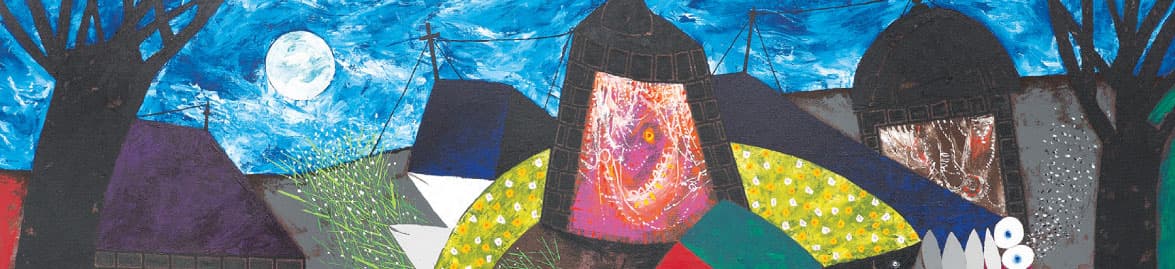
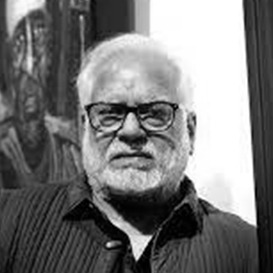 Few artists have captured the spiritual essence and cultural vibrancy of India with as much distinction as Manu Parekh. Born in 1939 in Ahmedabad, Gujarat, Manu Parekh stands as one of India's most celebrated contemporary painters, whose six-decade career has produced a remarkable body of work characterized by bold expressionism and profound emotional depth. From the sacred ghats of Varanasi to lush banana plantations, his paintings pulsate with life, emotion, and a profound connection to his roots. A Padma Shri recipient and artistic visionary, his paintings invite viewers into a world where the sacred and profane, traditional and contemporary, urban and rural coexist in vivid conversation, creating a uniquely powerful visual language that has influenced generations of Indian artists.
Early Life & Background
Born in 1939, Manu Parekh grew up in the cultural hub of Kolkata. From a young age, he was exposed to art and this early exposure sparked a passion that would shape his future. During his youth, Parekh actively participated in theatre as an actor and stage designer. He worked under Gujarati playwright Tarak Mehta, which helped him develop a strong sense of drama and emotion. This theatrical influence became a hallmark of his expressive portraits and dynamic compositions. After graduating, Manu Parekh worked as a textile designer at the Weavers’ Service Centre in Mumbai under Pupul Jayakar, where he documented traditional crafts like Ikat and Madhubani art during travels to rural areas such as Orissa, Rajasthan, and Haryana. These experiences exposed him to India’s rich folk traditions and inspired recurring themes of fertility, nature and rural life in his work.
Later Life
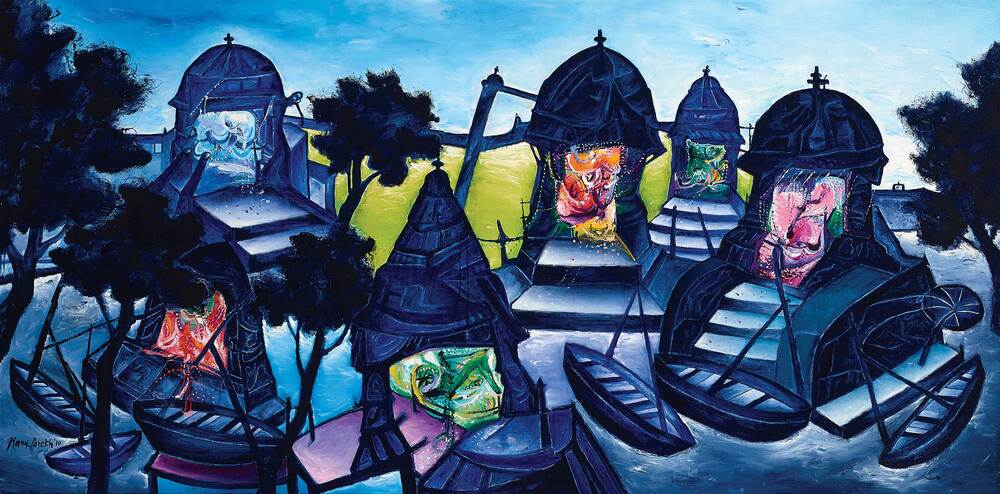
In his later years, Manu Parekh expanded his thematic repertoire, exploring concepts related to spirituality, nature, and the human experience. His paintings became more introspective, often reflecting personal narratives and broader societal issues. During the 1980s and 1990s, Parekh developed his iconic Banaras series, which became central to his artistic identity. Inspired by his first visit to the holy city after his father's death, these paintings exploring spirituality, light, and the essence of Varanasi would become his most celebrated works.
In his later years, Manu Parekh also became increasingly reflective about his artistic journey, participating in interviews, documentation projects, and mentoring younger artists. His influence on subsequent generations of Indian artists has been substantial, particularly in how he bridged traditional Indian themes with contemporary artistic expression. Throughout this period, Parekh maintained his home and studio in New Delhi, though he continued to draw inspiration from his travels throughout India, particularly his regular visits to Varanasi.
Family
Manu Parekh's family life has played a significant role in his personal journey and artistic development. His most notable family relationship is his marriage to Madhvi Parekh, who is herself an accomplished and celebrated artist. They were married in 1957 when Madhvi was just 15 years old. Madhvi Parekh, originally from a village near Ahmedabad, was inspired by Manu Parekh to take up painting and has developed a distinct artistic style influenced by folk art and Indian myths. Initially, Madhvi did not aspire to become an artist herself, but her husband's encouragement played a pivotal role in her artistic development. While expecting their first child, Manu gifted her Paul Klee’s Pedagogical Sketchbook, which inspired her to explore painting. The couple has a daughter, Manisha Parekh, born in 1964, who is also a noted contemporary artist. His daughter Manisha Parekh is recognized for her abstract paintings and installations and has studied at prestigious institutions including the Royal College of Art in London. The Parekh family has lived primarily in New Delhi since 1974. Their family dynamic represents an interesting case study in Indian art, with three distinctive artists developing under one roof, each with their own artistic identity and success.
Education
Manu Parekh received formal training at the Government College of Art & Craft in Kolkata, where he honed his skills in drawing and painting. His education laid a strong foundation, but it was his diverse experiences and constant exploration of new styles that shaped his artistry. His education helped him fuse traditional techniques with modern sensibilities, making his works stand out in the crowded Indian art scene.
Artistic Journey & Development
Over the years, Manu Parekh's work has evolved from an exploration of figurative forms to a more abstract and symbolic approach. Early on, he was inspired by Indian mythologies, and his work often depicted gods, goddesses, and symbolic figures. However, as he matured as an artist, Manu Parekh began focusing on a more personal vision, drawing upon his experiences, philosophy, and spirituality. This shift in style was pivotal to the growth of Manu Parekh’s Art, allowing him to create works that were not only visually compelling but also emotionally and intellectually profound.
Philosophy
Artist Manu Parekh’s philosophy revolves around a deep connection with spirituality, culture, and the exploration of the human psyche. He often uses his paintings as a medium to express complex thoughts and feelings about life, death, and the cosmos. His art reflects a quest for meaning and a desire to probe the unseen aspects of life, a theme that has remained constant throughout his career.
Painting Style & Techniques
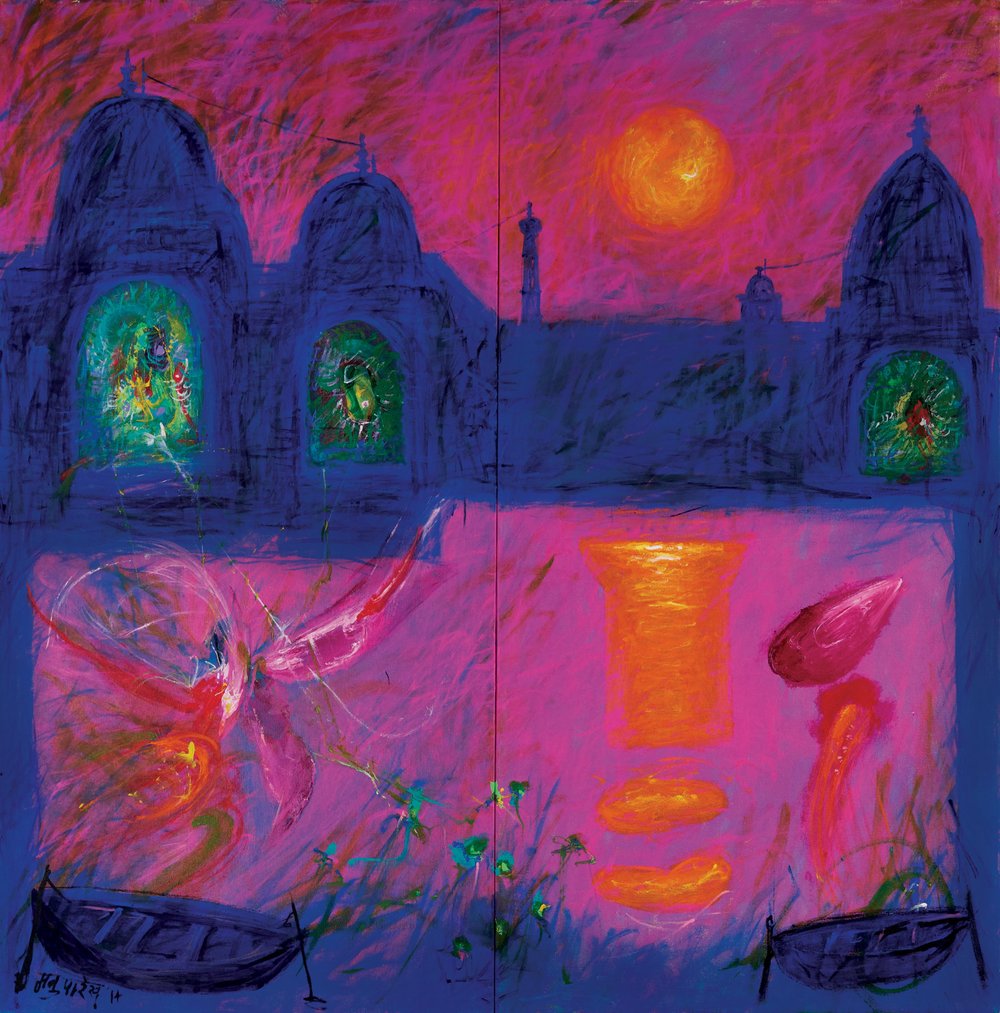
Manu Parekh is known for his use of vivid colors and strong, dynamic brushstrokes. His canvas paintings often explore the tension between abstraction and figuration, using these elements to evoke powerful emotional responses. His oil paintings are particularly noted for their rich texture and depth, which convey both movement and stillness in unique ways. Manu Parekh’s Art is also characterized by the bold use of geometry and symbols, often drawing from Indian traditions and cultural imagery.
Madhubani Art Influence
In his later works, Manu Parekh drew inspiration from Madhubani Art, a traditional Indian art form known for its intricate patterns and vibrant colors. This influence can be seen in his use of repetitive motifs and detailed line work, which imbue his paintings with a sense of rhythm and flow. The Madhubani Painting show in Italy and Denmark brought attention to this aspect of his work and showcased the depth of his artistic exploration on an international stage.
Admiration for Pablo Picasso
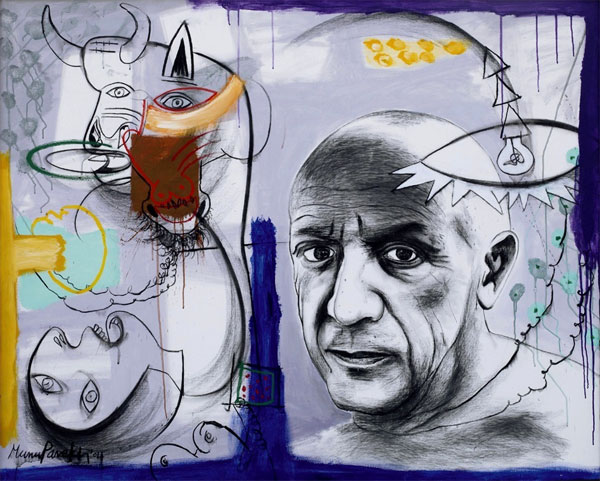
Manu Parekh held a deep admiration for Pablo Picasso, whose revolutionary approach to art inspired Parekh’s own exploration of form and abstraction. Parekh was particularly influenced by Picasso's ability to break conventional boundaries, blending figurative and abstract elements in ways that challenged traditional artistic norms. This admiration is evident in several of Manu Parekh’s paintings, where he adopts a similar boldness in deconstructing images and embracing abstraction. In works that reflect Picasso's influence, Parekh experiments with fragmented forms, distorted figures, and a vibrant color palette, using these techniques to express complex emotions and ideas. Manu Parekh's paintings about Picasso often reflect a fusion of the Western modernist influence with his own Indian heritage, creating a distinctive style that celebrates both global and local artistic expressions. This fusion allowed Parekh to push the boundaries of Indian art, incorporating elements of Picasso’s groundbreaking techniques while maintaining a unique cultural identity.
Famous Paintings
Manu Parekh’s famous paintings are celebrated for their bold use of color, intricate detail, and deep symbolism. Below are some of his most notable paintings:
The Last Supper - One of Manu Parekh's most iconic works is his interpretation of The Last Supper, where he reimagines the famous biblical scene with a contemporary twist. Manu Parekh’s Last Supper painting is characterized by its vibrant palette and abstracted forms, transforming the emotional intensity of the moment into a more modern, expressive representation. The composition deviates from traditional depictions, offering a unique lens on this religious story, with vivid colors and dynamic brushstrokes that convey the tension and spiritual depth of the scene.
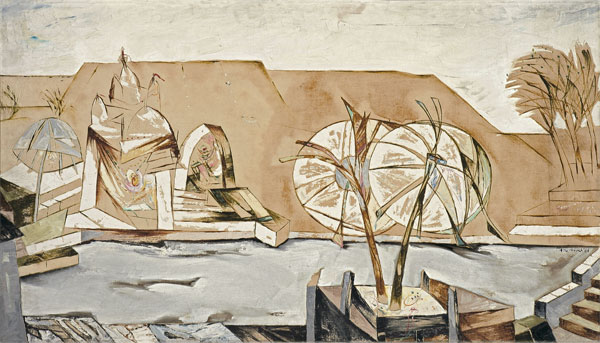
Banaras Series - Another of his well-known works is the Banaras painting series, where Manu Parekh captures the essence of the holy city of Varanasi, known for its spiritual significance and ghats along the Ganges. Manu Parekh Banaras paintings uses rich, warm hues and dynamic compositions to evoke the sacred and chaotic atmosphere of the city. The Banaras paintings highlight the contrast between the tranquility of the river and the bustling, spiritual fervor that surrounds it. This series showcases his mastery of color, texture, and form, as well as his ability to infuse cultural and spiritual themes into contemporary art.
Bhagalpur Portraits (Cry) - This politically charged series responded to the horrific 1979-80 Bhagalpur blindings in Bihar, where police blinded suspected criminals using acid. These powerful, disturbing works marked a significant political statement in Indian art.
Man and Woman in the Landscape - These artworks explore gender relationships and sexuality through symbolic imagery, showing Parekh's interest in the dynamics between masculine and feminine energies.
Ritual Oblation - This significant work depicts ritual ceremonies with bold colors and dramatic composition, exemplifying his interest in traditional Indian spiritual practices.
Prayer with Ashes - This artwork features a lingam resting on a yoni, draped in yellow oleander flowers, symbolizing the eternal process of creation.
Third Eye of Shiva - This massive painting features a lotus flower opening up at the center of what appears to be an explosion, symbolizing the destructive power associated with Shiva.
Kali - Inspired by the goddess Kali, this painting explore themes of power and femininity. Parekh's interpretation blends abstraction with traditional motifs, creating a visually striking representation of the goddess.
Controversial Paintings
Throughout his career, Manu Parekh has occasionally stirred controversy with his bold artistic statements. Some of his works, especially those dealing with religious themes and abstract expressions, have raised eyebrows and sparked debates. However, this willingness to challenge conventions is part of what has made Manu Parekh’s Art so impactful and enduring in the art world.
Characteristics Features Of His Paintings
The hallmark of Manu Parekh’s style is his fusion of modernism with traditional Indian art forms. His paintings are known for their rich textures, intricate detail, and the emotional intensity they convey. His use of vibrant, contrasting colors is also a key feature, as it allows him to express a wide range of emotions and ideas. Additionally, his Manu Parekh prints have become highly sought after by collectors and art enthusiasts alike.
Quotes
One of Manu Parekh’s most notable quotes reflects his deep philosophical outlook on art: “Art is not just an expression; it is an experience. It is the connection between the seen and the unseen.” This sentiment encapsulates his approach to painting and his belief in the spiritual power of art.
Accomplishments - Awards Won
Over the years, Manu Parekh has received numerous awards and accolades for his contributions to Indian art. These include prestigious honors such as the National Award from the Lalit Kala Akademi, recognition from the Indian Government, and widespread acclaim in international art exhibitions.
Major Exhibitions - "Manu Parekh: 60 Years of Selected Works" (2018):
This retrospective showcased 146 paintings and sculptures, along with four sketchbooks spanning Parekh’s entire career. The exhibition highlighted the evolution of his style, from early explorations of rural India and traditional crafts to his iconic Banaras series and powerful expressionist portraits. Notable works included his monumental 32-foot-long painting "Heads" (2017), inspired by Leonardo da Vinci’s "The Last Supper," and a series reflecting on the Bhagalpur blindings, which depicted anguished faces in stark, emotive colors.
Contributions and Impact on Indian Art
Artist Manu Parekh has made significant contributions to the development of modern Indian art. His work has inspired countless artists, and his influence can be seen in the works of many contemporary painters. By blending traditional Indian techniques with modern forms, Manu Parekh’s Art has helped elevate Indian painting onto the world stage, bringing attention to the country’s rich artistic heritage and its evolving contemporary art scene.
Conclusion
In conclusion, artist Manu Parekh has left an indelible mark on the world of art through his original Manu Parekh paintings. His ability to blend traditional motifs with contemporary techniques has made his Manu Parekh artwork not only visually striking but also deeply meaningful. Whether through his beautiful paintings, canvas paintings, or oil paintings, Manu Parekh’s Art has touched the hearts of many. Manu Parekh prints have become highly collectible with works fetching impressive prices at auctions. As his painting prices continue to rise, Manu Parekh’s legacy as one of India’s finest modern artists is firmly cemented in the annals of art history.
As we conclude our journey through the remarkable world of Manu Parekh, we invite you to explore his original paintings in greater depth. Click here to discover the stories behind the brushstrokes and the emotions that bring his art to life.