jamini roy - inspiring generations of indian artists
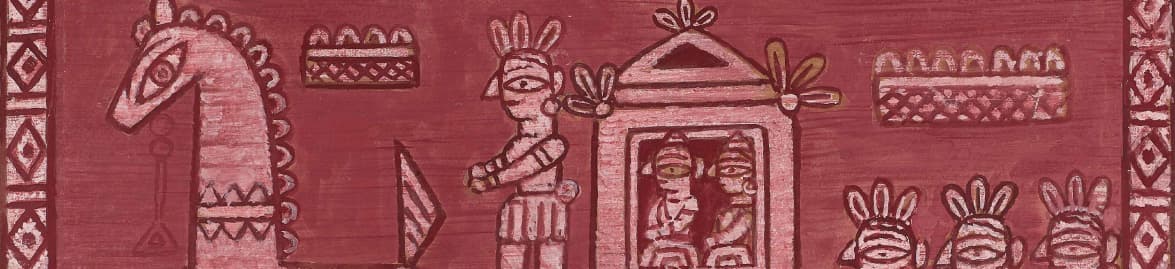
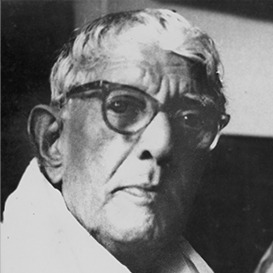 Jamini Roy (1887–1972) stands as one of the most celebrated artist in the history of modern Indian art. A painter whose works bridge the traditional & modern, Roy’s legacy is not merely defined by the technical prowess he demonstrated on canvas but also by the cultural revolution he inspired in the world of Indian visual arts. His deep connection to Indian folk traditions and his departure from the Western-influenced artistic conventions of his time set him apart from his contemporaries and helped shape a distinct Indian identity in modern art.
This article delves into the life, work and enduring influence of Jamini Roy, tracing his journey from a promising student at Calcutta’s Government School of Art to becoming one of the most revered artists of his era. Through his unique style, philosophy and the cultural implications of his work, Jamini Roy not only challenged the established norms of art but also inspired generations of Indian artists to embrace their roots and create art that resonated with the nation's indigenous heritage.
Early Life & Education
Jamini Roy was born on April 11, 1887, in the village of Beliatore in the Bankura district of Bengal, into a well-off family. His early years were spent in the rural landscape of Bengal, which would later influence his love for folk art. Despite being born in a village, Roy's family was progressive and ensured that he received a good education, sending him to Kolkata (then Calcutta) to pursue formal studies.
Jamini Roy’s early exposure to art came through his schooling, where he initially focused on Western academic training. He enrolled at the Government School of Art in Kolkata in 1903, which was the premier institution for artistic education in India at the time. Roy’s education at the School of Art was grounded in European academic traditions, with a focus on classical European art styles and techniques. These early influences are evident in his early works, which display a mastery of oil painting and the use of Western styles of shading, lighting, and perspective.
However, despite his skillful engagement with these techniques, Roy felt disillusioned with the Western style of painting that dominated the art scene during the British colonial period. His exposure to Indian culture and folk traditions, particularly through the vibrant art and handicrafts of rural Bengal, would soon inspire him to explore a unique artistic path. This marked the beginning of his shift towards a more Indianized approach to art, an evolution that would define his career.
Famous Paintings
Jamini Roy's works often drew inspiration from folk traditions, particularly Kalighat and Patachitra styles. Here are some famous paintings by him:
• The Santhal Paintings - In the 1920’s, Jamini Roy did a series of paintings featuring women from the Santhal community, an indigenous tribe found mostly in the Indian states of Bihar, West Bengal, Jharkhand, and Orissa. Painted sensuously, in angular lines, Roy’s paintings captured the women engaged in daily chores. They portrayed the romantic simplicity of their lives, and reflected upon the complexity of their relationship with their environment. His paintings from this time, are dotted with stories and cultural curiosities that reveal his connection with the community, and celebrate the integral dignity of their humble life. Roy’s fascination with the indigenous way of life is also reflected in the way he adopted the animal motifs from Indian folk-art drawing and depicted them in playful forms through his artwork.
• Calligraphic Brush Drawings - Another remarkable series of works from the 1920’s are a set of monochromatic brush drawings that seem to be inspired by East Asian paintings styles like Kalighat Pats. Drawn from everyday life featuring women, children etc, these works are characterised by sweeping, calligraphic lines, that reveal Jamini Roy’s mastery and control over his brushwork and the proportion of his figures.
• Mother & Child Paintings - Jamini Roy’s Mother and Child paintings are iconic examples of his exploration of Indian folk art traditions and themes of universal human connection. These works typically depict a mother tenderly holding her child, rendered in bold lines, earthy colors and a style inspired by Kalighat patachitra and Bengali folk art. The simplicity of form and profound emotional depth in these paintings reflect Jamini Roy’s intention to celebrate the sanctity of motherhood and the primal bond between a mother and her child, a timeless and universal theme. By focusing on this subject, Roy sought to break away from western academic art traditions and embrace a distinctly Indian aesthetic that resonated with his cultural roots.
• Religious Iconography - In the 1940’s Roy became preoccupied with the visual idea of portraying religious icons like Krishna, Jesus Christ and even the Buddha. He created a series of thought-provoking images around the life of Christ that adapted stories from an alien culture, rendering them in vibrant colours and bold lines. The aesthetic familiarity of these paintings made it seem like the depicted subjects were local people from an Indian village and became the distinguishing aspect of this work. His works about Krishna showcased idyllic landscapes with trees, birds and open pastures. By conjuring the rural utopia of people’s imagination, he was able to make his work relatable with the sensibility of the masses, thus making them more accessible.
• Gopis and Apsaras Paintings - Known for his fascination with Indian mythology, Jamini Roy often created imagery depicting the ‘gopis’ and ‘apsaras’ from epics like The Ramayana and The Mahabharata. He portrayed them in angel-like forms with almond eyes and extremely sharp features, making them look elegant but also ordinary at the same time. This helped him establish a common thread with the ordinary people and connect with them through his works.
• Krishna with Gopis Paintings - Jamini Roy’s Krishna with Gopis is a vibrant and stylized depiction of the divine love between Krishna and the Gopis, rooted in Indian mythology and devotional traditions. The painting showcases Krishna, the mischievous and charming god, surrounded by Gopis who are captivated by his divine presence. Rendered in bold, flat colors, and simplified forms inspired by folk art, the work draws heavily from Kalighat painting and traditional Bengali patachitra. Jamini Roy’s intent was to celebrate the spiritual and cultural richness of Indian narratives while moving away from Western artistic influences. The theme symbolizes the union of the human soul (Gopis) with the divine (Krishna), embodying devotion, love and spiritual longing. This painting reflects Roy’s desire to merge indigenous storytelling with modern artistic sensibilities, creating works that were deeply rooted in tradition yet universally evocative.
• Goddess Durga Paintings - These paintings by Jamini Roy depicts Hindu warrior Goddess Maa Durga in traditional bengali style, showing her as a powerful yet compassionate figure. His Durga paintings are heavily influenced by Kalighat art—flat, two-dimensional forms and bold outlines. Often, Durga is seen with her children (Lakshmi, Saraswati, Kartik & Ganesh) or slaying the buffalo demon Mahishasura.
• Radha Krishna Paintings - Jamini Roy’s Radha Krishna paintings are a sublime representation of divine love and spiritual union, drawn from the deeply rooted Indian tradition of Krishna and Radha’s eternal bond. Depicted in his signature folk-inspired style, these works use bold lines, flat vibrant colors and a minimalistic yet expressive approach to portray the tender intimacy between Radha and Krishna. The figures are often adorned with simplified ornaments and set against plain, unadorned backgrounds, emphasizing their connection rather than their surroundings. The painting symbolizes the transcendence of earthly love, representing the soul’s yearning for unity with the divine. Jamini Roy’s decision to paint Radha and Krishna reflects his intent to elevate indigenous myths and aesthetics, celebrating India’s cultural and spiritual heritage. By reimagining these iconic figures in a style rooted in Kalighat and Bengali folk art, Roy not only honored Indian traditions but also sought to make art more accessible and reflective of everyday Indian life.
• Ramayana Paintings - Jamini Roy’s Ramayana paintings are a vivid series that reimagine scenes from the ancient Indian epic with a distinctly folk-art aesthetic. Using bold outlines, earthy tones, and simplified forms influenced by Bengali patachitra and Kalighat painting, Roy brought to life iconic moments such as Sita’s abduction, Rama’s battles, and Hanuman’s devotion. These paintings capture the moral and spiritual essence of the epic, highlighting themes of duty, righteousness, and the triumph of good over evil. By depicting the Ramayana, Roy sought to connect deeply with India’s cultural heritage and create art that resonated with ordinary people. His stylistic choices reflect his rejection of Western techniques, focusing instead on indigenous traditions that were accessible and rooted in local storytelling. The Ramayana series not only preserves the timeless narrative of the epic but also celebrates its enduring relevance in Indian identity and values.
• Ganesh Paintings - Jamini Roy’s Ganesha paintings celebrate the beloved Hindu deity known as the remover of obstacles and the patron of arts and wisdom. In these works, Ganesha is depicted in Roy’s characteristic folk-art style, influenced by Bengali patachitra and Kalighat paintings. Using bold lines, earthy tones, and simplified yet expressive forms, Roy captures the divine essence of Ganesha while making it accessible and relatable. The painting often emphasizes Ganesha’s iconic features, such as his elephant head and potbelly, symbolizing wisdom, prosperity, and abundance. Roy’s choice to depict Ganesha reflects his deep engagement with Indian cultural and spiritual motifs, as well as his mission to bring traditional art forms into modern contexts. By integrating local artistic traditions with universally resonant themes, Roy’s Ganesha paintings embody a harmonious blend of devotion, artistry, and cultural pride, reinforcing his commitment to creating an Indian modern art identity rooted in heritage.
• Three Pujarins (Priestesses) Paintings - Jamini Roy’s Three Pujarins is a striking portrayal of three priestesses engaged in a moment of devotion, rendered in his iconic folk-inspired style. The painting features three women depicted with bold, geometric forms, minimalistic details, and vibrant yet earthy colors, reflecting the influence of Bengali patachitra and Kalighat painting. The serene expressions and symmetrical arrangement emphasize a sense of spiritual calm and collective reverence. The artwork symbolizes the sacredness of ritual and the role of women in maintaining cultural and spiritual traditions. By choosing this subject, Jamini Roy highlighted everyday spirituality and the quiet strength of women in Indian society. His focus on indigenous themes and stylization was part of his broader aim to reconnect Indian art with its folk roots, making it accessible while honoring its rich heritage. Three Pujarins thus becomes a celebration of devotion and cultural identity, captured in a timeless, evocative form.
• Kalighat Paintings - Jamini Roy’s Kalighat paintings reflect his deep inspiration from the traditional Kalighat patachitra style, which originated near the Kalighat temple in Kolkata. These works are characterized by bold, sweeping lines, flat, vibrant colors, and a focus on simplified yet expressive forms. Roy embraced this folk-art tradition to portray both religious and secular themes, including deities like Durga, Krishna, and Ganesha, as well as scenes from rural and urban life. By adopting the Kalighat style, he rejected Western artistic norms and instead celebrated the indigenous aesthetics of Bengal. His reinterpretation of Kalighat art emphasized the beauty of ordinary lives and spiritual devotion, making it accessible to a wider audience while preserving its cultural authenticity. Jamini Roy’s Kalighat paintings were a revolutionary statement in modern Indian art, blending traditional techniques with his vision for a national art identity rooted in heritage.
• Patachitra Paintings - Jamini Roy’s Pattachitra-inspired paintings are a testament to his admiration for traditional Indian folk art and his efforts to create a uniquely Indian modern art style. Drawing heavily from the centuries-old Bengal pattachitra tradition, his works feature bold outlines, flat, vivid colors, and simplified forms to depict themes from Indian mythology, rural life, and spiritual devotion. These paintings often incorporate narratives from epics like the Ramayana and Mahabharata, or iconic figures such as Radha, Krishna, and Durga, rendered with an earthy charm that reflects the essence of folk storytelling. By adopting and reimagining the pattachitra style, Jamini Roy sought to break away from Western artistic influences, creating art that resonated deeply with Indian cultural identity. His Pattachitra-inspired artworks not only celebrate the beauty of indigenous art forms but also elevate them to a national and global platform, ensuring their enduring legacy.
• Cat And The Lobster / Dual Cats With One Crayfish - Jamini Roy's Cat & Lobster paintings are a playful yet symbolic depiction of the natural world, rendered in his distinctive folk-art style. In these works, a cat is shown eyeing a lobster, capturing a moment of tension and curiosity. The simple, bold lines and flat, vivid colors typical of Roy’s style transform this everyday interaction into a vibrant, almost whimsical tableau. The cat, often associated with independence and curiosity, contrasts with the lobster, symbolizing a certain level of mystery and danger. This juxtaposition may reflect the dynamics of nature, where instinct and survival intertwine with beauty and intrigue. By choosing this subject, Roy aimed to explore the humor and complexities of life through a modern interpretation of folk art. His Cat and the Lobster paintings are a departure from more traditional mythological themes, showcasing Roy’s ability to blend the innocence of childhood curiosity with deeper reflections on the natural world, all while staying true to his vision of a distinctly Indian, accessible art form.
• Saree (Women in Traditional Attire) Paintings - Jamini Roy’s Women in Traditional Attire paintings are a celebration of Indian cultural heritage, capturing the grace and dignity of women dressed in traditional clothing. In these works, Roy portrays women in simple yet elegant forms, often wearing sarees or other regional garments, with their expressions and postures conveying a sense of quiet strength and poise. Using bold lines, vibrant colors, and minimal details, Roy’s style emphasizes the beauty of the subject rather than intricate realism. The depiction of women in traditional attire speaks to Roy’s desire to honor the everyday lives of Indian women, who, though often relegated to domestic roles, are portrayed with a sense of reverence and importance. By focusing on these figures, Roy sought to elevate the role of women in society while also celebrating the timeless beauty and cultural significance of traditional dress. These paintings reflect his broader commitment to modernizing Indian art by grounding it in indigenous, accessible themes that connect deeply with the nation’s identity and values.
• Black Horse Paintings - Jamini Roy’s Black Horse paintings are a striking representation of strength, elegance, and vitality, depicted in his iconic folk-inspired style. The black horse, often portrayed in motion with flowing mane and a dynamic posture, symbolizes power and unyielding spirit. Using bold, sweeping lines, earthy tones, and minimalistic details, Roy captures the essence of the animal with a sense of movement and energy that transcends the static medium. This subject reflects Roy’s admiration for the simplicity and vigor found in rural life, as horses were integral to both labor and cultural symbolism in traditional Indian society. By choosing such a theme, Roy not only celebrated India’s pastoral heritage but also demonstrated his commitment to creating art that resonated with the everyday lives of his audience. The Black Horse paintings epitomize Roy’s fusion of folk aesthetics with modern sensibilities, embodying both artistic beauty and cultural significance.
• Horse & Rider Paintings - Jamini Roy’s Horse and Rider paintings depict a powerful and dynamic relationship between the rider and the horse, rendered in his distinctive folk-art style. These works are characterized by bold lines, vibrant colors, and a minimalist approach, often using flat, earthy tones to portray the figures. The horse, symbolizing strength and vitality, and the rider, representing control and direction, together convey themes of harmony, power, and determination. Through this motif, Roy captures the essence of movement and the bond between man and nature, celebrating the rural and agrarian life where horses were integral to both work and culture. By choosing this subject, Roy sought to highlight the spirit of independence and resilience in Indian life, while also emphasizing the importance of human connection to the natural world. His Horse and Rider paintings reflect a departure from Western traditions, aligning instead with indigenous artistic expressions and creating a distinctly Indian modern art identity.
• Lady With A Flute Paintings - Jamini Roy's Lady with a Flute paintings showcase a graceful and simplified portrayal of a woman playing a flute, rendered in his signature folk-art style. Using bold, fluid lines, flat colors, and minimal detail, Roy captures the essence of the female form and the serene, almost meditative act of music-making. The image of the lady with a flute evokes themes of beauty, music, and the artistic expression of inner emotions. The painting may also reflect the idealized figure of the woman in traditional Indian culture, where femininity is often associated with creativity, nurturing, and spiritual connection. By choosing this subject, Roy not only celebrated the artistic and cultural significance of music in Indian life but also sought to reimagine the portrayal of women through a modern, indigenous lens. His focus on this serene, musical motif aligns with his broader vision to create accessible, culturally resonant art that moved away from Western influences and embraced Indian folk traditions.
• Woman With A Pot Paintings - Jamini Roy’s Woman with a Pot paintings are powerful representations of rural life and the role of women in traditional Indian society. In these works, Roy depicts women carrying large clay pots, a symbol of sustenance, domesticity, and connection to the earth. The women are shown with simplified, geometric forms, bold outlines, and vibrant, earthy colors, characteristic of Roy’s adaptation of folk-art styles like Kalighat and patachitra. The pot itself represents fertility, nourishment, and the cycle of life, while the act of carrying it signifies both strength and responsibility. Through this subject, Roy sought to highlight the dignity of everyday labor and the central role of women in sustaining both family and community life. His focus on rural and indigenous themes, such as the Woman with a Pot, reflected his desire to create art that resonated with Indian traditions, rejected Western artistic norms, and celebrated the everyday beauty of Indian life.
• Man With A Bull Paintings - Jamini Roy’s Man with a Bull paintings capture the profound connection between humans and animals, particularly in rural Indian life. Depicting a man standing alongside a bull, these works reflect the importance of the bull in agrarian societies as both a symbol of strength and a vital part of farming and daily labor. Using his signature folk style with bold outlines, simplified forms, and earthy tones, Roy highlights the harmonious bond between the man and the animal, emphasizing themes of cooperation, resilience, and the symbiosis of nature and humanity. The bull, representing power and endurance, contrasts with the human figure, symbolizing the partnership required for agricultural success. By choosing this subject, Roy not only celebrated rural life and its deep-rooted connection with nature but also sought to elevate the everyday, bringing attention to the dignity of labor and the importance of animals in sustaining traditional livelihoods. His Man with a Bull paintings reflect his broader goal of fostering a uniquely Indian art that was both rooted in indigenous themes and accessible to the masses.
• Peacock Paintings - Jamini Roy’s Peacock paintings are a vibrant celebration of one of India’s most beloved symbols of beauty, grace, and spiritual significance. The peacock, often associated with divine energy and abundance in Indian mythology, is depicted in Roy’s signature style, using bold lines, flat colors, and simplified forms. The elegant yet dynamic postures of the peacock in these works highlight its regal and enchanting nature. For Roy, the peacock was not just a decorative motif but a symbol of the rich cultural heritage of India, representing both the beauty of nature and the divine in everyday life. By choosing this subject, Roy sought to express the vibrant colors and textures of Indian folk art, drawing from traditions like Kalighat painting, while also making it relevant to modern audiences. His Peacock paintings reflect his vision of art that celebrates the natural world, cultural symbols, and the emotional depth inherent in traditional Indian themes.
Patua Paintings
Jamini Roy’s paintings are often termed as Patua, derived from the Bengali folk tradition of Patachitra, which involves intricate scroll paintings created by rural artisans or "Patuas." Deeply inspired by this indigenous art form, Roy adapted its stylistic features to create a unique modern aesthetic that resonated with India’s cultural roots. His works were characterized by bold, sweeping lines, flat and vivid colors, and minimalistic details, echoing the essence of Patachitra while infusing it with his own creative vision. By adopting the techniques and themes of the Patua tradition, Roy sought to revive and celebrate India’s rural artistic heritage.
Roy’s subject matter often mirrored the themes found in traditional Patachitra, such as mythological stories, folk narratives, and depictions of rural life. However, he reinterpreted these motifs with a modern sensibility. His paintings of characters like Krishna, Radha, and scenes from the Ramayana were stylized to reflect both the simplicity and elegance of folk art. Additionally, he introduced dynamic, flattened perspectives, a departure from the depth and realism of Western academic styles, which aligned his work with the iconic folk aesthetic. By calling his works Patua-inspired, Jamini Roy not only paid homage to the tradition but also elevated it to a respected position in modern Indian art.
Through his Patua-style paintings, Jamini Roy made a profound cultural statement, rejecting colonial art influences and advocating for an art form deeply rooted in the Indian ethos. His work symbolized a revival of indigenous traditions and demonstrated how folk art could resonate with contemporary audiences. Today, his art is celebrated as a bridge between rural craftsmanship and modern expression, underscoring the timeless appeal of Patua’s visual storytelling.
The Shift To Folk Art
Jamini Roy’s artistic breakthrough occurred in the 1920s, when he made a conscious decision to reject the European academic art style he had been trained in. He sought inspiration from the indigenous traditions of Indian folk art, particularly the traditional painting styles of Bengal, such as the Pattachitra and the Kalighat Pat (Kalighat paintings). These were forms of art produced in rural Bengal, characterized by their bold use of line, bright colors, and the depiction of local gods, goddesses, and everyday life. The simplicity and expressiveness of these folk art forms appealed to Roy’s artistic sensibilities.
In 1921, Roy visited the village of Kalighat in Kolkata, which was famous for its folk art traditions, particularly the Kalighat painting style that flourished in the 19th century. This encounter had a profound impact on him. He began to incorporate elements of folk art into his own work, developing a distinctive visual language that was rooted in Indian traditions. Instead of adhering to the realistic forms and depth of Western art, Roy embraced the bold, stylized forms of Indian folk art, which emphasized strong outlines, vibrant colors, and simplified figures.
Jamini Roy’s shift to folk art marked a significant departure from the dominant trend of Western-style academic painting that was prevalent in colonial India. He sought to create a uniquely Indian style that could speak to the country’s cultural identity and heritage. By using traditional themes and motifs, Roy found a way to represent Indian life, religion, and mythology in a manner that was both accessible and deeply connected to the Indian experience.
Artistic Evolution & Painting Style
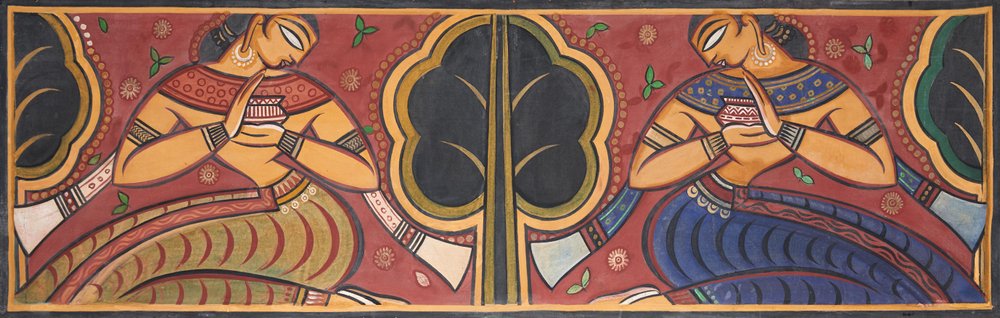
Jamini Roy’s work is easily recognizable due to its unique fusion of modernist sensibilities with traditional Indian motifs. His paintings are characterized by their simple, clear lines, bold colors, and flattened forms, all of which evoke a sense of folk art while maintaining a modern edge. Some of his most iconic works feature depictions of Hindu deities like Radha and Krishna, figures from Indian mythology, and portraits of rural life. His famous Mother and Child and Santhal Women series, for instance, showcase his focus on rural figures and his exploration of Indian womanhood.
One of the defining features of Jamini Roy’s painting style was his use of bright, vibrant colors. He often employed a limited palette, favoring earthy tones of red, yellow, green and blue, which were common in Bengali folk art. His paintings did not rely on perspective or shading, but rather on the strength of the lines and colors to convey meaning. These works were deeply symbolic, as he portrayed religious themes and everyday life with the same reverence and intensity.
In his earlier works, Roy would experiment with oil paints, but over time, he shifted towards tempera, a medium that suited the texture and qualities of folk art. This change also reflected his desire to create art that was more affordable and accessible to a larger audience. His works began to reflect the aesthetic principles of simplicity, directness, and expressiveness, aligning them with the folk traditions of India.
His mastery of simple yet powerful composition is evident in paintings like Krishna and Radha, where the figures are reduced to their most essential forms. The figures are presented in a manner that is both stylized and deeply spiritual, with a focus on the spiritual and emotional connection between the two characters. This technique not only rendered his work visually striking but also imbued his pieces with a timeless, almost meditative quality.
Roy’s depictions of tribal life, especially his portrayals of the Santhal tribes in Bengal, were particularly significant. By focusing on marginalized communities, Roy brought attention to rural life in India, which had often been overlooked by mainstream art. His paintings of Santhal women, often depicted in bright colors and strong forms, celebrated their strength and beauty while simultaneously asserting their rightful place in the broader narrative of Indian art and culture.
Impact & Recognition
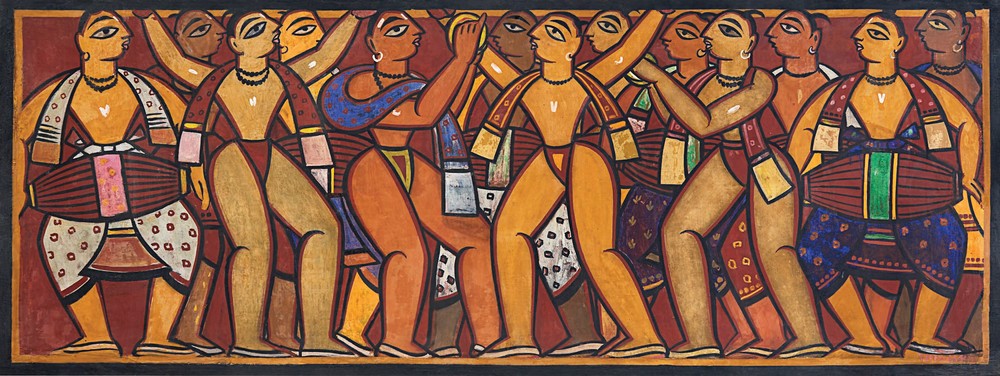
Jamini Roy's work gained significant recognition during his lifetime, both in India and internationally. He was part of the Bengal School of Art, a movement that sought to revive Indian traditions and break away from the colonial influence of Western academic art. He exhibited his works at several national and international exhibitions, garnering praise for his innovative approach to Indian art. Roy's works were featured in the Indian Art Exhibition in London in 1930, which brought him significant attention in the West.
Roy’s artistic evolution was not just a personal journey but part of a larger movement in Indian art during the early 20th century. Indian artists were increasingly seeking to assert their national identity, and this desire for a new aesthetic was reflected in the growing interest in folk art, mythology, and spirituality in Indian painting. Roy’s work contributed greatly to the development of modern Indian art by demonstrating that a distinctive Indian style could be created by drawing on indigenous traditions rather than imitating European styles.
In 1955, Jamini Roy was awarded the prestigious Padma Bhushan by the Government of India, one of the country’s highest civilian honors, recognizing his contributions to Indian art. His works were collected by major galleries and museums, including the National Gallery of Modern Art in New Delhi, and he became a mentor to many younger artists who were inspired by his vision of integrating folk traditions with modern art.
Legacy & Influence
Jamini Roy’s influence on Indian artists continues to be felt to this day. His rejection of colonial art influences and his embrace of indigenous traditions paved the way for future generations of artists to explore their roots and create works that reflected India’s cultural identity. Artists who followed in his footsteps, such as K.G. Subramanyan, S.H. Raza, and M.F. Husain, drew inspiration from Roy’s innovative blending of folk and modernist elements.
Roy’s focus on rural life, tribal communities, and Indian mythology opened up new avenues for artistic exploration. His works encouraged Indian artists to look beyond Western standards of beauty and form, inspiring them to find their unique voice within the rich tapestry of Indian culture. The idea of art being deeply tied to one’s heritage and the social context from which it emerges became an important theme for many artists after him.
In addition to his influence on artists, Roy’s work also played a significant role in the development of a national art narrative that was aligned with India’s struggles for independence. His art reflected the growing sense of nationalism, celebrating Indian spirituality, mythology, and folk traditions at a time when the country was under British colonial rule. Roy’s art became a form of resistance, an affirmation of India’s rich cultural heritage and identity in the face of colonial subjugation.
Conclusion
Jamini Roy’s legacy as a master artist continues to captivate art lovers and collectors around the world. His original paintings, celebrated for their bold lines and vibrant colors, remain a testament to the timeless appeal of India’s folk traditions. From his exquisite oil paintings to his innovative canvas works, each piece showcases a harmonious blend of simplicity and cultural depth. The beauty of his art has transcended decades, with prints and reproductions ensuring that his influence reaches a broader audience. Today, his beautiful paintings are highly sought after in auctions, often fetching impressive painting prices that reflect their historical and artistic value. Jamini Roy’s art not only enriched the canvas of Indian modernism but also set a benchmark for the celebration of indigenous traditions in contemporary art.
Through his rejection of colonial influence and his embrace of indigenous artistic traditions, Jamini Roy has inspired generations of Indian artists to explore their roots and create art that is both deeply personal and culturally significant. Today, his legacy continues to resonate, as his work not only stands as a testament to his skill as a painter but also as a symbol of the power of art to inspire, challenge, and redefine cultural identity.
The journey on Jamini Roy doesn’t stop here! Click here to explore a related article on him here - Jamini Roy : Exploring The Quintessence Of India’s Folk Art