


decoding the language - the unspoken messages in modern indian art
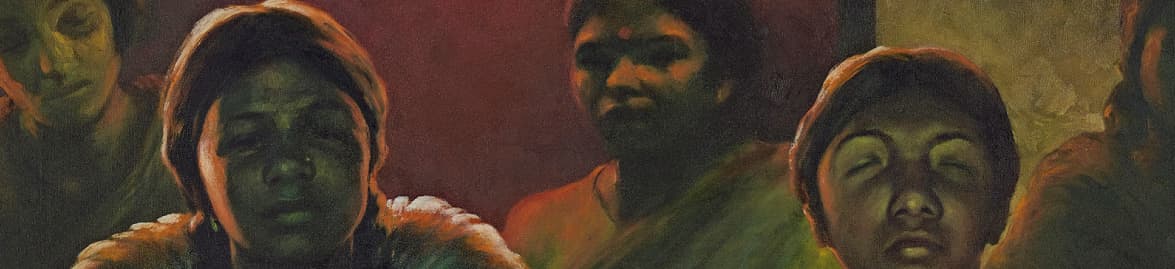
Modern Indian artists have utilised some unique themes and styles that have sparked a conversation about the unspoken messages behind them. Their struggles, background, ideas, and thoughts depicted in their works showcase their distinctive ability to transcend to their inner world and speak up on several issues through their art. Following are some of the artists and the unspoken messages often found in their compositions;
Human Suffering - Tyeb Mehta
Tyeb Mehta was a prominent Indian painter known for his expressionist and figurative works. His art reflects a deep concern with the human condition and his canvases often showcased figures that depicted the inner and outer image of the being. He interprets his understanding of the human suffering faced by an individual as they come in contact with certain incidents that have had a deep impact on their psychology. His work is also a commentary on the struggles of individuals against larger social and existential forces. The emotional and physical states of his figures often represent broader themes of human suffering, alienation, and resilience.
Churches Of Goa - F N Souza
One of India’s most celebrated artists, F N Souza was a prolific modern Indian painter known for his works influenced by expressionism and cubism. As a child, Souza was obsessed with the church. His Roman Catholic upbringing had a great influence on his images. His early works are a reflection of his various moods, fears, anger, frustration, and faith that drew him closer to the churches of Goa. His unconventional and abstract representations can be seen as a commentary on the complex interplay of power, religion, and culture. Through these works he expresses his internal struggles, offering a personal and critical view of religious structures and their place in society.
The Raj Series - M F Husain
M F Husain is a celebrated modern Indian painter who gained success for his works worldwide on a large scale. Husain’s work frequently includes scenes of conflict or unrest, highlighting the social and political upheavals of the time. This includes depictions of protests, riots, or other forms of resistance against colonial rule. Through the ‘Raj Series’ Husain comments on the social, economic, and political realities of India. It’s a powerful artistic exploration of the colonial experience, blending symbolism with historical and cultural commentary. His work provides insight into the complexities of colonialism and its impact on Indian identity and society.
Life Of Women - Bikash Bhattacharjee
Bikash Bhattacharjee is a contemporary Indian artist known for his evocative and richly textured paintings. His work often explores themes related to human experience and emotion, with a particular focus on the inner world of women. In his paintings, women are portrayed with a deep sense of introspection and strength. Bhattacharjee’s depictions of women frequently highlight their psychological depth and emotional complexity. His use of colour, texture, and form often creates a sense of intimacy and introspection. His women figures are not merely subjects but are presented as powerful, contemplative figures with rich inner lives.
Death & Loneliness - Ganesh Pyne
Ganesh Pyne grew up in a supportive art-loving family. During the turbulent times of the 1946 Calcutta riots, he witnessed some unsettling scenes that left a deep scar on his psyche. Many of his works are a reflection of his fascination with death as a subject which is deeply personal for obvious reasons. His observations of loss and suffering are reflected in his work, making the theme a means of processing and understanding his own existential concerns. His works also often included themes of abandonment and detachment. Portraying figures that seem to be disconnected from their surroundings or from other people. This visual language effectively conveys feelings of loneliness and existential isolation.
Bindu Series - S H Raza
S.H. Raza, a prominent Indian painter known for his abstract works, often employed the concept of the "Bindu" (a Sanskrit word meaning "point" or "dot") as a central motif in his art. The Bindu holds significant symbolism in Raza’s work and reflects his deep engagement with both traditional Indian philosophy and contemporary abstract art. Many of Raza’s paintings from the Bindu series represent the cosmic origin, the point from which everything emanates. This central dot can be seen as a metaphor for the centre of consciousness or the ultimate reality, reflecting the idea that all forms of existence are interconnected.
Modern artists in India have successfully spoken about their innermost struggles and life experiences through the art medium. This form of self-expression for the artists has opened a new world for the viewers to experience and appreciate it more. People have derived their own values and beliefs around specific subjects or themes and made them a part of their lives. Modern Indian art has not only sparked creativity but has also helped in connecting people from different parts of the world in a holistic way.




